Jolt said: A couple of quick questions to harvestgreen22 or someone that knows.
The training sessions generally show lowering "Condition"
But from my observations, condition always improves after each day with just training, and only lowerswhen playing matches (or getting injured, but that's beside the point). So my question, has it ever been tested whether these trainings actually: 1. Lower condition? OR 2. Training sessions with heavier condition reduction don't allow the players to recover condition as much as training sessions with lighter condition reduction?
The reason why I'm asking is simple: I'm unsure whether I should schedule my training sessions like this:
or like this:
If trainings don't lower condition, then putting a rest day in between sessions makes no sense, and it is always ideal to put all rest sessions immediately after a game, and the training sessions as late as possible (like in the second case).
If they do lower condition, then adding a rest day in between training sessions to allow the players to recover, can make sense to lower risk of injuries.
Hopefully my question is understandable.
如果你看不懂我的意思,我也会中文,所以如果我必须写汉字,我可以。(This says that I can also write in Chinese in case harvestgreen22 doesn't understand). Expand
I have discussed this issue in other posts and on our Chinese players Forum. Yes, there is indeed such a problem. A reduced training schedule brings both advantages and disadvantages
Advantages : Fewer training , Fewer injuries Disadvantage: Whether using "Recover (drop a little)" or "Rest (drop more)", Both "condition" and "March sharpness" will decline
However, these two things are useful and can affect the performance in the competition.
My idea is like this:
1. If it's a league with a very dense schedule of matches (like England), then this decline is basically not a problem because a large number of matches will make up for it
2. If it is a league with relatively few matches, then "arranging friendly matches" is needed to make up for this "condition" and "March sharpness".
3. Just right. According to another post I tested (posted on this forum), for young players, friendly matches are basically as valuable as official matches, providing the same growth needs and match time.
4.At the beginning of the season, friendly matches need to be arranged to ensure that "friendly matches + real matchs" = about twice a week.
Apart from being troublesome to arranged , there is no other Disadvantage to this.
Of course, the increased friendly matches will bring corresponding injury risks. However, by comparing "increasing friendly matches" and "increasing the training schedule", the test found that this risk would be lower.
5. For some special circumstances where friendly matches cannot be arranged and this "condition" and "March sharpness" are indeed needed, then a certain amount of training schedule can only be added according to these actual situations, and "recovery" should be used as much as possible to replace "rest" in the training schedule.
harvestgreen22 said: I have discussed this issue in other posts and on our Chinese players Forum. Yes, there is indeed such a problem. A reduced training schedule brings both advantages and disadvantages
Advantages : Fewer training , Fewer injuries Disadvantage: Whether using "Recover (drop a little)" or "Rest (drop more)", Both "condition" and "March sharpness" will decline
However, these two things are useful and can affect the performance in the competition.
My idea is like this:
1. If it's a league with a very dense schedule of matches (like England), then this decline is basically not a problem because a large number of matches will make up for it
2. If it is a league with relatively few matches, then "arranging friendly matches" is needed to make up for this "condition" and "March sharpness".
3. Just right. According to another post I tested (posted on this forum), for young players, friendly matches are basically as valuable as official matches, providing the same growth needs and match time.
4.At the beginning of the season, friendly matches need to be arranged to ensure that "friendly matches + real matchs" = about twice a week.
Apart from being troublesome to arranged , there is no other Disadvantage to this.
Of course, the increased friendly matches will bring corresponding injury risks. However, by comparing "increasing friendly matches" and "increasing the training schedule", the test found that this risk would be lower.
5. For some special circumstances where friendly matches cannot be arranged and this "condition" and "March sharpness" are indeed needed, then a certain amount of training schedule can only be added according to these actual situations, and "recovery" should be used as much as possible to replace "rest" in the training schedule. Expand
So what is your recommendation then? I feel like having a full day of Rest after a match makes more sense than having Recovery.
helioserebus said: So what is your recommendation then? I feel like having a full day of Rest after a match makes more sense than having Recovery. Expand talcxxv said: Probably a case of me being blind, but any schedule file for download? Expand
attachments
each of these methods has its own advantages ( having a full day of Rest after a match ). It may depend on whether your player is extremely tired or just a little tired.
I uploaded several schedules that I had posted before, which have been downloaded over 50,000 times in our community . You can try all of them based on your actual preferences and see which one you like. It's all about choosing according to the actual situation
If it were me: In medium and low-level leagues (low-level players), I would choose "21 recoveries"/" 7 recoveries "/" full rest ". For High-level leagues will switch to other schedules at an appropriate time (the schedule good for increase CA like quickness + match practice + attacking .
The first one is "21 recoveries + double Intensity + additional focus qucikness", which was created by taking advantage of some kind of bug. The effect is basically the same as a full rest. but lose less "condition" and "March sharpness" , If you don't want to be bothered by these troublesome mico-operations, I recommend using it
The setting is for automatic rest (no field or gym) when the player is tired.
In that sense, wouldn't it be redundant to schedule rest after a match? This is because the starters will already be resting due to the setting, while the substitutes who need match fitness or training will also be resting. Therefore, wouldn't it be better to schedule a match practice the day after a game so that the substitutes can train?
each of these methods has its own advantages ( having a full day of Rest after a match ). It may depend on whether your player is extremely tired or just a little tired.
I uploaded several schedules that I had posted before, which have been downloaded over 50,000 times in our community . You can try all of them based on your actual preferences and see which one you like. It's all about choosing according to the actual situation
If it were me: In medium and low-level leagues (low-level players), I would choose "21 recoveries"/" 7 recoveries "/" full rest ". For High-level leagues will switch to other schedules at an appropriate time (the schedule good for increase CA like quickness + match practice + attacking .
The first one is "21 recoveries + double Intensity + additional focus qucikness", which was created by taking advantage of some kind of bug. The effect is basically the same as a full rest. but lose less "condition" and "March sharpness" , If you don't want to be bothered by these troublesome mico-operations, I recommend using it Expand
So, if I play a team which play champions league (so I usually play 2x week) and I have a lot of youngsters between 17-23 years, which training schedule do you recommend for perform and grow better? Choose just 1 or 2 if possible. Thank you guys for the tests and information u provide.
Eddie said: The setting is for automatic rest (no field or gym) when the player is tired.
In that sense, wouldn't it be redundant to schedule rest after a match? This is because the starters will already be resting due to the setting, while the substitutes who need match fitness or training will also be resting. Therefore, wouldn't it be better to schedule a match practice the day after a game so that the substitutes can train? Expand https://fm-arena.com/thread/16424-rest-exploit-fm26/
Using the default database, I've cleared out Luton's players (20th in Premier League) and replaced them with 88 players. That's overloading the squad a bit too much (29.33 per 1st/u21/u18 team), but coach workload was light to average, and I don't know about others but I tend to buy too many players anyway - in any case, it shouldn't change the results too much.
The players I choose were young players, age 16-23 (average ~19), who were pretty cheap to buy and met a lenient search filter criteria (i.e. for ST, ~11 pace/acc + 6 work rate). I would try to pick players with high CA-PA gap. So it's meant to be represent what you'd realistically be able to sign in game. Luton staff were kept the same, knap tactic used.
4 years meta (Quickness + Match Practice + 2 x Attack + Quickness/Agility focus):
GK - 4.75 agil, 1.25 aer, (-0.25) ref DL/DR - 2.14 acc, 3.69 pace, 0.07 drib DC - 2.85 acc, 3.69 pace, 0.5 drib DM - 2 acc, 3 pace AML/AMR - 1.71 acc, 2.76 pace ST - 1.58 acc, 3.25 pace
2 years full rest then 2 years meta:
DL/DR - (-1.81) drib AML/AMR - 3.2 acc, 4.4 pace ST - 3.8 acc, 5 pace
4 years meta with 5 weeks full rest at start of each season:
ST - 2.47 acc, 3.67 pace
I'll just cut to the chase about this. It's pretty clear to me that even full rest for just 5 weeks each season sucked too much due to the loss in mentals/technicals. But with meta, only 36 of 83 outfield players got to 16/16 and none got 19/19 or higher. I think at least 17/17 is necessary to dominate in premier league, and given there's a trade off in going for full rest, 18/18 I reckon is the sweet spot. With 5 weeks rest, 1 player reached 20 pace, 6 reached 18/18. I think ~3 weeks rest per season is probably best, and done in the pre-season so it doesn't result in poor performing players due to low match fitness during the competitive matches.
Now after I did these three tests, I used the EBFM test league to test different training schedules to try and find something superior. Eventually I did find a combo that works noticeably better than the meta, but then when I tested it in my Luton realistic test, it failed horribly with 1.87 acc, 2.2 pace and even significant losses in technicals/mentals. I noticed the EBFM file is using FM23 database, maybe this is the cause, but I doubt it, as it should still use the FM24 training values. Another reason I figured is that it could be that the number of matches effects it, so I tried a reduced training schedule that also worked about as good as meta - again I got 1.93 acc, 2.07 pace. Now neither of these employed match practice notably, so that could be the key factor here. It could also tie into the fact that the Luton players have less CA-PA headroom, worse personalities, and so on.. maybe the CA gain limit is too low to absorb all those gains, or maybe the low CA gain limit or poor professionalism changes the actual distribution of attribute gains (i.e. maybe poor professionalism player can only gain physicals, very little mentals/technicals). It could even be the coaches. Who knows.
So the main takeaway from that is that the EBFM test league, and probably all other artificial test leagues, will give different results to realistic gameplay when it comes to assessing training schedules.
Another reason why not to use full rest is because it's clear, albeit in EBFM test league tests, that those lost technicals/mentals are too difficult to recover even if you use 2 years rest then 2 years meta.
So I'm still working on trying to find a better schedule than the meta.
Came across this glitch, don't think anyone has found it before?
How to get more than 2 match practice:
Make a schedule of 2x match practice, then apply it to a week with a match in it. Then copy & paste that week to an empty week, the match will be replaced with match practice (total 3x match practice). Then you can just fill it up with as many as you want.
I tested 21x match practice with my realistic Luton test for most of a season. Tremendous amounts of injuries, but in the few who escaped largely unscathed, their attribute increases were mediocre or even declined slightly.
I then tested it with the EBFM test file. Surprisingly hardly any injuries at all over an entire season; '1' injury proneness has a greater protective effect than I realized. Looking at attribute gains of one player that had no injuries, gains were good but not unusually great.
I'm still thinking of the implications here, but one thing is that these players have 20 professionalism. Could it be that professionalism alone accounts for why players in the EBFM league develop significantly while those in my Luton save do not..
Make a schedule of 2x match practice, then apply it to a week with a match in it. Then copy & paste that week to an empty week, the match will be replaced with match practice (total 3x match practice). Then you can just fill it up with as many as you want.
I tested 21x match practice with my realistic Luton test for most of a season. Tremendous amounts of injuries, but in the few who escaped largely unscathed, their attribute increases were mediocre or even declined slightly.
I then tested it with the EBFM test file. Surprisingly hardly any injuries at all over an entire season; '1' injury proneness has a greater protective effect than I realized. Looking at attribute gains of one player that had no injuries, gains were good but not unusually great.
I'm still thinking of the implications here, but one thing is that these players have 20 professionalism. Could it be that professionalism alone accounts for why players in the EBFM league develop significantly while those in my Luton save do not.. Expand
Yeah, it's been known for a few years, but I don't remember if it was thoroughly tested
Sorry i not looked through here in long time could someone remind me what the best "meta" attributes was again i think i remember Pace, Acceleration, Jumping Reach, Dribbling, Work Rate and maybe Concentration?
BulldozerJokic said: Yeah, it's been known for a few years, but I don't remember if it was thoroughly tested Expand I was afraid it would turn out I wasn't the first to notice I had only seen the recovery glitch pointed out
Robbo84FM said: Sorry i not looked through here in long time could someone remind me what the best "meta" attributes was again i think i remember Pace, Acceleration, Jumping Reach, Dribbling, Work Rate and maybe Concentration? Expand I would say you've got it correct. Concentration for the defenders only in my view.
Robbo84FM said: Sorry i not looked through here in long time could someone remind me what the best "meta" attributes was again i think i remember Pace, Acceleration, Jumping Reach, Dribbling, Work Rate and maybe Concentration? Expand
Importance priority (Briefly, it can be seen from the table "3":
table 1: Increase the attribute from its initial value to 18, table 2: Reduce the attribute from its initial value to 1, table 3: Subtract Table 2 from Table 1 to obtain the overall importance.
1. Acceleration 、 Pace 、 Work Rate (The Work Rate minimum is 6 . below 6 will result in severe penalties, but above 6 will result in a small increase.)
harvestgreen22 said: Importance priority (Briefly, it can be seen from the table "3":
table 1: Increase the attribute from its initial value to 18, table 2: Reduce the attribute from its initial value to 1, table 3: Subtract Table 2 from Table 1 to obtain the overall importance.
1. Acceleration 、 Pace 、 Work Rate (The Work Rate minimum is 6 . below 6 will result in severe penalties, but above 6 will result in a small increase.)
4. The influence of other attributes has become relatively insignificant. Expand
Ok thanks, i wonder why Attacking session is part of the "meta" training schedule and not a Defending session? with an Attacking session it only prioritises Dribbling from the 2nd group of "meta" attributes and both Finishing & Composure from the 3rd group while a Defending session prioritises Work Rate from the 1st group off "meta" attributes and Anticipation & Concentration from the 2nd group and Positioning & Aggression from the 3rd group so this would seem that Defending would be a better choice, no?
Using the default database, I've cleared out Luton's players (20th in Premier League) and replaced them with 88 players. That's overloading the squad a bit too much (29.33 per 1st/u21/u18 team), but coach workload was light to average, and I don't know about others but I tend to buy too many players anyway - in any case, it shouldn't change the results too much.
The players I choose were young players, age 16-23 (average ~19), who were pretty cheap to buy and met a lenient search filter criteria (i.e. for ST, ~11 pace/acc + 6 work rate). I would try to pick players with high CA-PA gap. So it's meant to be represent what you'd realistically be able to sign in game. Luton staff were kept the same, knap tactic used.
4 years meta (Quickness + Match Practice + 2 x Attack + Quickness/Agility focus):
GK - 4.75 agil, 1.25 aer, (-0.25) ref DL/DR - 2.14 acc, 3.69 pace, 0.07 drib DC - 2.85 acc, 3.69 pace, 0.5 drib DM - 2 acc, 3 pace AML/AMR - 1.71 acc, 2.76 pace ST - 1.58 acc, 3.25 pace
2 years full rest then 2 years meta:
DL/DR - (-1.81) drib AML/AMR - 3.2 acc, 4.4 pace ST - 3.8 acc, 5 pace
4 years meta with 5 weeks full rest at start of each season:
ST - 2.47 acc, 3.67 pace
I'll just cut to the chase about this. It's pretty clear to me that even full rest for just 5 weeks each season sucked too much due to the loss in mentals/technicals. But with meta, only 36 of 83 outfield players got to 16/16 and none got 19/19 or higher. I think at least 17/17 is necessary to dominate in premier league, and given there's a trade off in going for full rest, 18/18 I reckon is the sweet spot. With 5 weeks rest, 1 player reached 20 pace, 6 reached 18/18. I think ~3 weeks rest per season is probably best, and done in the pre-season so it doesn't result in poor performing players due to low match fitness during the competitive matches.
Now after I did these three tests, I used the EBFM test league to test different training schedules to try and find something superior. Eventually I did find a combo that works noticeably better than the meta, but then when I tested it in my Luton realistic test, it failed horribly with 1.87 acc, 2.2 pace and even significant losses in technicals/mentals. I noticed the EBFM file is using FM23 database, maybe this is the cause, but I doubt it, as it should still use the FM24 training values. Another reason I figured is that it could be that the number of matches effects it, so I tried a reduced training schedule that also worked about as good as meta - again I got 1.93 acc, 2.07 pace. Now neither of these employed match practice notably, so that could be the key factor here. It could also tie into the fact that the Luton players have less CA-PA headroom, worse personalities, and so on.. maybe the CA gain limit is too low to absorb all those gains, or maybe the low CA gain limit or poor professionalism changes the actual distribution of attribute gains (i.e. maybe poor professionalism player can only gain physicals, very little mentals/technicals). It could even be the coaches. Who knows.
So the main takeaway from that is that the EBFM test league, and probably all other artificial test leagues, will give different results to realistic gameplay when it comes to assessing training schedules.
Another reason why not to use full rest is because it's clear, albeit in EBFM test league tests, that those lost technicals/mentals are too difficult to recover even if you use 2 years rest then 2 years meta.
So I'm still working on trying to find a better schedule than the meta. Expand
I haven't continued with the test for the time being. Right now, my mind is a bit confused and I'm not sure if you can understand this explanation:
1. First of all, I haven't tried to see what the outcome would be if I combined different training schedules within a single season. Then,
It is obvious that the testing conditions were under the most ideal circumstances, being even better than normal conditions.
However, this is necessary because we need to highlight the differences in the training results of various types of training programs. Otherwise, the degree of distinction would be insufficient.
And the players need to be designed to "grow rapidly", so that the effects of different training programs can be distinguished.
2. So, in the test, the "professional level" of the players was set to be high. The difference between potential (PA) and current ability (CA) is significant (this has a very significant impact on the actual growth rate). The training facilities are the best. The initial ability won't be that high (if set too high, each level-up will require more effort).
3. In this way, after the test, the training program derived from it is a roughly optimal solution.
Then, for the "actual" players, it is obvious that they usually grow more slowly than player in test league (because the PA-CA value is usually small) and are more affected by randomness.
In this situation, my idea is to create better conditions for their subsequent growth.
The main point is toensure that the "difference between PA and CA" remains sufficiently large for a certain period of time. in this way can Acceleration and Pace maintain the fastest growth.
4. The advantage brought by this "difference between PA and CA" is that it can to some extent make up for the deficiencies in "professional attributes", training facilities, and other aspects.
The disadvantage is that there is definitely a risk of not being able to fully achieve the PA target.
I think I can accept this risk. and , those lost technicals/mentals was worth it .
those lost technicals/mentals was worth it , Because the attributes of these losses actually do not contribute as much to the winning rate as the attributes of the gains do.
5.
That above is for players at the middle and lower levels. This effectively ensures that everyone can reach the value of 19/20 Acceleration and Pace as soon as possible.
I don't fully agree with the view that 18/18 is sufficient and balance . I think it's still worthwhile to further improve to 20/20.
Of course, this is just my personal opinion. And I might be wrong. My practical experience is also not sufficient.
For high-level/high-potential players, I don't have any well-developed ideas either. they have a lot of PA. If we consider the long term, high-level players may not necessarily need "total rest". However, if short-term performance is required, I think it is worth taking the risk to use "total rest".
Robbo84FM said: Ok thanks, i wonder why Attacking session is part of the "meta" training schedule and not a Defending session? with an Attacking session it only prioritises Dribbling from the 2nd group of "meta" attributes and both Finishing & Composure from the 3rd group while a Defending session prioritises Work Rate from the 1st group off "meta" attributes and Anticipation & Concentration from the 2nd group and Positioning from the 3rd group so this would seem that Defending would be a better choice, no? Expand
Defending session: Most importantly, in terms of "weight", It adds a much greater number of "Decision", but "Decision" are of no use and consume a large amount of CA.
In general, you can consider that the "effects" described in the game may not be exactly the same as what they "actually increase that much", or the increase may not be as significant as described .
To "Anticipation", Defending session is It is slightly better than Attacking session, but the difference is very small. So it can be concluded that they are the same.
To "Concentration ",Attacking session increase better
To "Finishing", "Composure",Attacking session increase better
Chris said: So, if I play a team which play champions league (so I usually play 2x week) and I have a lot of youngsters between 17-23 years, which training schedule do you recommend for perform and grow better? Choose just 1 or 2 if possible. Thank you guys for the tests and information u provide. Expand
Chris said: So, if I play a team which play champions league (so I usually play 2x week) and I have a lot of youngsters between 17-23 years, which training schedule do you recommend for perform and grow better? Choose just 1 or 2 if possible. Thank you guys for the tests and information u provide. Expand
1. From what you said, I infer that your players' level is quite high. Then, if you are not "challenging the limits", then you can take a look at the “274th floor” above, Download that " 【身体】+【练习赛】+【攻击】+【恢复】x7+【双倍强度】+【额外重点速度】.fmf "
It mainly involves the same three training sessions per week, but the training intensity is further reduced (less injure). Then, the training effects are very similar.
Remember to make the change of "[Double Intensity]+[Addtional Focus Quickness]"
2. Once you feel that the attributes are high enough (although I suggest increasing Acceleration and Pace to 19 or 20 before making any changes), you can replace Additional Focus with whatever else you need.
3. If your goal is to "challenge the limits", try to win the Champions League in the shortest possible time Then I would suggest using "21恢复.fmf"
Make a schedule of 2x match practice, then apply it to a week with a match in it. Then copy & paste that week to an empty week, the match will be replaced with match practice (total 3x match practice). Then you can just fill it up with as many as you want.
I tested 21x match practice with my realistic Luton test for most of a season. Tremendous amounts of injuries, but in the few who escaped largely unscathed, their attribute increases were mediocre or even declined slightly.
I then tested it with the EBFM test file. Surprisingly hardly any injuries at all over an entire season; '1' injury proneness has a greater protective effect than I realized. Looking at attribute gains of one player that had no injuries, gains were good but not unusually great.
I'm still thinking of the implications here, but one thing is that these players have 20 professionalism. Could it be that professionalism alone accounts for why players in the EBFM league develop significantly while those in my Luton save do not.. Expand
I conducted a rough "injury susceptibility" test months ago.
The second row of the table is "injury susceptibility", The team consists of 25 members. They play 2 matches each week, and there are a total of 100 matches throughout the season. Then, without any training, I calculated the average number of injuries suffered in match.
The last 4 lines, from top to bottom, are the least severe injury and the most severe injury.
Overall, it can be seen that the "injury susceptibility" of 20 is twice injury compare to 10, the "injury susceptibility" of 10 is twice injury compare to 1,
The approximate proportions of the four types of injuries are: (from mild to severe) 40% : 15% : 35% : 10%
Then this is the test conducted under “the maximum tactical intensity”.
Reducing the intensity of the tactics can slightly reduce the number of injuries, but not by much.
Eddie said: The setting is for automatic rest (no field or gym) when the player is tired.
In that sense, wouldn't it be redundant to schedule rest after a match? This is because the starters will already be resting due to the setting, while the substitutes who need match fitness or training will also be resting. Therefore, wouldn't it be better to schedule a match practice the day after a game so that the substitutes can train? Expand
I didn't think about it that much. In fact, all of those options are acceptable.
Because the training schedule usually consists of only 0-4 sessions per week, there is usually plenty of room to accommodate these 4 activities (with actual training intensity to make Possible injure). All that's needed is to schedule them at times when there are no match.
It's better not to schedule sessions on the day after match, as to will minimize the risk of injury .
harvestgreen22 said: Importance priority (Briefly, it can be seen from the table "3":
table 1: Increase the attribute from its initial value to 18, table 2: Reduce the attribute from its initial value to 1, table 3: Subtract Table 2 from Table 1 to obtain the overall importance.
1. Acceleration 、 Pace 、 Work Rate (The Work Rate minimum is 6 . below 6 will result in severe penalties, but above 6 will result in a small increase.)
4. The influence of other attributes has become relatively insignificant. Expand
Can I ask please mate, if you're using Genie Scout (GS) how would you search for players using these attributes, what value would you assign to say Jumping Reach? Sorry little confused with you saying 6 for work rate as a the minimum, would this mean the secondary attributes can be 6 or less?
CBP87 said: Can I ask please mate, if you're using Genie Scout (GS) how would you search for players using these attributes, what value would you assign to say Jumping Reach? Sorry little confused with you saying 6 for work rate as a the minimum, would this mean the secondary attributes can be 6 or less?
Thanks Expand
1. Genie Scout: I haven't used this thing before, so I have no idea at all about his scoring criteria (I'm behind the age and haven't used these automated software in FM).
2. If I were to assign a "value" level, I would probably give "Jumping Reach" a value ranging from "1/3 (33%)" to "1/4 (25%)" for "Acceleration".
The reason is simple: Its effect in the table is roughly "Acceleration" or "Pace" at "1/3 (33%)" to "1/4 (25%)".
Then, if it is a long-term training process, the value of this "Jumping Reach" can be greater (including things like Dribbling and Concentration ). This is because their improvement rate during training is relatively lower (Unless players specifically set the corresponding options for their improvement , The cost is sacrificing some of the "Acceleration/Pace" growth. ).
3. Work rate: This attribute was specifically tested and it is a unique property.
Between "1 and 6", the difference in effect (winning rate/net goals scored) is extremely significant, accounting for the majority of his contribution in the table. Between "6 and 10", the effect decreases to low. "Above 10", the effect is decreases to very low.
As for the other attributes, I only tested a portion of them and did not test all of them. So far, I haven't found any changes with values contributed mainly by "1-6" like "Work rate".
Therefore, there is no need to set a lower limit of "6" for other attributes.
The other attributes only need to be approximately regarded as attributes that uniformly increase/decrease efficiency (although they are not completely linear, but it is fine to consider them as linear in general)
Setting professionalism to 20 (and injury proneness to 1) did solve the anomaly.
I'll post more detailed results sometime later, but basically in EBFM test league using the following schedule I found was roughly ~10% better than meta:
Chance creation + Attacking + Aerial Defense + Handling + Defending from the front + Quickness + Quickness focus (Agility & Balance for GK)
You'll note the lack of match practice. I didn't just select different combos to test randomly. This combo is based on HarvestGreen22's training result data. Initially I had used EBFM's data, which I thought would be better to use because it was broken down by position precisely and every training option was listed, but I've found that it can't be applied to FM24.
I found in training meta vs full rest, that the technical/mental losses are difficult to recover, so really you just want to grow everything as much as possible, ideally while limiting the worst useless CA growth such as 'decisions'.
If you look at the different options for pace/acc boosts, whether it's the physical modules or simply using rest, they give a lot of -1 to technicals/mentals. So I figure pace/acc boost should be the priority in assessing the various other training modules. Basically between a module that gives +13 CA and +4.9 pace/acc, and one that gives +8 CA and +5.1 pace/acc, I'm going to choose the latter one.
For reasons I'm yet to understand, 'quickness' and 'attacking' remain an essential part of the recipe, and so they've been kept in after failing without them. Yes, even if you have quickness individual focus, it doesn't work.
If you look at HarvestGreen22's data you'll see things modules don't simply add or multiply together in the way one would intuit, so I just worked off what we do know (thankfully HarvestGreen actually tested several actual combos not just individual modules, this turned out to be crucial information) and tried a few theoretically promising combinations.
So I thought I had come up with the winning combination, but when I tested this in my realistic Luton save, I got unexpectedly poor results compared to meta.
It seemed to me it must probably be because of the lower professionalism, and surprisingly that turned out to be true. It is surprising because although one would expect somewhat lower professionalism might slow progress generally, it shouldn't stunt progress entirely or haphazardly. One strange thing about it was that acc was better than meta, but pace was a lot worse, whereas in the EBFM league test both acc & pace were better. Even stranger, meta results were not hampered for some unknown reason.
But the data indeed says lower professionalism is the underlying cause (probably in concert with certain other factors no doubt):
Meta (Quickness + 2 x Attacking + Match Practice + Quickness focus) test:
Agility & balance focus is used for goalkeepers, not quickness.
I suspected maybe low CA-PA gap was the problem rather than low professionalism, but I checked and there's typically about 20-30 CA-PA gap left after the 4 years, so it's not that. And when I checked low professionalism players individually, it seemed to line up with professionalism being the problem - the low professionalism players were the ones with the largest differences such as 16 vs 20 pace.
I haven't measured attributes on the finer scale of 1-100, and there I may have even skipped over a player or two. Some variables were also not properly controlled. Margin of error is probably around -/+ 0.2 for each attribute. Overall it's definitely good enough in my opinion, and the reality is that there is a random element in player progress anyway - the player might get injured for example.
An advantage of my training regime isn't just the increased pace/acc, but the lower decisions growth. In my view, you should count this as equal to pace/acc in the inverse, because it occupies a lot of CA but is useless. I found quite a few combos that matched meta, except that they had significantly higher decisions growth, which made me discount them. Also some regimes had poor GK growth, a lesser consideration, whereas in this regime GK growth is excellent and slightly better than meta.
Because I can only demonstrate it works with 20 professionalism players so far, I recommend sticking with the meta for now unless you just buy very high professionalism players (which isn't a bad idea anyway). I think it won't take long to solve this though. I'm not sure what the reason is that meta works with lower professionalism players, the only idea I have right now is that maybe match practice is treated like a match rather than a training session and that you don't need professionalism for match gains but you need it for training module gains.
harvestgreen22 said: I haven't continued with the test for the time being. Right now, my mind is a bit confused and I'm not sure if you can understand this explanation:
1. First of all, I haven't tried to see what the outcome would be if I combined different training schedules within a single season. Then,
It is obvious that the testing conditions were under the most ideal circumstances, being even better than normal conditions.
However, this is necessary because we need to highlight the differences in the training results of various types of training programs. Otherwise, the degree of distinction would be insufficient.
And the players need to be designed to "grow rapidly", so that the effects of different training programs can be distinguished.
2. So, in the test, the "professional level" of the players was set to be high. The difference between potential (PA) and current ability (CA) is significant (this has a very significant impact on the actual growth rate). The training facilities are the best. The initial ability won't be that high (if set too high, each level-up will require more effort).
3. In this way, after the test, the training program derived from it is a roughly optimal solution.
Then, for the "actual" players, it is obvious that they usually grow more slowly than player in test league (because the PA-CA value is usually small) and are more affected by randomness.
In this situation, my idea is to create better conditions for their subsequent growth.
The main point is toensure that the "difference between PA and CA" remains sufficiently large for a certain period of time. in this way can Acceleration and Pace maintain the fastest growth.
4. The advantage brought by this "difference between PA and CA" is that it can to some extent make up for the deficiencies in "professional attributes", training facilities, and other aspects.
The disadvantage is that there is definitely a risk of not being able to fully achieve the PA target.
I think I can accept this risk. and , those lost technicals/mentals was worth it .
those lost technicals/mentals was worth it , Because the attributes of these losses actually do not contribute as much to the winning rate as the attributes of the gains do.
5.
That above is for players at the middle and lower levels. This effectively ensures that everyone can reach the value of 19/20 Acceleration and Pace as soon as possible.
I don't fully agree with the view that 18/18 is sufficient and balance . I think it's still worthwhile to further improve to 20/20.
Of course, this is just my personal opinion. And I might be wrong. My practical experience is also not sufficient.
For high-level/high-potential players, I don't have any well-developed ideas either. they have a lot of PA. If we consider the long term, high-level players may not necessarily need "total rest". However, if short-term performance is required, I think it is worth taking the risk to use "total rest". Expand
I decided to do more tests before responding immediately.
I agree with everything you have said, excepting the following:
20/20 pace/acc has measurable performance difference over 18/18 pace/acc, it is true. However it seems unrealistic to achieve unless you either buy fairly elite (16+?) pace/acc players to begin with, or employ full rest.
It is also true that pace/acc are necessary attributes unlike almost all the others. The 1 CA 20/20 pace/acc player will beat the 100 CA 14/14 pace/acc player. However I found in testing 1 CA players that 20 pace/acc alone was not enough to win the league, nor even 20 pace/acc/jump/drib.. but it was possible if you boosted certain other technicals/mentals in addition such as concentration on defenders, while decreasing pace/acc to ~18/18 to fit in 1 CA. I found that ~17/17 pace/acc seems about the minimum you need to edge a win of the premier league.
If you do full rest, it can give you 20/20 pace/acc players, but they will be technically/mentally deficient, with overall losses of ~2 per technical/mental attribute in realistic testing even when doing 2 years full rest and then 2 years meta.
I didn't test the performance effect in a realistic test, but I noticed in my EBFM test league that the full rest teams ended up finishing last all the time, while meta training or my own regime finished 1st.
And that could be not just because of the technicals/mentals attribute losses themselves, but the poorer match fitness that results from full rest, and we know that match fitness has a big impact on performance.
Even with just 5 weeks of full rest per season with the rest meta, there was significant technical/mental losses that were not recovered. This means that it's better to gain all attributes through meta or similar, than to attempt some combo of full rest and meta, even where the gameplan is lower CA with full rest first to maximize CA-PA gap so that technicals/mentals can be pumped in rapidly at the last minute. But I found that meta alone wasn't sufficient, there needs to be some full rest or equivalent to get that ~18/18 threshold.
You've laid a lot of the necessary groundwork, I'm just building on top of that now. And it's probably true that in lower leagues full rest is more viable or perhaps even preferable.
There is one thing I would like to ask of you, and that is do you have the positional breakdown of the training session attribute effects? This would really help with fine-tuning the training regime
I think the main point is basically that you shouldn't say alright that's enough lets switch to something else when you reach 18 pace, it is worth pursuing further. Whether you can reach 20 or not is a different matter. From what I remember from my FM24 YAC save I could reach 20 using only using some version of meta training on players with as low as 135 PA. Obviously not every player was reaching that, but pretty much the whole team was at 17+ without any (or minimal) technical loss. I don't know how it works when buying 18 year olds, I suspect a solid initial pace is required to begin with.
I added match practice to my training regime, but left professionalism as default (realistic luton test).
Result was ST - acc 2.06, pace 2.56
That means match practice can be ruled out as the relevant factor
I also had a look at the players individually and found that the general pattern, while not that consistent, was that it scaled roughly linearly with professionalism, i.e. 15 pro was 77-100% of 20 pro, 10 pro was 40-77% of 20 pro.
I suppose then that [Chance creation + Attacking + Aerial Defense + Handling + Defending from the front + Quickness + Quickness focus] should be used only if you have a squad that is ~16+ professionalism
GeorgeFloydOverdosed said: I added match practice to my training regime, but left professionalism as default (realistic luton test).
Result was ST - acc 2.06, pace 2.56
That means match practice can be ruled out as the relevant factor
I also had a look at the players individually and found that the general pattern, while not that consistent, was that it scaled roughly linearly with professionalism, i.e. 15 pro was 77-100% of 20 pro, 10 pro was 40-77% of 20 pro.
I suppose then that [Chance creation + Attacking + Aerial Defense + Handling + Defending from the front + Quickness + Quickness focus] should be used only if you have a squad that is ~16+ professionalism Expand
I noticed in FM24 that there were 6 training routines that used 40% individual training, which I think would remove the need for using physical routines given all the outfield players have Quickness as their individual focus. 2 are GK being Shot Stopping and Handling, 2 defence being Aerial Defence and Ground Defence and 2 are attacking being Chance Creation and Chance Conversion (although these are under Technical). They all also focus on the key attributes for each position.
I am wondering whether one of each of the following would be best and it would certainly lower injuries - Attacking, Defending (given EBFM results), Shot Stopping, Handling, Aerial Defence, Ground Defence, Chance Creation and Chance Conversion. I would run the GK ones on Monday, Attacking and Defending on Tuesday or Wednesday (as it wouldnt hurt to lose these some weeks) depending when your second game usually happens and the other 4 spread across Thursday and Friday. I have started running with this but am just about to finish season one so wont know for a while. Just a theory based on what I have read and some discussion back in FM22 or 23.
lasko911 said: Is this all for FM 24? If so, is there any research applicable to FM 26? Expand
I don't believe there has been changes to the training under the hood for FM26, just presentational.
Mark said: I noticed in FM24 that there were 6 training routines that used 40% individual training, which I think would remove the need for using physical routines given all the outfield players have Quickness as their individual focus. 2 are GK being Shot Stopping and Handling, 2 defence being Aerial Defence and Ground Defence and 2 are attacking being Chance Creation and Chance Conversion (although these are under Technical). They all also focus on the key attributes for each position.
I am wondering whether one of each of the following would be best and it would certainly lower injuries - Attacking, Defending (given EBFM results), Shot Stopping, Handling, Aerial Defence, Ground Defence, Chance Creation and Chance Conversion. I would run the GK ones on Monday, Attacking and Defending on Tuesday or Wednesday (as it wouldnt hurt to lose these some weeks) depending when your second game usually happens and the other 4 spread across Thursday and Friday. I have started running with this but am just about to finish season one so wont know for a while. Just a theory based on what I have read and some discussion back in FM22 or 23. Expand
This sounds really interesting to me, particularly as after thinking about it, I thought perhaps 'additional focus' (quickness) is what's interacting with professionalism to cause the pace discrepancy. I decided in the end to remove it from my post, because it still doesn't explain why the meta training overcomes it, but it sounded sensible to me that poor professionalism would result in players being unwilling to put in the extra work on top of their existing team training.
But I don't get what you mean by 'used 40% individual training', what do you mean by this and where is this shown?
I can comment a few things on the different training modules/combos. From memory, EBFM found that more of the same module has diminishing returns. I've generally stuck by this, but as the meta which has 2x attack shows, it's no longer necessarily the case in FM24. In fact, a lot of the training module effects have drastically changed since EBFM done it. I initially tried designing training schedules based on EBFM's data. It didn't really work, so I tried doing it HarvestGreen22's FM24 data, and that did work. And the changes are so drastic that 'defending from the front' would have been one of the worst in EBFM's results for my purposes, but supposedly it's one of the best in FM24, and my results off the bat seem to have proved that. There are a bunch of different combos that come close to the meta, but the problem is usually that they boost garbage attributes too much and also usually cause more injuries to boot.
Here are some relevant key points to know:
One early theory I had was that more training modules means less rest, which means less physical growth, in exchange for (usually meagre) technical/physical growth. This explains why 1 module/week doesn't do enough, and 4 modules/week (meta) is optimal. I realized it must be the optimal schedule crams as much useful CA into those ~3-5 modules. But testing showed this wasn't quite the picture. In hindsight now, it could be right, it's just that I was using EBFM's data which is not suitable for FM24.
Even if it's just a data issue, if you look closely at HarvestGreen22's data, you will see that strange things happen when you combine modules. If one module does +1 drib and another does -1 drib, you'd expect them to cancel each other out, or at least some kind of multiplicative process would occur. But it is nonsensical, or at least too complicated to easily work out.
So my thought then was, given rest loses technicals/mentals significantly to gain pace/acc, anything that gains pace/acc near equally even if does 0.00 growth for technicals/mentals is a win, and I would just try different combinations of these promising modules.
rest = 4.8 pace/acc match practice 15.6 CA, 4.2 pace/acc attacking direct 16.3, 4.5 chance conversion 13.6, 4.2 defending from the front 14.7, 4.6 one on ones 12.6, 4.2 attacking wings 13.9, 4.0 defending 14.4, 3.6 attacking 13.2, 4.1 goalkeeping 13.4, 4.4
So you can see here why defending is disfavored, although I have tried it before. In EBFM's data, defending was actually very good from memory. And you can see that surprisingly match practice isn't actually that essential, especially when you consider its intensity impact.
Intensity impact is another thing where I think something is going on. It's more of a case that the proof is in the pudding at the moment, but my theory is that intensity can add up to 100% per week and anymore gets squished down to match 100% while retaining proportions. If it's less than 100%, it stays less than 100%. This would explain why 1-3 modules produces poor results, and it so happens that the meta is 105%. And in fact it's actually quite difficult to make an exactly 100% training schedule, and for all positional units (GK, defending, attacking). But this is what my successful regime does, with the exception of GK which is 105%. Maybe it's actually just coincidence, but it does do significantly better than the meta training.
I tried to experiment without a session of Quickness. Unfortunately I just couldn't get it to work, the pace/acc would suffer significantly. This includes trying such things as 2x endurance replacing it.
Jolt said: A couple of quick questions to harvestgreen22 or someone that knows.


The training sessions generally show lowering "Condition"
But from my observations, condition always improves after each day with just training, and only lowerswhen playing matches (or getting injured, but that's beside the point). So my question, has it ever been tested whether these trainings actually: 1. Lower condition? OR 2. Training sessions with heavier condition reduction don't allow the players to recover condition as much as training sessions with lighter condition reduction?
The reason why I'm asking is simple: I'm unsure whether I should schedule my training sessions like this:
or like this:
If trainings don't lower condition, then putting a rest day in between sessions makes no sense, and it is always ideal to put all rest sessions immediately after a game, and the training sessions as late as possible (like in the second case).
If they do lower condition, then adding a rest day in between training sessions to allow the players to recover, can make sense to lower risk of injuries.
Hopefully my question is understandable.
如果你看不懂我的意思,我也会中文,所以如果我必须写汉字,我可以。(This says that I can also write in Chinese in case harvestgreen22 doesn't understand).
I have discussed this issue in other posts and on our Chinese players Forum. Yes, there is indeed such a problem.
A reduced training schedule brings both advantages and disadvantages
Advantages : Fewer training , Fewer injuries
Disadvantage: Whether using "Recover (drop a little)" or "Rest (drop more)",
Both "condition" and "March sharpness" will decline
However, these two things are useful and can affect the performance in the competition.
My idea is like this:
1. If it's a league with a very dense schedule of matches (like England), then this decline is basically not a problem because a large number of matches will make up for it
2. If it is a league with relatively few matches, then "arranging friendly matches" is needed to make up for this "condition" and "March sharpness".
3. Just right. According to another post I tested (posted on this forum), for young players, friendly matches are basically as valuable as official matches, providing the same growth needs and match time.
4.At the beginning of the season, friendly matches need to be arranged to ensure that "friendly matches + real matchs" = about twice a week.
Apart from being troublesome to arranged , there is no other Disadvantage to this.
Of course, the increased friendly matches will bring corresponding injury risks.
However, by comparing "increasing friendly matches" and "increasing the training schedule", the test found that this risk would be lower.
5. For some special circumstances where friendly matches cannot be arranged and this "condition" and "March sharpness" are indeed needed, then a certain amount of training schedule can only be added according to these actual situations, and "recovery" should be used as much as possible to replace "rest" in the training schedule.
harvestgreen22 said: I have discussed this issue in other posts and on our Chinese players Forum. Yes, there is indeed such a problem.
A reduced training schedule brings both advantages and disadvantages
Advantages : Fewer training , Fewer injuries
Disadvantage: Whether using "Recover (drop a little)" or "Rest (drop more)",
Both "condition" and "March sharpness" will decline
However, these two things are useful and can affect the performance in the competition.
My idea is like this:
1. If it's a league with a very dense schedule of matches (like England), then this decline is basically not a problem because a large number of matches will make up for it
2. If it is a league with relatively few matches, then "arranging friendly matches" is needed to make up for this "condition" and "March sharpness".
3. Just right. According to another post I tested (posted on this forum), for young players, friendly matches are basically as valuable as official matches, providing the same growth needs and match time.
4.At the beginning of the season, friendly matches need to be arranged to ensure that "friendly matches + real matchs" = about twice a week.
Apart from being troublesome to arranged , there is no other Disadvantage to this.
Of course, the increased friendly matches will bring corresponding injury risks.
However, by comparing "increasing friendly matches" and "increasing the training schedule", the test found that this risk would be lower.
5. For some special circumstances where friendly matches cannot be arranged and this "condition" and "March sharpness" are indeed needed, then a certain amount of training schedule can only be added according to these actual situations, and "recovery" should be used as much as possible to replace "rest" in the training schedule.
So what is your recommendation then? I feel like having a full day of Rest after a match makes more sense than having Recovery.
Probably a case of me being blind, but any schedule file for download?
helioserebus said: So what is your recommendation then? I feel like having a full day of Rest after a match makes more sense than having Recovery.
talcxxv said: Probably a case of me being blind, but any schedule file for download?
attachments
each of these methods has its own advantages ( having a full day of Rest after a match ).
It may depend on whether your player is extremely tired or just a little tired.
I uploaded several schedules that I had posted before, which have been downloaded over 50,000 times in our community .
You can try all of them based on your actual preferences and see which one you like.
It's all about choosing according to the actual situation
If it were me: In medium and low-level leagues (low-level players), I would choose "21 recoveries"/" 7 recoveries "/" full rest ".
For High-level leagues will switch to other schedules at an appropriate time (the schedule good for increase CA like quickness + match practice + attacking .
The first one is "21 recoveries + double Intensity + additional focus qucikness", which was created by taking advantage of some kind of bug.
The effect is basically the same as a full rest. but lose less "condition" and "March sharpness" , If you don't want to be bothered by these troublesome mico-operations, I recommend using it
Hello!
This is this^ in fm26.
A page back someone said it is working in his test of 4 seasons?
I cant confirm as i did not had time to test.
But i made schedule and posting it for use:
Its most 'suggested' one and one that i used in fm24 with great success.
[Recovery]x7+[Double Intensity]+[Addtional Focus Quickness]
https://www.mediafire.com/file/z0jf80zc9wwykox/Resting_at_double_intensity_FM26.zip/file
Full link with all files. Or you can download separately.
Thanks and have fun!
P.S
Dont forget "Training Intensity" and Individual Training. They are not part of .fmf file!
GK's: Agility+Balance
Rest:Quickness
P.P.S
As already said, dont forget to add friendlies if you are in a 'dry spell'. To keep up that sharpness.
The setting is for automatic rest (no field or gym) when the player is tired.
In that sense, wouldn't it be redundant to schedule rest after a match? This is because the starters will already be resting due to the setting, while the substitutes who need match fitness or training will also be resting. Therefore, wouldn't it be better to schedule a match practice the day after a game so that the substitutes can train?
harvestgreen22 said: attachments
each of these methods has its own advantages ( having a full day of Rest after a match ).
It may depend on whether your player is extremely tired or just a little tired.
I uploaded several schedules that I had posted before, which have been downloaded over 50,000 times in our community .
You can try all of them based on your actual preferences and see which one you like.
It's all about choosing according to the actual situation
If it were me: In medium and low-level leagues (low-level players), I would choose "21 recoveries"/" 7 recoveries "/" full rest ".
For High-level leagues will switch to other schedules at an appropriate time (the schedule good for increase CA like quickness + match practice + attacking .
The first one is "21 recoveries + double Intensity + additional focus qucikness", which was created by taking advantage of some kind of bug.
The effect is basically the same as a full rest. but lose less "condition" and "March sharpness" , If you don't want to be bothered by these troublesome mico-operations, I recommend using it
So, if I play a team which play champions league (so I usually play 2x week) and I have a lot of youngsters between 17-23 years, which training schedule do you recommend for perform and grow better? Choose just 1 or 2 if possible. Thank you guys for the tests and information u provide.
Eddie said: The setting is for automatic rest (no field or gym) when the player is tired.
In that sense, wouldn't it be redundant to schedule rest after a match? This is because the starters will already be resting due to the setting, while the substitutes who need match fitness or training will also be resting. Therefore, wouldn't it be better to schedule a match practice the day after a game so that the substitutes can train?
https://fm-arena.com/thread/16424-rest-exploit-fm26/
So I've been doing some tests
Using the default database, I've cleared out Luton's players (20th in Premier League) and replaced them with 88 players. That's overloading the squad a bit too much (29.33 per 1st/u21/u18 team), but coach workload was light to average, and I don't know about others but I tend to buy too many players anyway - in any case, it shouldn't change the results too much.
The players I choose were young players, age 16-23 (average ~19), who were pretty cheap to buy and met a lenient search filter criteria (i.e. for ST, ~11 pace/acc + 6 work rate). I would try to pick players with high CA-PA gap. So it's meant to be represent what you'd realistically be able to sign in game. Luton staff were kept the same, knap tactic used.
4 years meta (Quickness + Match Practice + 2 x Attack + Quickness/Agility focus):
GK - 4.75 agil, 1.25 aer, (-0.25) ref
DL/DR - 2.14 acc, 3.69 pace, 0.07 drib
DC - 2.85 acc, 3.69 pace, 0.5 drib
DM - 2 acc, 3 pace
AML/AMR - 1.71 acc, 2.76 pace
ST - 1.58 acc, 3.25 pace
2 years full rest then 2 years meta:
DL/DR - (-1.81) drib
AML/AMR - 3.2 acc, 4.4 pace
ST - 3.8 acc, 5 pace
4 years meta with 5 weeks full rest at start of each season:
ST - 2.47 acc, 3.67 pace
I'll just cut to the chase about this. It's pretty clear to me that even full rest for just 5 weeks each season sucked too much due to the loss in mentals/technicals. But with meta, only 36 of 83 outfield players got to 16/16 and none got 19/19 or higher. I think at least 17/17 is necessary to dominate in premier league, and given there's a trade off in going for full rest, 18/18 I reckon is the sweet spot. With 5 weeks rest, 1 player reached 20 pace, 6 reached 18/18. I think ~3 weeks rest per season is probably best, and done in the pre-season so it doesn't result in poor performing players due to low match fitness during the competitive matches.
Now after I did these three tests, I used the EBFM test league to test different training schedules to try and find something superior. Eventually I did find a combo that works noticeably better than the meta, but then when I tested it in my Luton realistic test, it failed horribly with 1.87 acc, 2.2 pace and even significant losses in technicals/mentals. I noticed the EBFM file is using FM23 database, maybe this is the cause, but I doubt it, as it should still use the FM24 training values. Another reason I figured is that it could be that the number of matches effects it, so I tried a reduced training schedule that also worked about as good as meta - again I got 1.93 acc, 2.07 pace. Now neither of these employed match practice notably, so that could be the key factor here. It could also tie into the fact that the Luton players have less CA-PA headroom, worse personalities, and so on.. maybe the CA gain limit is too low to absorb all those gains, or maybe the low CA gain limit or poor professionalism changes the actual distribution of attribute gains (i.e. maybe poor professionalism player can only gain physicals, very little mentals/technicals). It could even be the coaches. Who knows.
So the main takeaway from that is that the EBFM test league, and probably all other artificial test leagues, will give different results to realistic gameplay when it comes to assessing training schedules.
Another reason why not to use full rest is because it's clear, albeit in EBFM test league tests, that those lost technicals/mentals are too difficult to recover even if you use 2 years rest then 2 years meta.
So I'm still working on trying to find a better schedule than the meta.
Came across this glitch, don't think anyone has found it before?


How to get more than 2 match practice:
Make a schedule of 2x match practice, then apply it to a week with a match in it. Then copy & paste that week to an empty week, the match will be replaced with match practice (total 3x match practice). Then you can just fill it up with as many as you want.
I tested 21x match practice with my realistic Luton test for most of a season. Tremendous amounts of injuries, but in the few who escaped largely unscathed, their attribute increases were mediocre or even declined slightly.
I then tested it with the EBFM test file. Surprisingly hardly any injuries at all over an entire season; '1' injury proneness has a greater protective effect than I realized. Looking at attribute gains of one player that had no injuries, gains were good but not unusually great.
I'm still thinking of the implications here, but one thing is that these players have 20 professionalism. Could it be that professionalism alone accounts for why players in the EBFM league develop significantly while those in my Luton save do not..
GeorgeFloydOverdosed said: Came across this glitch, don't think anyone has found it before?


How to get more than 2 match practice:
Make a schedule of 2x match practice, then apply it to a week with a match in it. Then copy & paste that week to an empty week, the match will be replaced with match practice (total 3x match practice). Then you can just fill it up with as many as you want.
I tested 21x match practice with my realistic Luton test for most of a season. Tremendous amounts of injuries, but in the few who escaped largely unscathed, their attribute increases were mediocre or even declined slightly.
I then tested it with the EBFM test file. Surprisingly hardly any injuries at all over an entire season; '1' injury proneness has a greater protective effect than I realized. Looking at attribute gains of one player that had no injuries, gains were good but not unusually great.
I'm still thinking of the implications here, but one thing is that these players have 20 professionalism. Could it be that professionalism alone accounts for why players in the EBFM league develop significantly while those in my Luton save do not..
Yeah, it's been known for a few years, but I don't remember if it was thoroughly tested
Sorry i not looked through here in long time could someone remind me what the best "meta" attributes was again i think i remember Pace, Acceleration, Jumping Reach, Dribbling, Work Rate and maybe Concentration?
BulldozerJokic said: Yeah, it's been known for a few years, but I don't remember if it was thoroughly tested
I was afraid it would turn out I wasn't the first to notice
I had only seen the recovery glitch pointed out
Robbo84FM said: Sorry i not looked through here in long time could someone remind me what the best "meta" attributes was again i think i remember Pace, Acceleration, Jumping Reach, Dribbling, Work Rate and maybe Concentration?
I would say you've got it correct. Concentration for the defenders only in my view.
Robbo84FM said: Sorry i not looked through here in long time could someone remind me what the best "meta" attributes was again i think i remember Pace, Acceleration, Jumping Reach, Dribbling, Work Rate and maybe Concentration?
 :
:
Importance priority (Briefly, it can be seen from the table "3"
table 1: Increase the attribute from its initial value to 18,
table 2: Reduce the attribute from its initial value to 1,
table 3: Subtract Table 2 from Table 1 to obtain the overall importance.
1.
Acceleration 、 Pace 、
Work Rate (The Work Rate minimum is 6 . below 6 will result in severe penalties, but above 6 will result in a small increase.)
2.
Jumping Reach 、 Dribbling 、 Concentration 、 Anticipation 、Stamina 、Agility 、 Balance
3.
Composure 、 Finishing 、 Strength 、Aggression 、 Positioning
4.
The influence of other attributes has become relatively insignificant.
harvestgreen22 said: Importance priority (Briefly, it can be seen from the table "3" :
:
table 1: Increase the attribute from its initial value to 18,
table 2: Reduce the attribute from its initial value to 1,
table 3: Subtract Table 2 from Table 1 to obtain the overall importance.
1.
Acceleration 、 Pace 、
Work Rate (The Work Rate minimum is 6 . below 6 will result in severe penalties, but above 6 will result in a small increase.)
2.
Jumping Reach 、 Dribbling 、 Concentration 、 Anticipation 、Stamina 、Agility 、 Balance
3.
Composure 、 Finishing 、 Strength 、Aggression 、 Positioning
4.
The influence of other attributes has become relatively insignificant.
Ok thanks, i wonder why Attacking session is part of the "meta" training schedule and not a Defending session? with an Attacking session it only prioritises Dribbling from the 2nd group of "meta" attributes and both Finishing & Composure from the 3rd group while a Defending session prioritises Work Rate from the 1st group off "meta" attributes and Anticipation & Concentration from the 2nd group and Positioning & Aggression from the 3rd group so this would seem that Defending would be a better choice, no?
GeorgeFloydOverdosed said: So I've been doing some tests
Using the default database, I've cleared out Luton's players (20th in Premier League) and replaced them with 88 players. That's overloading the squad a bit too much (29.33 per 1st/u21/u18 team), but coach workload was light to average, and I don't know about others but I tend to buy too many players anyway - in any case, it shouldn't change the results too much.
The players I choose were young players, age 16-23 (average ~19), who were pretty cheap to buy and met a lenient search filter criteria (i.e. for ST, ~11 pace/acc + 6 work rate). I would try to pick players with high CA-PA gap. So it's meant to be represent what you'd realistically be able to sign in game. Luton staff were kept the same, knap tactic used.
4 years meta (Quickness + Match Practice + 2 x Attack + Quickness/Agility focus):
GK - 4.75 agil, 1.25 aer, (-0.25) ref
DL/DR - 2.14 acc, 3.69 pace, 0.07 drib
DC - 2.85 acc, 3.69 pace, 0.5 drib
DM - 2 acc, 3 pace
AML/AMR - 1.71 acc, 2.76 pace
ST - 1.58 acc, 3.25 pace
2 years full rest then 2 years meta:
DL/DR - (-1.81) drib
AML/AMR - 3.2 acc, 4.4 pace
ST - 3.8 acc, 5 pace
4 years meta with 5 weeks full rest at start of each season:
ST - 2.47 acc, 3.67 pace
I'll just cut to the chase about this. It's pretty clear to me that even full rest for just 5 weeks each season sucked too much due to the loss in mentals/technicals. But with meta, only 36 of 83 outfield players got to 16/16 and none got 19/19 or higher. I think at least 17/17 is necessary to dominate in premier league, and given there's a trade off in going for full rest, 18/18 I reckon is the sweet spot. With 5 weeks rest, 1 player reached 20 pace, 6 reached 18/18. I think ~3 weeks rest per season is probably best, and done in the pre-season so it doesn't result in poor performing players due to low match fitness during the competitive matches.
Now after I did these three tests, I used the EBFM test league to test different training schedules to try and find something superior. Eventually I did find a combo that works noticeably better than the meta, but then when I tested it in my Luton realistic test, it failed horribly with 1.87 acc, 2.2 pace and even significant losses in technicals/mentals. I noticed the EBFM file is using FM23 database, maybe this is the cause, but I doubt it, as it should still use the FM24 training values. Another reason I figured is that it could be that the number of matches effects it, so I tried a reduced training schedule that also worked about as good as meta - again I got 1.93 acc, 2.07 pace. Now neither of these employed match practice notably, so that could be the key factor here. It could also tie into the fact that the Luton players have less CA-PA headroom, worse personalities, and so on.. maybe the CA gain limit is too low to absorb all those gains, or maybe the low CA gain limit or poor professionalism changes the actual distribution of attribute gains (i.e. maybe poor professionalism player can only gain physicals, very little mentals/technicals). It could even be the coaches. Who knows.
So the main takeaway from that is that the EBFM test league, and probably all other artificial test leagues, will give different results to realistic gameplay when it comes to assessing training schedules.
Another reason why not to use full rest is because it's clear, albeit in EBFM test league tests, that those lost technicals/mentals are too difficult to recover even if you use 2 years rest then 2 years meta.
So I'm still working on trying to find a better schedule than the meta.
I haven't continued with the test for the time being. Right now, my mind is a bit confused and I'm not sure if you can understand this explanation:
1.
First of all, I haven't tried to see what the outcome would be if I combined different training schedules within a single season. Then,
It is obvious that the testing conditions were under the most ideal circumstances, being even better than normal conditions.
However, this is necessary because we need to highlight the differences in the training results of various types of training programs.
Otherwise, the degree of distinction would be insufficient.
And the players need to be designed to "grow rapidly", so that the effects of different training programs can be distinguished.
2.
So, in the test, the "professional level" of the players was set to be high.
The difference between potential (PA) and current ability (CA) is significant (this has a very significant impact on the actual growth rate).
The training facilities are the best.
The initial ability won't be that high (if set too high, each level-up will require more effort).
3.
In this way, after the test, the training program derived from it is a roughly optimal solution.
Then, for the "actual" players, it is obvious that they usually grow more slowly than player in test league (because the PA-CA value is usually small) and are more affected by randomness.
In this situation, my idea is to create better conditions for their subsequent growth.
The main point is toensure that the "difference between PA and CA" remains sufficiently large for a certain period of time. in this way can Acceleration and Pace maintain the fastest growth.
4.
The advantage brought by this "difference between PA and CA" is that it can to some extent make up for the deficiencies in "professional attributes", training facilities, and other aspects.
The disadvantage is that there is definitely a risk of not being able to fully achieve the PA target.
I think I can accept this risk. and , those lost technicals/mentals was worth it .
those lost technicals/mentals was worth it , Because the attributes of these losses actually do not contribute as much to the winning rate as the attributes of the gains do.
5.
That above is for players at the middle and lower levels. This effectively ensures that everyone can reach the value of 19/20 Acceleration and Pace as soon as possible.
I don't fully agree with the view that 18/18 is sufficient and balance . I think it's still worthwhile to further improve to 20/20.
Of course, this is just my personal opinion. And I might be wrong. My practical experience is also not sufficient.
For high-level/high-potential players,
I don't have any well-developed ideas either.
they have a lot of PA. If we consider the long term, high-level players may not necessarily need "total rest". However, if short-term performance is required, I think it is worth taking the risk to use "total rest".
Robbo84FM said: Ok thanks, i wonder why Attacking session is part of the "meta" training schedule and not a Defending session? with an Attacking session it only prioritises Dribbling from the 2nd group of "meta" attributes and both Finishing & Composure from the 3rd group while a Defending session prioritises Work Rate from the 1st group off "meta" attributes and Anticipation & Concentration from the 2nd group and Positioning from the 3rd group so this would seem that Defending would be a better choice, no?
Defending session: Most importantly, in terms of "weight", It adds a much greater number of "Decision", but "Decision" are of no use and consume a large amount of CA.
In general, you can consider that the "effects" described in the game may not be exactly the same as what they "actually increase that much", or the increase may not be as significant as described .
To "Anticipation", Defending session is It is slightly better than Attacking session, but the difference is very small. So it can be concluded that they are the same.
To "Concentration ",Attacking session increase better
To "Finishing", "Composure",Attacking session increase better
To "Positioning", They are the same.
Chris said: So, if I play a team which play champions league (so I usually play 2x week) and I have a lot of youngsters between 17-23 years, which training schedule do you recommend for perform and grow better? Choose just 1 or 2 if possible. Thank you guys for the tests and information u provide.
Chris said: So, if I play a team which play champions league (so I usually play 2x week) and I have a lot of youngsters between 17-23 years, which training schedule do you recommend for perform and grow better? Choose just 1 or 2 if possible. Thank you guys for the tests and information u provide.
1.
From what you said, I infer that your players' level is quite high.
Then, if you are not "challenging the limits", then you can take a look at the “274th floor” above,
Download that
" 【身体】+【练习赛】+【攻击】+【恢复】x7+【双倍强度】+【额外重点速度】.fmf "
it's
[Physical]+[Match Practice]+[Attacking]+[Recovery]x7
It mainly involves the same three training sessions per week, but the training intensity is further reduced (less injure). Then, the training effects are very similar.
Remember to make the change of "[Double Intensity]+[Addtional Focus Quickness]"
2.
Once you feel that the attributes are high enough (although I suggest increasing Acceleration and Pace to 19 or 20 before making any changes), you can replace Additional Focus with whatever else you need.
3.
If your goal is to "challenge the limits", try to win the Champions League in the shortest possible time
Then I would suggest using
"21恢复.fmf"
GeorgeFloydOverdosed said: Came across this glitch, don't think anyone has found it before?


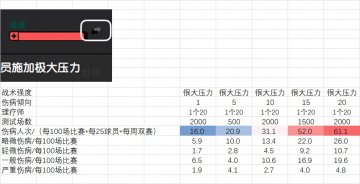
How to get more than 2 match practice:
Make a schedule of 2x match practice, then apply it to a week with a match in it. Then copy & paste that week to an empty week, the match will be replaced with match practice (total 3x match practice). Then you can just fill it up with as many as you want.
I tested 21x match practice with my realistic Luton test for most of a season. Tremendous amounts of injuries, but in the few who escaped largely unscathed, their attribute increases were mediocre or even declined slightly.
I then tested it with the EBFM test file. Surprisingly hardly any injuries at all over an entire season; '1' injury proneness has a greater protective effect than I realized. Looking at attribute gains of one player that had no injuries, gains were good but not unusually great.
I'm still thinking of the implications here, but one thing is that these players have 20 professionalism. Could it be that professionalism alone accounts for why players in the EBFM league develop significantly while those in my Luton save do not..
I conducted a rough "injury susceptibility" test months ago.
The second row of the table is "injury susceptibility", The team consists of 25 members. They play 2 matches each week, and there are a total of 100 matches throughout the season.
Then, without any training, I calculated the average number of injuries suffered in match.
The last 4 lines, from top to bottom, are the least severe injury and the most severe injury.
Overall, it can be seen that the "injury susceptibility" of 20 is twice injury compare to 10,
the "injury susceptibility" of 10 is twice injury compare to 1,
The approximate proportions of the four types of injuries are: (from mild to severe)
40% : 15% : 35% : 10%
Then this is the test conducted under “the maximum tactical intensity”.
Reducing the intensity of the tactics can slightly reduce the number of injuries, but not by much.
Eddie said: The setting is for automatic rest (no field or gym) when the player is tired.
In that sense, wouldn't it be redundant to schedule rest after a match? This is because the starters will already be resting due to the setting, while the substitutes who need match fitness or training will also be resting. Therefore, wouldn't it be better to schedule a match practice the day after a game so that the substitutes can train?
I didn't think about it that much. In fact, all of those options are acceptable.
Because the training schedule usually consists of only 0-4 sessions per week, there is usually plenty of room to accommodate these 4 activities (with actual training intensity to make Possible injure). All that's needed is to schedule them at times when there are no match.
It's better not to schedule sessions on the day after match, as to will minimize the risk of injury .
harvestgreen22 said: Importance priority (Briefly, it can be seen from the table "3" :
:
table 1: Increase the attribute from its initial value to 18,
table 2: Reduce the attribute from its initial value to 1,
table 3: Subtract Table 2 from Table 1 to obtain the overall importance.
1.
Acceleration 、 Pace 、
Work Rate (The Work Rate minimum is 6 . below 6 will result in severe penalties, but above 6 will result in a small increase.)
2.
Jumping Reach 、 Dribbling 、 Concentration 、 Anticipation 、Stamina 、Agility 、 Balance
3.
Composure 、 Finishing 、 Strength 、Aggression 、 Positioning
4.
The influence of other attributes has become relatively insignificant.
Can I ask please mate, if you're using Genie Scout (GS) how would you search for players using these attributes, what value would you assign to say Jumping Reach? Sorry little confused with you saying 6 for work rate as a the minimum, would this mean the secondary attributes can be 6 or less?
Thanks
CBP87 said: Can I ask please mate, if you're using Genie Scout (GS) how would you search for players using these attributes, what value would you assign to say Jumping Reach? Sorry little confused with you saying 6 for work rate as a the minimum, would this mean the secondary attributes can be 6 or less?
Thanks
1.
Genie Scout: I haven't used this thing before, so I have no idea at all about his scoring criteria
(I'm behind the age and haven't used these automated software in FM).
2.
If I were to assign a "value" level, I would probably give "Jumping Reach" a value ranging from "1/3 (33%)" to "1/4 (25%)" for "Acceleration".
The reason is simple: Its effect in the table is roughly "Acceleration" or "Pace" at "1/3 (33%)" to "1/4 (25%)".
Then, if it is a long-term training process, the value of this "Jumping Reach" can be greater (including things like Dribbling and Concentration ).
This is because their improvement rate during training is relatively lower (Unless players specifically set the corresponding options for their improvement , The cost is sacrificing some of the "Acceleration/Pace" growth. ).
3.
Work rate:
This attribute was specifically tested and it is a unique property.
Between "1 and 6", the difference in effect (winning rate/net goals scored) is extremely significant, accounting for the majority of his contribution in the table.
Between "6 and 10", the effect decreases to low.
"Above 10", the effect is decreases to very low.
As for the other attributes, I only tested a portion of them and did not test all of them.
So far, I haven't found any changes with values contributed mainly by "1-6" like "Work rate".
Therefore, there is no need to set a lower limit of "6" for other attributes.
The other attributes only need to be approximately regarded as attributes that uniformly increase/decrease efficiency (although they are not completely linear, but it is fine to consider them as linear in general)
Setting professionalism to 20 (and injury proneness to 1) did solve the anomaly.
I'll post more detailed results sometime later, but basically in EBFM test league using the following schedule I found was roughly ~10% better than meta:
Chance creation + Attacking + Aerial Defense + Handling + Defending from the front + Quickness + Quickness focus (Agility & Balance for GK)
You'll note the lack of match practice. I didn't just select different combos to test randomly. This combo is based on HarvestGreen22's training result data. Initially I had used EBFM's data, which I thought would be better to use because it was broken down by position precisely and every training option was listed, but I've found that it can't be applied to FM24.
I found in training meta vs full rest, that the technical/mental losses are difficult to recover, so really you just want to grow everything as much as possible, ideally while limiting the worst useless CA growth such as 'decisions'.
If you look at the different options for pace/acc boosts, whether it's the physical modules or simply using rest, they give a lot of -1 to technicals/mentals. So I figure pace/acc boost should be the priority in assessing the various other training modules. Basically between a module that gives +13 CA and +4.9 pace/acc, and one that gives +8 CA and +5.1 pace/acc, I'm going to choose the latter one.
For reasons I'm yet to understand, 'quickness' and 'attacking' remain an essential part of the recipe, and so they've been kept in after failing without them. Yes, even if you have quickness individual focus, it doesn't work.
If you look at HarvestGreen22's data you'll see things modules don't simply add or multiply together in the way one would intuit, so I just worked off what we do know (thankfully HarvestGreen actually tested several actual combos not just individual modules, this turned out to be crucial information) and tried a few theoretically promising combinations.
So I thought I had come up with the winning combination, but when I tested this in my realistic Luton save, I got unexpectedly poor results compared to meta.
It seemed to me it must probably be because of the lower professionalism, and surprisingly that turned out to be true. It is surprising because although one would expect somewhat lower professionalism might slow progress generally, it shouldn't stunt progress entirely or haphazardly. One strange thing about it was that acc was better than meta, but pace was a lot worse, whereas in the EBFM league test both acc & pace were better. Even stranger, meta results were not hampered for some unknown reason.
But the data indeed says lower professionalism is the underlying cause (probably in concert with certain other factors no doubt):
Meta (Quickness + 2 x Attacking + Match Practice + Quickness focus) test:
ST:
acc - 1, 0, 1, 2, 2, 1, 3, 1, 1, 1, 2, 4 = 1.58
pace - 2, 2, 2, 4, 4, 2, 5, 2, 4, 4, 4, 4 = 3.25
DL/DR:
drib - 0, -2, 4, 0, 2, 0, 0, -2, 1, -1, 1, 0, -1, 0, -1 = 0.07
GK:
agil - 3, 5, 5, 6 = 4.75
aer - 0, 1, 2, 2 = 1.25
ref - 0, 0, 0, -1 = -0.25
Chance creation + Attacking + Aerial Defense + Handling + Defending from the front + Quickness + Quickness focus:
ST:
acc - -1, 1, 1, 1, 2, 2, 2, 2, 2, 2, 4, 3, 3, 1, 3 = 1.87
pace - 0, 2, 1, 1, 3, 1, 3, 1, 3, 2, 3, 3, 1, 3, 3 = 2.2
Meta 20 pro + 1 injury prone (4 years):
ST:
acc - 1, 1, 0, 3, 0, 2, 4, 2, 3, 1, 3, 3, 3, 3, 1 = 2
pace - 1, 4, 1, 4, 2, 2, 2, 3, 4, 4, 5, 4, 4, 4, 5 = 3.27
dec - 5, 1, -1, -1, -1, 0, 0, 0, 0, 0, 2, 1, -1, 0, -1 = 0.267
DL/DR:
drib - 2, -1, 2, 1, 1, -1, 1, 0, 1, 1, 1, -1, 2, 1, 1, 2 = 1
GK:
agil - 7, 5, 7, 5, 4 = 5.6
aer - 3, 2, 0, 1, 1 = 1.4
ref - 0, 0, 0, 0, 0 = 0
8 players with 18/18 or equivalent
Chance creation + Attacking + Aerial Defense + Handling + Defending from the front + Quickness + Quickness focus (20 pro, 1 injury prone, 4 years):
ST:
acc - 3, 0, 3, 0, 3, 2, 3, 1, 2, 0, 3, 5, 4, 4, 3 = 2.4
pace - 4, 1, 3, 1, 5, 2, 3, 3, 5, 3, 6, 7, 4, 6, 6 = 3.93
dec - 0, 0, 1, -1, -1, 0, 0, -2, 0, -1, 1, 0, -1, 0, -1 = -0.333
DL/DR:
drib - 0, 0, 0, 0, 0, 0, 1, -1, 1, 0, -1, 1, 0, 2, 2, 2, 2 = 0.529
GK:
agil - 7, 6, 5, 5, 4 = 5.4
aer - 5, 2, 1, 1, 1 = 2
ref - 1, 0, 0, 0, 0 = 0.2
15 players with 18/18 or equivalent
Chance creation + Attacking + Aerial Defense + Handling + Defending from the front + Quickness + Quickness focus (20 pro, 1 injury prone, 3 years):
ST:
acc - 3, 1, 3, 0, 2, 2, 3, 1, 2, 0, 4, 4, 4, 3, 3 = 2.33
pace - 4, 1, 3, 1, 5, 2, 3, 2, 4, 2, 6, 6, 3, 5, 5 = 3.47
dec - 0, 0, 1, -1, -1, 0, 0, -1, 0, -1, 1, 0, -1, 0, -1 = -0.267
DL/DR:
drib - 0, 1, 0, 0, 0, 1, 0, 1, 0, 0, 2, 1, 0, 2, 1, 2 = 0.6875
GK:
agil - 7, 4, 5, 4, 4 = 4.8
aer - 5, 1, 2, 1, 1 = 2
ref - 0, 0, 0, 0, 0 = 0
11 players with 18/18 or equivalent
Extra notes:
Agility & balance focus is used for goalkeepers, not quickness.
I suspected maybe low CA-PA gap was the problem rather than low professionalism, but I checked and there's typically about 20-30 CA-PA gap left after the 4 years, so it's not that. And when I checked low professionalism players individually, it seemed to line up with professionalism being the problem - the low professionalism players were the ones with the largest differences such as 16 vs 20 pace.
I haven't measured attributes on the finer scale of 1-100, and there I may have even skipped over a player or two. Some variables were also not properly controlled. Margin of error is probably around -/+ 0.2 for each attribute. Overall it's definitely good enough in my opinion, and the reality is that there is a random element in player progress anyway - the player might get injured for example.
An advantage of my training regime isn't just the increased pace/acc, but the lower decisions growth. In my view, you should count this as equal to pace/acc in the inverse, because it occupies a lot of CA but is useless. I found quite a few combos that matched meta, except that they had significantly higher decisions growth, which made me discount them. Also some regimes had poor GK growth, a lesser consideration, whereas in this regime GK growth is excellent and slightly better than meta.
Because I can only demonstrate it works with 20 professionalism players so far, I recommend sticking with the meta for now unless you just buy very high professionalism players (which isn't a bad idea anyway). I think it won't take long to solve this though. I'm not sure what the reason is that meta works with lower professionalism players, the only idea I have right now is that maybe match practice is treated like a match rather than a training session and that you don't need professionalism for match gains but you need it for training module gains.
harvestgreen22 said: I haven't continued with the test for the time being. Right now, my mind is a bit confused and I'm not sure if you can understand this explanation:
1.
First of all, I haven't tried to see what the outcome would be if I combined different training schedules within a single season. Then,
It is obvious that the testing conditions were under the most ideal circumstances, being even better than normal conditions.
However, this is necessary because we need to highlight the differences in the training results of various types of training programs.
Otherwise, the degree of distinction would be insufficient.
And the players need to be designed to "grow rapidly", so that the effects of different training programs can be distinguished.
2.
So, in the test, the "professional level" of the players was set to be high.
The difference between potential (PA) and current ability (CA) is significant (this has a very significant impact on the actual growth rate).
The training facilities are the best.
The initial ability won't be that high (if set too high, each level-up will require more effort).
3.
In this way, after the test, the training program derived from it is a roughly optimal solution.
Then, for the "actual" players, it is obvious that they usually grow more slowly than player in test league (because the PA-CA value is usually small) and are more affected by randomness.
In this situation, my idea is to create better conditions for their subsequent growth.
The main point is toensure that the "difference between PA and CA" remains sufficiently large for a certain period of time. in this way can Acceleration and Pace maintain the fastest growth.
4.
The advantage brought by this "difference between PA and CA" is that it can to some extent make up for the deficiencies in "professional attributes", training facilities, and other aspects.
The disadvantage is that there is definitely a risk of not being able to fully achieve the PA target.
I think I can accept this risk. and , those lost technicals/mentals was worth it .
those lost technicals/mentals was worth it , Because the attributes of these losses actually do not contribute as much to the winning rate as the attributes of the gains do.
5.
That above is for players at the middle and lower levels. This effectively ensures that everyone can reach the value of 19/20 Acceleration and Pace as soon as possible.
I don't fully agree with the view that 18/18 is sufficient and balance . I think it's still worthwhile to further improve to 20/20.
Of course, this is just my personal opinion. And I might be wrong. My practical experience is also not sufficient.
For high-level/high-potential players,
I don't have any well-developed ideas either.
they have a lot of PA. If we consider the long term, high-level players may not necessarily need "total rest". However, if short-term performance is required, I think it is worth taking the risk to use "total rest".
I decided to do more tests before responding immediately.
I agree with everything you have said, excepting the following:
20/20 pace/acc has measurable performance difference over 18/18 pace/acc, it is true. However it seems unrealistic to achieve unless you either buy fairly elite (16+?) pace/acc players to begin with, or employ full rest.
It is also true that pace/acc are necessary attributes unlike almost all the others. The 1 CA 20/20 pace/acc player will beat the 100 CA 14/14 pace/acc player. However I found in testing 1 CA players that 20 pace/acc alone was not enough to win the league, nor even 20 pace/acc/jump/drib.. but it was possible if you boosted certain other technicals/mentals in addition such as concentration on defenders, while decreasing pace/acc to ~18/18 to fit in 1 CA. I found that ~17/17 pace/acc seems about the minimum you need to edge a win of the premier league.
If you do full rest, it can give you 20/20 pace/acc players, but they will be technically/mentally deficient, with overall losses of ~2 per technical/mental attribute in realistic testing even when doing 2 years full rest and then 2 years meta.
I didn't test the performance effect in a realistic test, but I noticed in my EBFM test league that the full rest teams ended up finishing last all the time, while meta training or my own regime finished 1st.
And that could be not just because of the technicals/mentals attribute losses themselves, but the poorer match fitness that results from full rest, and we know that match fitness has a big impact on performance.
Even with just 5 weeks of full rest per season with the rest meta, there was significant technical/mental losses that were not recovered. This means that it's better to gain all attributes through meta or similar, than to attempt some combo of full rest and meta, even where the gameplan is lower CA with full rest first to maximize CA-PA gap so that technicals/mentals can be pumped in rapidly at the last minute. But I found that meta alone wasn't sufficient, there needs to be some full rest or equivalent to get that ~18/18 threshold.
You've laid a lot of the necessary groundwork, I'm just building on top of that now. And it's probably true that in lower leagues full rest is more viable or perhaps even preferable.
There is one thing I would like to ask of you, and that is do you have the positional breakdown of the training session attribute effects? This would really help with fine-tuning the training regime
I think the main point is basically that you shouldn't say alright that's enough lets switch to something else when you reach 18 pace, it is worth pursuing further. Whether you can reach 20 or not is a different matter. From what I remember from my FM24 YAC save I could reach 20 using only using some version of meta training on players with as low as 135 PA. Obviously not every player was reaching that, but pretty much the whole team was at 17+ without any (or minimal) technical loss. I don't know how it works when buying 18 year olds, I suspect a solid initial pace is required to begin with.
I added match practice to my training regime, but left professionalism as default (realistic luton test).
Result was ST - acc 2.06, pace 2.56
That means match practice can be ruled out as the relevant factor
I also had a look at the players individually and found that the general pattern, while not that consistent, was that it scaled roughly linearly with professionalism, i.e. 15 pro was 77-100% of 20 pro, 10 pro was 40-77% of 20 pro.
I suppose then that [Chance creation + Attacking + Aerial Defense + Handling + Defending from the front + Quickness + Quickness focus] should be used only if you have a squad that is ~16+ professionalism
Is this all for FM 24? If so, is there any research applicable to FM 26?
GeorgeFloydOverdosed said: I added match practice to my training regime, but left professionalism as default (realistic luton test).
Result was ST - acc 2.06, pace 2.56
That means match practice can be ruled out as the relevant factor
I also had a look at the players individually and found that the general pattern, while not that consistent, was that it scaled roughly linearly with professionalism, i.e. 15 pro was 77-100% of 20 pro, 10 pro was 40-77% of 20 pro.
I suppose then that [Chance creation + Attacking + Aerial Defense + Handling + Defending from the front + Quickness + Quickness focus] should be used only if you have a squad that is ~16+ professionalism
I noticed in FM24 that there were 6 training routines that used 40% individual training, which I think would remove the need for using physical routines given all the outfield players have Quickness as their individual focus. 2 are GK being Shot Stopping and Handling, 2 defence being Aerial Defence and Ground Defence and 2 are attacking being Chance Creation and Chance Conversion (although these are under Technical). They all also focus on the key attributes for each position.
I am wondering whether one of each of the following would be best and it would certainly lower injuries - Attacking, Defending (given EBFM results), Shot Stopping, Handling, Aerial Defence, Ground Defence, Chance Creation and Chance Conversion. I would run the GK ones on Monday, Attacking and Defending on Tuesday or Wednesday (as it wouldnt hurt to lose these some weeks) depending when your second game usually happens and the other 4 spread across Thursday and Friday. I have started running with this but am just about to finish season one so wont know for a while. Just a theory based on what I have read and some discussion back in FM22 or 23.
lasko911 said: Is this all for FM 24? If so, is there any research applicable to FM 26?
I don't believe there has been changes to the training under the hood for FM26, just presentational.
Mark said: I noticed in FM24 that there were 6 training routines that used 40% individual training, which I think would remove the need for using physical routines given all the outfield players have Quickness as their individual focus. 2 are GK being Shot Stopping and Handling, 2 defence being Aerial Defence and Ground Defence and 2 are attacking being Chance Creation and Chance Conversion (although these are under Technical). They all also focus on the key attributes for each position.
I am wondering whether one of each of the following would be best and it would certainly lower injuries - Attacking, Defending (given EBFM results), Shot Stopping, Handling, Aerial Defence, Ground Defence, Chance Creation and Chance Conversion. I would run the GK ones on Monday, Attacking and Defending on Tuesday or Wednesday (as it wouldnt hurt to lose these some weeks) depending when your second game usually happens and the other 4 spread across Thursday and Friday. I have started running with this but am just about to finish season one so wont know for a while. Just a theory based on what I have read and some discussion back in FM22 or 23.
This sounds really interesting to me, particularly as after thinking about it, I thought perhaps 'additional focus' (quickness) is what's interacting with professionalism to cause the pace discrepancy. I decided in the end to remove it from my post, because it still doesn't explain why the meta training overcomes it, but it sounded sensible to me that poor professionalism would result in players being unwilling to put in the extra work on top of their existing team training.
But I don't get what you mean by 'used 40% individual training', what do you mean by this and where is this shown?
I can comment a few things on the different training modules/combos. From memory, EBFM found that more of the same module has diminishing returns. I've generally stuck by this, but as the meta which has 2x attack shows, it's no longer necessarily the case in FM24. In fact, a lot of the training module effects have drastically changed since EBFM done it. I initially tried designing training schedules based on EBFM's data. It didn't really work, so I tried doing it HarvestGreen22's FM24 data, and that did work. And the changes are so drastic that 'defending from the front' would have been one of the worst in EBFM's results for my purposes, but supposedly it's one of the best in FM24, and my results off the bat seem to have proved that. There are a bunch of different combos that come close to the meta, but the problem is usually that they boost garbage attributes too much and also usually cause more injuries to boot.
Here are some relevant key points to know:
One early theory I had was that more training modules means less rest, which means less physical growth, in exchange for (usually meagre) technical/physical growth. This explains why 1 module/week doesn't do enough, and 4 modules/week (meta) is optimal. I realized it must be the optimal schedule crams as much useful CA into those ~3-5 modules. But testing showed this wasn't quite the picture. In hindsight now, it could be right, it's just that I was using EBFM's data which is not suitable for FM24.
Even if it's just a data issue, if you look closely at HarvestGreen22's data, you will see that strange things happen when you combine modules. If one module does +1 drib and another does -1 drib, you'd expect them to cancel each other out, or at least some kind of multiplicative process would occur. But it is nonsensical, or at least too complicated to easily work out.
So my thought then was, given rest loses technicals/mentals significantly to gain pace/acc, anything that gains pace/acc near equally even if does 0.00 growth for technicals/mentals is a win, and I would just try different combinations of these promising modules.
rest = 4.8 pace/acc
match practice 15.6 CA, 4.2 pace/acc
attacking direct 16.3, 4.5
chance conversion 13.6, 4.2
defending from the front 14.7, 4.6
one on ones 12.6, 4.2
attacking wings 13.9, 4.0
defending 14.4, 3.6
attacking 13.2, 4.1
goalkeeping 13.4, 4.4
So you can see here why defending is disfavored, although I have tried it before. In EBFM's data, defending was actually very good from memory. And you can see that surprisingly match practice isn't actually that essential, especially when you consider its intensity impact.
Intensity impact is another thing where I think something is going on. It's more of a case that the proof is in the pudding at the moment, but my theory is that intensity can add up to 100% per week and anymore gets squished down to match 100% while retaining proportions. If it's less than 100%, it stays less than 100%. This would explain why 1-3 modules produces poor results, and it so happens that the meta is 105%. And in fact it's actually quite difficult to make an exactly 100% training schedule, and for all positional units (GK, defending, attacking). But this is what my successful regime does, with the exception of GK which is 105%. Maybe it's actually just coincidence, but it does do significantly better than the meta training.
I tried to experiment without a session of Quickness. Unfortunately I just couldn't get it to work, the pace/acc would suffer significantly. This includes trying such things as 2x endurance replacing it.
GeorgeFloydOverdosed said: But I don't get what you mean by 'used 40% individual training', what do you mean by this and where is this shown?


If you look at the training detail and split. Here are Aerial Defence, Chance Completion and GK Handling breakups:
There main focus is 60% with the secondary and tertiary 40% and all individual focus.