Since this is a very common question, and player attributes are possibly more important than tactics, I decided to open a discussion about training schedules. The data about different schedules can be found here.
In short, training in FM26 has three main goals: 1. To improve performance of players 2. To increase revenue with transfers 3. To keep players in top shape for the current season (condition, fatigue, match sharpness and injuries)
You can also argue about secondary goals like training for new positions, improving team bonding and player happiness, but I will focus this discussion on the three main goals only.
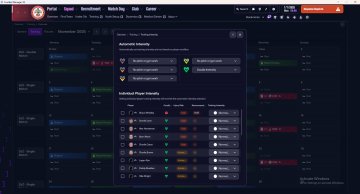
How to optimize improvement of players? Other than having good staff and facilities, setting training intensity to double is proven to increase the speed of growth, which can be offset with resting and lighter schedules to avoid injuries and keep players in shape. My recommendation is to set players to double intensity when full condition, but others argue that double intensity at 80% can increase growth even further. I do not think it is worth the increase in injuries, but it is simply a matter of priorities. The picture below shows how I set automatic intensity, with no pitch or gym work for any player below full condition.
The main decision when picking a training schedule is "what attributes you want your players go grow", because some attributes like pace and acceleration are clearly more impactful than others like decisions and technique. Since CA is limited by PA, your goal is to maximize those important attributes, ideally reaching PA in the process to also make use of secondary attributes that are less important but still make a difference. Players with high CA also sell for higher values, which increases your revenue and allows you to hire even better players or wonderkids.
According to the tables provided by @harvestgreen22, I decided to filter 10 attributes that I think are the most important to players. Below is my list of preferred attributes.
Top priority: Pace and Acceleration are by far the most effective attributes. Minimum requirements: 6 in Work Rate, Agility, Concentration and Stamina. These attributes hurt a lot when low, but do not improve performance significantly at higher values. Only look below if still in doubt between two players. Priority #2: Jumping Reach (especially for defenders). Secondary requirements: 10 in Balance, Dribbling (especially for flank players), Work Rate and Anticipation. Only look below if still in doubt between two players. Priority #3: Dribbling and balance.
Example of ideal player Pace: 18+++ Acceleration: 18+++ Work Rate: 10 Agility: 6 Concentration: 6 Stamina: 6 Anticipation: 10 Jumping Reach: 10++ Dribbling: 10+ Balance: 10+
Since five of those important attributes do not increase player performance significantly as they get higher values, we can ignore them from training schedules and assume they are a pre-requisite when hiring new players. Our focus will be Pace, Acceleration, Jumping Reach, Dribbling and Balance. There is also a negative value to attributes like Decisions, Technique, Vision, Marking and Tackling, which means they have little to no effect in performance, but have high CA weights for some positions. Therefore, it is better to avoid schedules focused in those attributes, especially Decisions and Technique.
Cost-effective Schedules A schedule that increases more CA is not necessarily better, because players stop growing once they reach PA. Our goal is to improve key stats as much as possible before reaching PA, which means we want as much increase in the key attributes for the lowest total improvement of CA. Normalizing those key attributes by their impact in performance (from the tables), I found out those ten training schedules to be the most cost effective, in order. Those schedules consider double intensity and Quickness focus for all players. - 044 [Overall]: 16.82 CA - 085 [Match Review]: 17.40 CA - 100 [Match Review]x2: 17.72 CA - 082 [Recovery]: 17.76 CA - 086 [Rest]x21: 17.53 CA - 045 [Outfield]: 17.84 CA - 077 [Penalties]: 18.01 CA - 105 [Quickness][Attacking]: 17.84 CA - 080 [Resistance]: 18.72 CA - 079 [Endurance]: 18.27 CA
Most Effective Schedules If you do not consider CA to be a limiting factor, then there are a few schedules that are even more effective. Below are the ten training schedules that I consider the most effective for growing the key attributes, without considering total CA gain, normalized by their impact in performance, in order. Those schedules consider double intensity and Quickness focus for all players. - 339 [Quickness][Attacking][Match Practice]: 35.72 CA - 263 [Physical]x5[Attacking]x5: 27.85 CA - 214 [Physical]x2[Attacking]x2: 33.83 CA - 081 [Quickness]: 18.78 CA - 100 [Match Review]x2: 17.72 CA - 139 [Physical][Quickness][Resistance][Defending]: 28.71 CA - 080 [Resistance]: 18.72 CA - 340 [Physical]x2[Attacking Wings][Attacking]: 31.27 CA - 243 [Quickness][Match Practice][Attacking]x2: 37.93 CA - 077 [Penalties]: 18.01 CA
Using any of the training schedules above will yield good results for improving performance of players, and you can also combine different schedules to customize the outcome. If anyone is curious about how attribute growth works, the "experience" of attributes seems to be assigned after each week of training, so if you combine schedule A with schedule B evenly, your results will be around the average of both schedules.
The biggest issue of the schedules above, according to the experience of many players that tested them, is the quick drop in match sharpness, which forces players to put extra effort in friendlies. Low match sharpness decrease player performance and increase injuries, which also reduces player growth, and that is far from ideal. To solve that issue, I recommend adding one [Recovery] session in every day without training, except after matches, which should be reserved for super-rest. You can learn more about the rest exploit here. After testing, I found out Recovery does not affect training results very much, and in my opinion the benefit of keeping match sharpness far outweighs any negligible difference in growth.
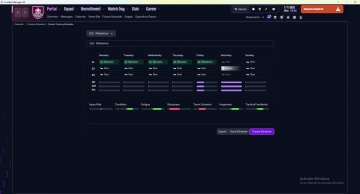
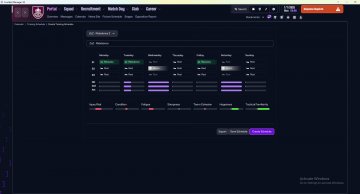
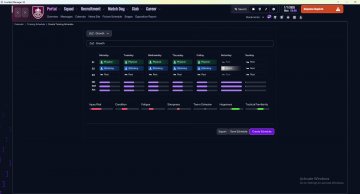
Below is my suggested training schedules, but feel free to adapt it to your own needs and preferences. Suggested TrainingSchedules Ideally split evenly during the season, alternating every week or month. Rebalance ([Resistance]): Redistributes CA among the most important attributes. Growth ([Physical]x5[Attacking]x5 for one match or [Physical]x2[Attacking]x2 for two matches): Improves secondary attributes, with focus on key attributes.
Rest and Recovery Three Rest sessions are used after every match to trigger super-rest, and Recovery sessions are used to reduce the loss of match sharpness in days without training.
Automatic Intensity Double when full energy, and no pitch or gym training when below full condition.
Individual Focus Quickness, or Agility/Reactions for goalkeepers
Roles Not needed, but you can pick any role with highlighted Pace and Acceleration to train new positions
My suggested training schedules are in the attachments. Pictures for people on consoles are below.
For youth teams, I usually do just the rebalance routine (Resistance x1), to ensure players grow Pace and Acceleration without compromising their potential attributes.
Let me know in the comments how you handle training, sharing your experience and further suggestions. If you tested my suggested training schedules, let me know how they worked for you. Have fun!
Since this is a very common question, and player attributes are possibly more important than tactics, I decided to open a discussion about training schedules. The data about different schedules can be found here.
In short, training in FM26 has three main goals:
1. To improve performance of players
2. To increase revenue with transfers
3. To keep players in top shape for the current season (condition, fatigue, match sharpness and injuries)
You can also argue about secondary goals like training for new positions, improving team bonding and player happiness, but I will focus this discussion on the three main goals only.
How to optimize improvement of players?
Other than having good staff and facilities, setting training intensity to double is proven to increase the speed of growth, which can be offset with resting and lighter schedules to avoid injuries and keep players in shape. My recommendation is to set players to double intensity when full condition, but others argue that double intensity at 80% can increase growth even further. I do not think it is worth the increase in injuries, but it is simply a matter of priorities. The picture below shows how I set automatic intensity, with no pitch or gym work for any player below full condition.
The main decision when picking a training schedule is "what attributes you want your players go grow", because some attributes like pace and acceleration are clearly more impactful than others like decisions and technique. Since CA is limited by PA, your goal is to maximize those important attributes, ideally reaching PA in the process to also make use of secondary attributes that are less important but still make a difference. Players with high CA also sell for higher values, which increases your revenue and allows you to hire even better players or wonderkids.
According to the tables provided by @harvestgreen22, I decided to filter 10 attributes that I think are the most important to players. Below is my list of preferred attributes.
Top priority: Pace and Acceleration are by far the most effective attributes.
Minimum requirements: 6 in Work Rate, Agility, Concentration and Stamina. These attributes hurt a lot when low, but do not improve performance significantly at higher values.
Only look below if still in doubt between two players.
Priority #2: Jumping Reach (especially for defenders).
Secondary requirements: 10 in Balance, Dribbling (especially for flank players), Work Rate and Anticipation.
Only look below if still in doubt between two players.
Priority #3: Dribbling and balance.
Example of ideal player
Pace: 18+++
Acceleration: 18+++
Work Rate: 10
Agility: 6
Concentration: 6
Stamina: 6
Anticipation: 10
Jumping Reach: 10++
Dribbling: 10+
Balance: 10+
Since five of those important attributes do not increase player performance significantly as they get higher values, we can ignore them from training schedules and assume they are a pre-requisite when hiring new players. Our focus will be Pace, Acceleration, Jumping Reach, Dribbling and Balance. There is also a negative value to attributes like Decisions, Technique, Vision, Marking and Tackling, which means they have little to no effect in performance, but have high CA weights for some positions. Therefore, it is better to avoid schedules focused in those attributes, especially Decisions and Technique.
Cost-effective Schedules
A schedule that increases more CA is not necessarily better, because players stop growing once they reach PA. Our goal is to improve key stats as much as possible before reaching PA, which means we want as much increase in the key attributes for the lowest total improvement of CA. Normalizing those key attributes by their impact in performance (from the tables), I found out those ten training schedules to be the most cost effective, in order. Those schedules consider double intensity and Quickness focus for all players.
- 044 [Overall]: 16.82 CA
- 085 [Match Review]: 17.40 CA
- 100 [Match Review]x2: 17.72 CA
- 082 [Recovery]: 17.76 CA
- 086 [Rest]x21: 17.53 CA
- 045 [Outfield]: 17.84 CA
- 077 [Penalties]: 18.01 CA
- 105 [Quickness][Attacking]: 17.84 CA
- 080 [Resistance]: 18.72 CA
- 079 [Endurance]: 18.27 CA
Most Effective Schedules
If you do not consider CA to be a limiting factor, then there are a few schedules that are even more effective. Below are the ten training schedules that I consider the most effective for growing the key attributes, without considering total CA gain, normalized by their impact in performance, in order. Those schedules consider double intensity and Quickness focus for all players.
- 339 [Quickness][Attacking][Match Practice]: 35.72 CA
- 263 [Physical]x5[Attacking]x5: 27.85 CA
- 214 [Physical]x2[Attacking]x2: 33.83 CA
- 081 [Quickness]: 18.78 CA
- 100 [Match Review]x2: 17.72 CA
- 139 [Physical][Quickness][Resistance][Defending]: 28.71 CA
- 080 [Resistance]: 18.72 CA
- 340 [Physical]x2[Attacking Wings][Attacking]: 31.27 CA
- 243 [Quickness][Match Practice][Attacking]x2: 37.93 CA
- 077 [Penalties]: 18.01 CA
Using any of the training schedules above will yield good results for improving performance of players, and you can also combine different schedules to customize the outcome. If anyone is curious about how attribute growth works, the "experience" of attributes seems to be assigned after each week of training, so if you combine schedule A with schedule B evenly, your results will be around the average of both schedules.
The biggest issue of the schedules above, according to the experience of many players that tested them, is the quick drop in match sharpness, which forces players to put extra effort in friendlies. Low match sharpness decrease player performance and increase injuries, which also reduces player growth, and that is far from ideal. To solve that issue, I recommend adding one [Recovery] session in every day without training, except after matches, which should be reserved for super-rest. You can learn more about the rest exploit here. After testing, I found out Recovery does not affect training results very much, and in my opinion the benefit of keeping match sharpness far outweighs any negligible difference in growth.
Below is my suggested training schedules, but feel free to adapt it to your own needs and preferences.
Suggested Training Schedules
Ideally split evenly during the season, alternating every week or month.
Rebalance ([Resistance]): Redistributes CA among the most important attributes.
Growth ([Physical]x5[Attacking]x5 for one match or [Physical]x2[Attacking]x2 for two matches): Improves secondary attributes, with focus on key attributes.
Rest and Recovery
Three Rest sessions are used after every match to trigger super-rest, and Recovery sessions are used to reduce the loss of match sharpness in days without training.
Automatic Intensity
Double when full energy, and no pitch or gym training when below full condition.
Individual Focus
Quickness, or Agility/Reactions for goalkeepers
Roles
Not needed, but you can pick any role with highlighted Pace and Acceleration to train new positions
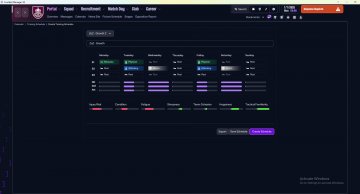
My suggested training schedules are in the attachments. Pictures for people on consoles are below.
For youth teams, I usually do just the rebalance routine (Resistance x1), to ensure players grow Pace and Acceleration without compromising their potential attributes.
Let me know in the comments how you handle training, sharing your experience and further suggestions. If you tested my suggested training schedules, let me know how they worked for you. Have fun!