Summary of recent findings for optimal play in FM24

Joined
Nov 11, 2026
Messages
19
Reaction score
7
Work in progress.

Club/Nation Selection
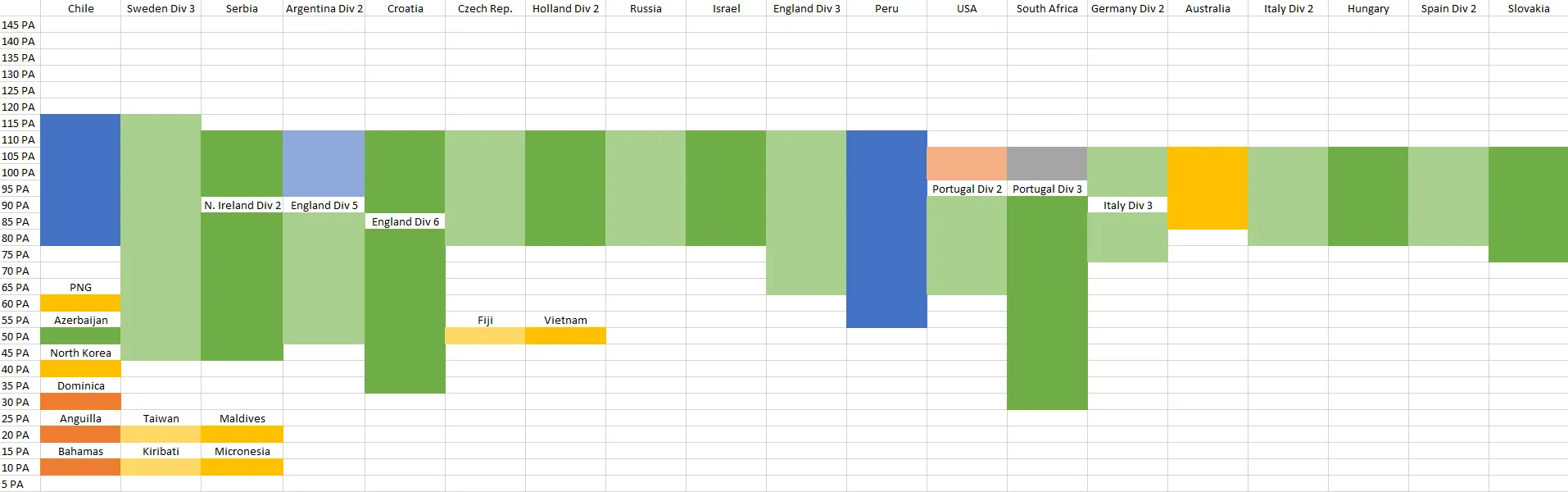
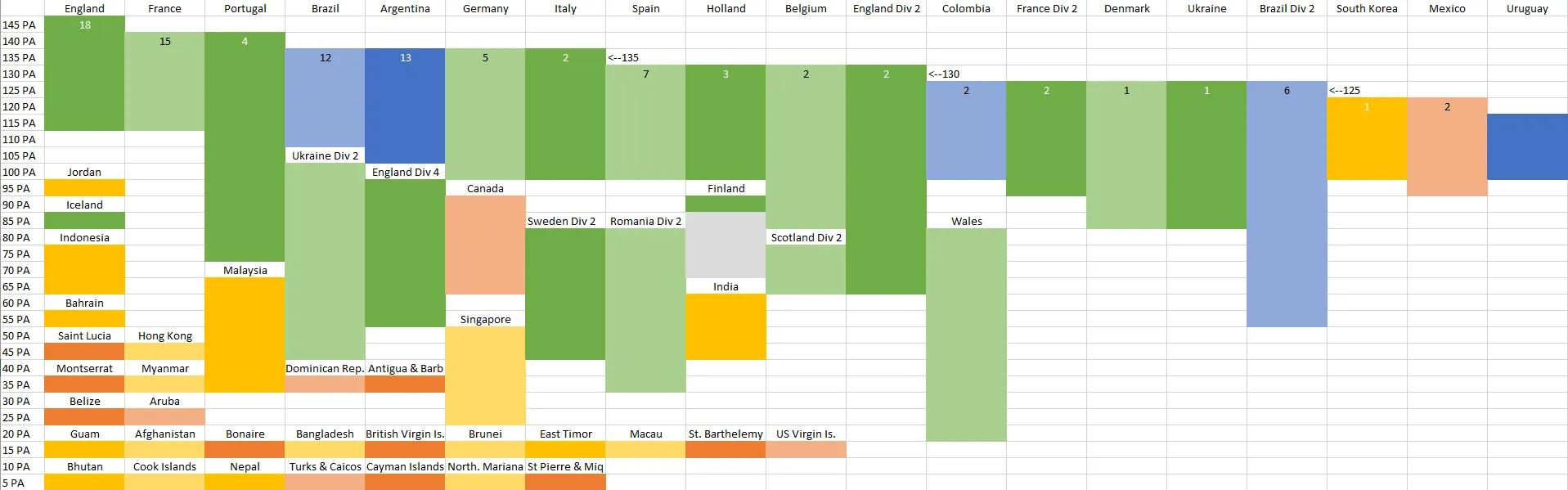
Choose your nation carefully as it has a significant permanent hidden effect on newgen quality:

AqgYnhx.png


The above shows the median PA of Div 1 newgens when all relevant factors are controlled to be the same.

Two examples to illustrate the tangible impacts of this:
  • A maximum 20 JC / 20 YR Singapore club is approximately equivalent to a 1 JC / 1 YR English club.
  • 15 JC / 15 YR West Ham is approximately equivalent to a maximum 20 JC / 20 YR Italian club.
For club choice, consider attendance. Truro (225) and Yeovil (3618) play in the same division; Yeovil has +1.19 effective pace bonus.

Your club choice otherwise only carries some very minor permanent effects:

Weather - Minor effect on performance and injuries.
Altitude - Significant effect on fitness at high levels. Consider a low altitude club.
City attraction - Affects willingness of players to join your club potentially. Does not effect newgens.
Inhabitants range - Cosmetic effect only (newgen birth city)
Local Region - Does not effect newgens, with possible exception of nationality & language proficiency.

Game Setup:
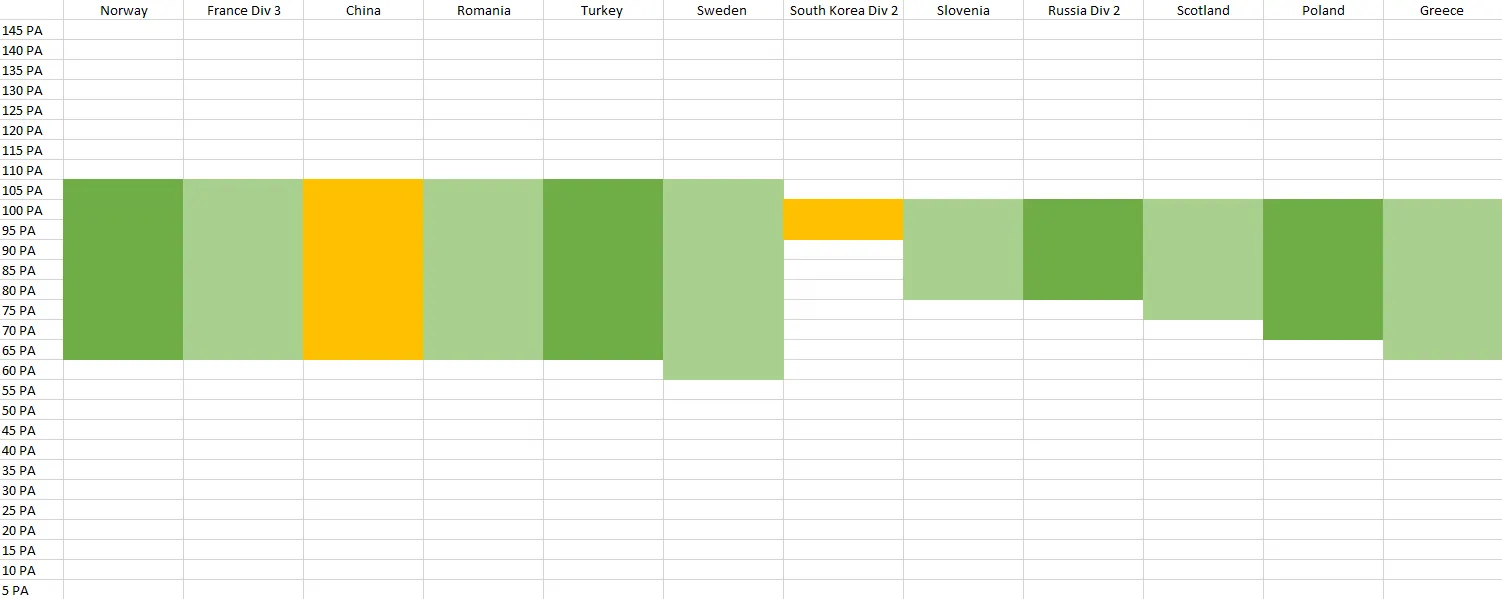
League options by newgen quality (somewhat outdated):
1*Ic1SP7YyCKi-rDZ2AjP5pQ.png

1*vIG2d7InSn7FGk1HmmsOFg.png

1*0cZU8Mwa9LSylnndemu3mw.png


Processing time is mostly number of teams in division + active status + detail level. Player numbers make negligible difference.

Recommended settings:
  • 'Large' database size (for immersion & transfer activity)
  • Load players from all national teams (immersion) and optionally all players from your main nation, but overdoing it can unbalance the transfer market
  • Load key divs of interest (i.e. Spain Div 1) and one or two divs for player poaching (i.e. Netherlands Div 2)
All games your team plays, probably even U18s, are always played in full detail.

Attribute Template:

**I've temporarily removed these to update

Attribute Weightings

Current version: Premier League 2.1 weights

FMST26 weights (copy paste this into statistics > custom metrics (advanced))

Genie Scout file: https://files.catbox.moe/9n18q0.grf (**Requires GK update)

GS has serious bugs. Switch to FMST26 or FMSS.

Tactics:
424 | Knap's EF 424 IF HP V2 P101 AC
433 | Diabolo4480's Mars Attacks V7


Only these two tactics win with default Luton. Knap is more reliable and stronger overall, but V7 has more Luton 1sts.

Avoid altering these tactics without testing. Like a proven chef's recipe, changes are more likely to harm than improve, with any gains likely negligible.

Possibly marginally beneficial tweaks:
  • ADD Hit Early Crosses
  • ADD Be More Expressive
  • ADD Trap Inside
  • ADD Play Out Of Defense
  • REMOVE Distribute Quickly
  • REMOVE Pass Into Space
Tactical Familiarity 50% > 100% is negligable vs. +13%(?) for FM27.
‘Partnerships’ (lines between players) are placebo.
Touchline shouts slow the fatigue rates of players modestly during games.

Training schedule:
Choose one of these (both equally good):

Most efficient - [Physical]x2[Attacking]x2
Highest CA - [Physical][Match Practice][Attacking][Defending]

cgXpuab.png


Do not set player roles in training. It messes up attribute distribution. Position/role/duty familairity will be ~0%, which is fine as it is placebo.
‘Training’ > ‘Rest’ (tab), set intensity ‘None’-‘None’-‘None’-‘Double’-‘Double’.
Change individual focus to train key attributes (i.e. Drib) to ~8-10, then return to Quickness.
Pure ‘rest’ boosts physicals and preserves CA-PA gap but sacrifices important mentals, offers suboptimal CA gains, and risks injuries and poor results through low match sharpness.

Fitness Management:
Maintaining high match sharpness is critical to performance and is difficult to manage without careful planning.
Condition matters of course, but is relatively easy to manage.
Fatigue doesn't matter much, because it is easily avoidable.

In order to manage match sharpness correctly:

Squad of 23 players
No natural fitness 7 or less
~30-50%+ squad natural fitness 14+

7 pre-season home friendlies against u18 team of worst local club.
Sprinkle in mid-season friendlies during lulls or losing streaks.

Friendlies gain match fitness at 55% rate of competitive matches.
Stamina does not effect condition recovery, but it does affect condition usage during matches.
Having a physio - just one of any caliber, reduces match sharpness decay significantly.

Morale:
20% morale is roughly equivalent to:
  • 1.58% condition
  • 3.15% match sharpness
  • 1927% tactical familiarity
  • 0.424 pace for all outfield in your starting 11
  • 1211 home fans attending your match
It is of minor to moderate impact, and momentum (i.e. winning/losing streaks affecting future performance) appears to be a real thing. Some tips to manage it:

- The friendlies against dud teams mentioned previously will boost morale significantly
- Set up your training calendar for the season, then delegate 'general training' to a staff member. No more training unhappiness complaints.
- Avoid somewhat players that are disloyal, highly temperamental, highly ambitious.
- Favor a compact squad with fairly easy training

The difference between ‘Okay’ and ‘Very Good’ morale is ~3% condition or ~6% sharpness. In most cases, the more fit player is the better pick.
  • 100% condition ‘Abysmal’ player = 92% condition ‘Perfect’ player
  • 99% condition 90% sharpness ‘Good’ player = 97% condition 100% sharpness ‘Poor’ player
In a losing streak situation, the 'good' player above is likely to be the backup that is ~10% worse in terms of attributes. So they should generally only come into contention to replace the 'poor' morale player if are perfectly fit (i.e. through reserve friendlies).

Development:
34% Natural growth
25% Randomness
21% Competitive matches
---> 85% Division Reputation
---> 8% Loan club training facilities (if loaned out)
---> 7% Club Reputation
20% Training

Age 14-18 - Keep at club, u18s/reserves friendlies sufficient
Age 19-20 - Play minimum 15 games/season or loan out, but keeping at club playing reserve friendlies still decent
Age 21+ - Must be playing competitively or loaned out to develop further

3 first-team matches or 6 reserve/u18s matches per month to max out growth (friendlies fine). Realistically you would need to schedule ~8 friendlies/month to max out growth.

There is a hidden shifting PA below actual PA called 'progress factor' which effectively limits or delays growth for many players. To avoid this, maximize morale, club atmosphere, training facilities, player relationships (i.e. preferred staff being at club), and player pro/amb/det. ~60-70% of max in all these things together will allow a player to actually hit his PA instead of being capped to ~85-95% of it.

Loans:
- CA growth requires competitive matches played. Game time should be 1st priority.
- CA growth hard-capped by division reputation. Division level is 2nd priority.
- Inactive division best (South Korea Div 1 appears the ideal choice for loans)
- Training facilities and club rep minor factors

Affiliates:
- For loan feeder, choose mid-table team or division with no relegation (high chance of being played, low chance relegated)
- For newgen intake feeder, choose Brazilian club for high youth rating. One of your newgens will be partially determined by the higher nation youth rating.
- Cut bad default affiliates. Foreign affiliates can drag down one of your newgen's PA (low nation youth rating), have mandatory friendlies you pay for, and charge you an annual fee.

Newgen quality:
50% Randomness
13% Unique Nation ID (i.e. England vs Romania)
13% Junior Coaching
8% Youth Recruitment
8% Nation Youth Rating
5% Nation Game Importance
1% Youth Facilities
0.3% Brazilian affiliate
0.2% HoYD
0.1% Youth Coaches
-0.6% Kiribati affiliate

An approximate formula for newgen PA is:

((JCx1.5)+YR+((NYR/10)+X)x1.15

Where:
  • JC = Junior Coaching
  • YR = Youth Recruitment
  • NYR = Nation Youth Rating
  • X = Hidden nation/division factor
For 'X' see image at beginning of post. Assume England = '62' and Singapore = '25' and calculate values of other nations proportionally. E.g. Italy is '49.14', Spain is '56.71'.

Other factors not included in the above formula:
  • Game Importance 'Very Important' > 'Unimportant' = 0% median PA change, -8.3% peak PA
  • Club Reputation tiebreaker for Youth Recruitment
  • HoYD influence 1-2 newgen personality
  • Youth coaches 50% of above
League position at the time of intake also matters:

zeyKDpA.png


Skins
It's subjective

cinckhT.png
 
Last edited:
Let me know if you'd like any of these assumptions validating or drilling down on with a code inspection.
 
Thanks for the summary! I've been measuring a few of these points with the Match-Harness and by reading the development code. Some results contradict the post, so here they are. One caveat up front: my simatch.fmf is a mod (FM TWEAK v1.4), so the match-engine numbers measure that engine, but in the past results were almost equal. The development numbers come from FM's unmodified development routine.
Would be interesting to find why our findings differ!


1. "Morale, atmosphere, relationships and facilities at 60–70 % let players reach PA instead of 85–95 %"
FM's monthly development routine (408 harness runs, ~27,000 player-months, 50 seeds per cell) shows a different mechanism. Every player has a hidden development ceiling (1–5) that caps the CA growth aims for at 0.70 / 0.75 / 0.85 / 0.95 / 1.00 × PA. In one save the shares were 9.5 / 25.7 / 45.2 / 14.7 / 4.9 %. Over four in-game months only 1.0 % of growing players went past that cap. Personality only enters via professionalism and ambition: ambition 1 gives ×0.65 growth, 18+ gives ×1.48; professionalism 1–5 gives ×0.70, 14+ gives ×1.15; either at 1 caps the target at 0.70 × PA. Morale, determination, facilities, coaching and reputation showed no clear effect on growth. Facilities matter indirectly: the ceiling is re-rolled on a transfer (~50 %), a renewal (~40 %) and the first pro contract (~64 %), and after a move to a club with 18–20 facilities, ceilings 4–5 came up 66 % of the time and 1–2 only 5 %.


2. "Max growth needs 3 first-team or 6 reserve/U18 matches per month; division level hard-caps growth"
Growth needs ~125 match points per development month: 100–110 is still braked, below ~80 it nearly stops. From the last development month of 160,000 players in a save, points per full match (median / top 10 %):
  • amateur and youth sides (top-11 mean CA < 80): 0 / 4–15
  • mean CA 80–100: 7 / 21
  • professional, mean CA 100–200: ~15 / ~24, flat above 100
  • a top first team: 20 / 29
  • an academy U19 side: 16.5 / 22

So an academy game gives roughly 10–30 % fewer points than a professional one, not half. You need ~4–5 full games a month at either level. Playing at all matters far more than the level. So ideally if you have a big academy squad you schedule as many friendlies as possible and distribute the playing time so everyone reaches at least 125 match points. I've set up my own companion app to manage that automatically and so far results are good, but I have to tweak it to lower the injury risk.


3. The morale vs sharpness example (Poor morale at 98 % sharp vs Fairly Good at 83 % sharp, the latter rated higher)
Whole XI set to each level, season points vs a perfect state, 10,000 seeds:


Season points
Sharpness 90 / 75 / 50 %−4.5 / −14.4 / −44.0
Morale 15 / 10 / 5 / 1−2.1 / −3.4 / −4.0 / −4.5

83 % sharpness costs roughly 9–10 points; morale 6 instead of 11 costs about 1. The sharp player with poor morale is clearly the better pick in my tests.


4. "Condition is easy to manage, fatigue doesn't matter much"
Condition was the strongest match-day factor I measured. Whole XI:


Season points
Condition 95 / 90 / 85 / 80 / 70 %−6.0 / −11.7 / −19.7 / −32.3 / −60.0
Fatigue 400 / 600−2.4 / −10.6

That's about 3× the earlier community figures (EBFM, Zippo) for condition.


5. Morale win rates (Perfect 50.2 % … Abysmal 33.0 %)
In my runs the whole XI at morale 1 instead of 20 cost only −4.5 points a season, about ¼ of EBFM's figure. A 17-point drop in win rate would be several times that.


6. "Physical ×2 + Attacking ×2 is the most efficient schedule"
Twelve months, 3–5 players aged 17–23, 50 seeds. CA over pure rest: Attacking ×1 / ×2 / ×3 / ×6 = +3.1 / +5.1 / +6.1 / +6.9 (the training categories cap at 50, so it saturates after ~3). Tactical ×3 = +1.9, Outfield ×3 = +1.5, Quickness or Physical ×1–3 = +0.2 to +0.4. But in match value every schedule ended within ±0.2 points of pure rest: technical sessions put CA into attributes the engine barely rewards and cost ~0.3 pace and acceleration. An 18-year-old who only rests still gains +16.9 CA a season, almost all physical. I'd say the schedule matters for condition and sharpness on match day much more than for development and you should maximize playtime with minimal fatigue so they don't get injured.


7. "Loan club training facilities: 8 % of competitive-match development"
I'm, pretty sure facilities don't enter the monthly growth routine. They only matter through the ceiling re-roll on a transfer or contract, which a loan doesn't trigger.

Full tables and methods: FM24-Companion/docs/findings at main · Forsti37/FM24-Companion
 
I've been measuring a few of these points with the Match-Harness and by reading the development code. Some results contradict the post, so here they are.
Would be interesting to find why our findings differ!

Initially I was going include the full formula for 'progress factor', but fm-arena has a 10,000 character limit for posts now. Then I figured, the point is to summarize anyway. So '60%-70%' in the relevant factors is my simplification of what's required.

In regards to MatchXP, I'm yet to investigate training myself using the harness. I've merely taken LightningFlik's assessment of it. From memory it involves opposition reputation and I think opposition average CA, so I don't see how an U19 match would be 70-90% of a first-team match. And are those U19 matches friendly or competitive? Because there wouldn't be enough competitive youth matches. But I'll look at this later and if true, will adjust the number of required matches downwards.

---

For morale, I have inferred rather than tested 83% sharp 11 morale beating 98% sharp 6 morale (note an additional 2% condition difference too). To make it clear, I'm inferring based on 5 morale = 15.75% sharpness, which is based on some other simulating I did do. Rather than argue it, I've put it to the test:
99% condition 83% sharpness 11 morale = W 321 (10.7%) D 565 (18.8%) L 2114 (70.5%)
99% condition 87% sharpness 11 morale = W 368 (12.3%) D 630 (21.0%) L 2002 (66.7%)
99% condition 90% sharpness 11 morale = W 415 (13.8%) D 646 (21.5%) L 1939 (64.6%)

97% condition 99% sharpness 6 morale = W 425 (14.2%) D 594 (19.8%) L 1981 (66.0%)


100% condition 100% sharpness 20 morale = W 47442 (23.72%) D 51301 (25.65%) L 101257 (50.63%)

..and now I see my error. I misread my own conversions and took 1 morale to equal 3.15% sharpness, rather than 1 morale level (20%) (so, effectively 4 morale) to equal 3.15% sharpness. So I need to divide my effect by 4. So the 5 morale difference should actually be equivalent to 3.94% match sharpness.

99% sharpness - 4% sharpness (for the 2% condition) - 3.94% sharpness (for 5 morale) = 91.06%
There we go.

I'll update my conclusions on morale based on this.

I'll add in here that I haven't drawn my conclusions based on the EBFM data. I've just left that in for now until I get simulation data.

---

Condition is important yes, but it's something we all consciously try to get to 100% for each match, and usually make it to 96-99% I daresay. Match fitness on the other hand is difficult to keep on top of. Condition solves itself over time, whereas match sharpness doesn't.

---

With training schedule, what I will say is that I've tested pure rest vs. meta schedule before, and the pure rest resulted in significant technical & mental declines while the meta schedule kept technicals & mentals stagnant or slightly growing while growing key attributes.

So I'm yet to test the different schedules in simulation, but I strongly suspect pure rest is inferior. It's not just about pure CA, but the distribution, and also very young players have a lot of natural growth anyway aside from training. I'm guessing simulation also won't show negative effect of low match fitness from pure rest.

---

It's difficult to recall what exactly I was thinking of in regards to '8% (of 21%) Loan club training facilities (if loaned out)', but I'm pretty sure it's that over the course of a player's development, the loan club's training facilities only account for 1.68% of it.

I came up with this figure pre-simulation testing, so I can remove it if testing shows training facilities don't influence CA growth, only progress factor (effective PA limit).. but it does effect CA growth doesn't it?

I guess I should really get cracking on the training simulation to find out
It's a product of the average CA of everyone who plays (scaled by how long they play) and the reputation of the competition in which you're playing, divided by 100 (friendlies get a value of 1, the EPL is 17).


Thanks both. Answers with numbers from the same save:

U19 / match points. The academy figure comes from FC Salzburg’s U18 academy side in the last development month. Its matches were 3 friendlies and 3 Austrian U18 league games (reputation 1). Match points per match, median:

SideCompetitionsPoints per match (median, p90)
First teamBundesliga, rep 152; Super Cup27.9, 34.7
B team2. Liga, rep 10919.0, 29.7
U18 academy (59 players)friendlies and a rep-1 league only16.5, 24.8
The level matters, but nowhere near as much as the CA on the field: a rep-1/10 game still gives ~40-60 % of a rep-152 game, depending on how good the opponent is. This fits the reputation divided by 100 formula. So × 1,52 for a Bundesliga game compared to a flat × 1 which seems to be the baseline.
Maximizing your opponents average fielded CA for youth friendlies should therefore be something to look out for.


Regarding pure rest. Agreed that technical attributes drop. In my 12-month runs untrained technical attributes lost ~0.5–0.7 a season. In match value it didn’t matter (every schedule within ±0.2 points of pure rest), because those attributes barely move the engine’s results. That’s with the modded engine (FM TWEAK v1.4), so a vanilla run would be a fair check.
 
Maximizing your opponents average fielded CA for youth friendlies should therefore be something to look out for
One thing you could do is organise a friendly for your senior team against the strongest opponent available to you and then play only your kids. You could do this during international breaks when your senior players aren't around anyway.
 
It's a product of the average CA of everyone who plays (scaled by how long they play) and the reputation of the competition in which you're playing, divided by 100 (friendlies get a value of 1, the EPL is 17).
I see, that changes my perspective on it a bit.

Looking back at the formula you had in your thread:

MatchXP = (Minutes/5) x (((average CA of everyone who played, weighted by minutes/10)+(competition rep/10)+(opponent team rep/500)))/40)+0.5) x ((competition rep/10)/Highest established level)

Youth friendly typical: (95/5) x (((7+0.1+2)/40)+0.5) x 1.0 = 13.82

Youth friendly realistic max: (95/5) x (((11+0.1+5)/40)+0.5) x 1.0 = 17.14

EPL competitive typical: (95/5) x (((15+18+14)/40)+0.5) x 2.0 = 63.65

EPL competitive realistic max: (95/5) x (((17+18+18)/40)+0.5) x 2.0 = 69.35

Have I got it correct?

Key question: is it 0.5 before or after the division? I've assumed it's after.

Is competition rep in the middle reduced to no lower than '1' as you say, or 0.1 as calculated?
Would a youth friendly be 0.85 or 1.0? I'm not sure how to get to 0.85
Does extra time give extra minutes, or is it capped to 90? The +1 win bonus and whatnot is extra on top of the +18 for 90 minutes right?

View attachment 919Do you think using the recovery glitch would affect [Physical]x2[Attacking]x2 positively or negatively?
I'm citing this from memory, but I'm pretty sure that changing rest to recovery changes the results of the training schedule. Replacing all rest with recovery also results in too much fatigue and low condition. Mixing recovery with rest was best for condition typically, but as I said it interferes with the training results so don't use it. I guess maybe training simulation allows us to test more sessions with rest/recovery blends now though.

Also with this MatchXP thing now, I reckon you'd want more rest to get more friendly matches in. I wouldn't go all the way to full rest though, as 4 sessions isn't difficult to fit in even with 2 matches a week, and super rest could be utilized.

Thanks both. Answers with numbers from the same save:

U19 / match points. The academy figure comes from FC Salzburg’s U18 academy side in the last development month. Its matches were 3 friendlies and 3 Austrian U18 league games (reputation 1). Match points per match, median:

SideCompetitionsPoints per match (median, p90)
First teamBundesliga, rep 152; Super Cup27.9, 34.7
B team2. Liga, rep 10919.0, 29.7
U18 academy (59 players)friendlies and a rep-1 league only16.5, 24.8
The level matters, but nowhere near as much as the CA on the field: a rep-1/10 game still gives ~40-60 % of a rep-152 game, depending on how good the opponent is. This fits the reputation divided by 100 formula. So × 1,52 for a Bundesliga game compared to a flat × 1 which seems to be the baseline.
Maximizing your opponents average fielded CA for youth friendlies should therefore be something to look out for.


Regarding pure rest. Agreed that technical attributes drop. In my 12-month runs untrained technical attributes lost ~0.5–0.7 a season. In match value it didn’t matter (every schedule within ±0.2 points of pure rest), because those attributes barely move the engine’s results. That’s with the modded engine (FM TWEAK v1.4), so a vanilla run would be a fair check.
Could it be that you're not taking into the account the 2x match level youth players would get from playing in the higher standard of competition?

I'm still coming to grips with the formula, but so far my back of the envelope calculation is that a high competitive match such as the Bundesliga or EPL should be ~60 points/match (this fits the 3x matches for 150 MatchXP assertion, whereas 27.9/match would require 5 to fulfil the 125-150 XP tier).

The U18 & B team figures match my calculation, as they would use the normal 1x match level.

On a separate note, I don't think it's realistic to be able to raise average CA of players too much. Your own probably won't be too high, especially if you use pure rest, but even with any meta training, as keeping CA-PA gap high is important for growth. Even if maximize CA though, your players might be 100-120 CA average say. With opponents, Aston Villa ain't going to be accepting a friendly from your U18 side. Even if they did, they'd play a lot of their low CA youth players. Not sure on what's the best main team that would accept an U18 friendly, probably something like a Vanarama North Club, which if I pick one at random would play ~70 CA average. (110+70)/2 = 90 CA. So my 'youth realistic max' of 110 CA average is pretty generous, and that only gives ~17 MatchXP per won full match.
 
One thing you could do is organise a friendly for your senior team against the strongest opponent available to you and then play only your kids. You could do this during international breaks when your senior players aren't around anyway.
I forgot about this option. I personally don't like doing that, because it sounds like just wrecking havoc on one side's morale and injury list one way or the other. Plus its more cheesy and so less fun.

On the other hand, it would guarantee not only higher CA, but higher team rep.

(90/5) x (((11+0.1+14)/40)+0.5) x 1.0 = 20.29

If I've got the formula correct, it would be a bit better than normal friendlies, but not that much better
 
Sorry I think I was inaccurate before when I spoke. I've rechecked my notes and I think I confused two things. Here's my best, sober explanation:

Points for one match

Code:
m      = minutes on the pitch, capped at 90        (no minutes -> no points)
steps  = max(1, floor(m / 5))
if m >= 45:
    steps += +1 for a win, −1 for a defeat, 0 for a draw
    steps += +1 if the player is player of the match

F      = ( floor(avgCA / 10) + level + floor(oppRep / 500) ) / 40 + 0.5
         (if the match is competitive: F = max(F, 1.0))

r      = level / playedLevel                (r = 1 if playedLevel = 0)
if level != 0 and level >= playedLevel and appsAtLevel <= 59:
    r *= 1.5 - 0.5 * appsAtLevel / 60       (new-level bonus, up to x1.5)
r      = clamp(r, competitive ? 1.0 : 0.85, 2.0)

points = floor(F * r * steps)

What each input means:
  • avgCA is the average current ability of everyone who played in the match, both teams, weighted by minutes played. Unused substitutes count with 0 minutes, so they don't change it.
  • If a senior player turns out for a lower team of their own club (reserves or U21s), their CA is first scaled down by up to 19%, based on low morale and low Professionalism.
  • level is the competition's reputation divided by 10, with a minimum of 1. The Premier League is 18 and Serie A is 17. Friendlies with no competition count as 1. These are always integers (i.e. no floating points).
  • oppRep is the opposing team's reputation.
  • playedLevel is the highest competition level at which the player has made 11 or more appearances in a season. Later seasons at a lower level pull it down.
  • appsAtLevel is the number of appearances the player has made at that level.
  • Competitive means neither team is flagged as a reserve or youth side, and the fixture is not a friendly. Non-competitive matches lose the F >= 1 floor, and their r floor is 0.85 instead of 1.0.
Minutes:
  • A starter's minutes run to the minute they were substituted, injured off or sent off, otherwise to the end of the match.
  • A substitute's minutes count from the minute they came on.
  • Extra time is still capped at 90.
What this means in practice
  • There is no 60-minute threshold. Points are pro rata from the first minute. Only the win/loss and player-of-the-match bonuses need 45 minutes or more.
  • Match rating, goals and assists don't count, apart from the +1 step for player of the match.
  • Young players earn about twice as much. A player whose playedLevel is low (or 0) gets r at the cap of 2.0 in a top-flight match. A 17-year-old and an established 24-year-old who both played the whole Premier League match earned 57 and 30 points.
  • Stronger matches and opponents are worth slightly more. Each extra 10 average CA, 1 level or 500 opponent reputation adds 0.025 to F, which is about 1.5% more points.
  • Friendlies count. Senior players get the x0.85 floor in them. Youth players with playedLevel 0–1 still get the x1.5 new-level bonus.
Worked example: a Premier League match (level 18), average CA 150, opponent reputation 9000:
  • F = (15 + 18 + 18) / 40 + 0.5 = 1.775
  • A full 90 minutes in a win gives 18 + 1 = 19 steps.
  • A veteran with r = 1.0 earns floor(1.775 * 19) = 33.
  • A youth with r = 2.0 earns 67.
The monthly band

Points last month< 2020-3940-5960-7980-99100124125-149150+
Band-1 (none)0123456
  • Only the points total matters. 150 points from 1 match and 150 points from 6 matches gave the same development.
  • Above about 125-150 points a month, extra points add little.
  • Players aged 18 and under (later for late developers) get a minimum band of 2-4 without playing, depending on Professionalism. Only points above that minimum help them.
  • Players at clubs in leagues the save doesn't run in detail don't use points. The game rolls a band for them instead, from age, Work Rate and Determination, capped at 3. It then stores that band (instead of a points total) in the "last month" slot.
EDIT: some things I want to clarify, which I've just looked in to.
  • Player of the match is the player with the highest match rating. Ties go to the home team first, then selection order.
  • Competitive means both sides are clubs' first teams in a non-friendly fixture. Reserve, B, youth and national-team matches are not competitive.
I am very surprised to hear international matches are considered non-competitive. Again, this is FM 24; I can't validate any of this for 26+.

Also I checked what happens for players who belong to clubs who aren't in leagues, belong to leagues which aren't run in detail or a player without a club.
  • Playing time doesn't matter. A player at a club in a league not run in detail develops the same whether they play every match or none.
  • The lowest possible band is 2, which is 60-79 points' worth. A player in a detailed league who doesn't play gets band -1. So these players are never penalised for lack of matches.
  • Young, hard-working, determined or ambitious players usually reach band 4 (100+ points' worth) or higher. Professionalism decides 5 and 6, and only when some value on the Player object (which I've not investigated yet) is >= 85.
  • Older players at clubs below their reputation are held at band 3.
 
Last edited:
Here's my best, sober explanation
So if an U18 player wins his 10th friendly against a 1000 rep team, and the average CA of fielded players was 70 CA, the result should be this right?:

Youth friendly typical: (95/5) x (((7+1+2)/40)+0.5) x ((1.5-(0.5x(10/60))) = 20.1875

Or is level ratio simply 1?

Is max MatchXP effect hit at 150+ (band 6) or already by 125-149 (band 5)?

'level / playedLevel' remains a bit confusing.

If I understand it right, it's:

(EPL competition rep 185/10) / (Starting default for no player history 1)

Because the numbers are first rounded to whole integers, it becomes:

18 / 1

But this is capped to 2.0. So an EPL game is 2.0.
This continues for the whole year regardless of how many EPL games the newgen plays, because it only updates with each new season.
If he played 10 matches in the first year, the following year the calculation would remain the same, because it takes 11+ appearances in a season to change their match level.
But if they played 11 matches in the first year, the second year would look like this:

(EPL competition rep 185/10) / (Established at EPL level with 11 matches 185/10)

= (18/10)/(18/10)
= 1

However there is also a modifier for when less than 60 games at the level has been played, so it becomes:

1 (from above) x (1.5 - appearances (11/60)) = 1.316 level ratio

Is that correct?

I suppose if this is true, don't play young players for more than 10 first team games a season for a few years until they're ready, or you'll lose their doubled level ratio multiplier.
 
For the youth friendly example:
  • Friendlies don't count as appearances at a level. The appearance count in the bonus only comes from league seasons, and only once that league's season has finished. Friendlies, cups and the current season's league games never add to it. So "his 10th friendly" doesn't reduce the bonus. Only his finished league seasons matter.
  • "Is the level ratio 1?"It depends on his played level, which comes from his finished league seasons:
    • He has never had 11+ league appearances in a finished season (played level 0): r = 1, plus the new-level bonus at 0 appearances, x1.5. His points are 19 * 0.75 * 1.5 = 21.4, so 21.
    • He had 11+ appearances in a U18 league last season: his played level is that league's reputation / 10. If that is 2 or more, then 1 / played level is below 0.85. The bonus doesn't apply because the friendly's level (1) is below his played level. r is then clamped to the friendly floor of 0.85, giving 19 * 0.75 * 0.85 = 12.1, so 12.
  • For players aged 18 and under, friendly points often don't matter anyway. The game gives them a minimum band of 2-4 each month without playing:
    • Professionalism 15+: a floor of band 4;
    • Professionalism 6–14: band 3;
    • otherwise band 3 at age 17 or under (if their projected ability is at least 80), or band 2 at 18.
So points only help once they pass the floor's threshold: 80, 100 or 125 a month.

When comparing bands, almost all the CA gain comes from band 5:

PlayerBand 5 (125)Band 6 (150)
Kellyman (17)+2.72 CA+2.76
Proctor (16)+2.02+2.08
Rogers (21)+1.62+1.80
Zaniolo (24)+1.00+1.04

Band 6 adds a little, at most about 0.2 CA a month. Treat 125 points a month as the target, and 150 as "nothing left to gain".

The Premier League ratio:
  • No history isn't "1", it's 0. With a played level of 0, r = 1 * the new-level bonus, so at most 1.5, not 2.0.
  • The 2.0 cap needs a played level of 1. Lots of youngsters have that from a low-reputation youth or reserve league. Then 18 / 1 is clamped to 2.0.
  • It updates at the end of each league season. You're right that it holds for the whole season.
  • After 11+ Premier League appearances, next season his played level is 18 with 11 appearances (subs count as 1/3). The bonus is 1.5 - 0.5 * 11/60, not 1.5 - 11/60:

    r = 1 × (1.5 - 0.0917) = 1.408

    It then falls each season towards 1.0 at 60 appearances.
 
"Is the level ratio 1?"It depends on his played level, which comes from his finished league seasons:
  • He has never had 11+ league appearances in a finished season (played level 0): r = 1, plus the new-level bonus at 0 appearances, x1.5. His points are 19 * 0.75 * 1.5 = 21.4, so 21.
  • He had 11+ appearances in a U18 league last season: his played level is that league's reputation / 10. If that is 2 or more, then 1 / played level is below 0.85. The bonus doesn't apply because the friendly's level (1) is below his played level. r is then clamped to the friendly floor of 0.85, giving 19 * 0.75 * 0.85 = 12.1, so 12.

The Premier League ratio:
  • No history isn't "1", it's 0. With a played level of 0, r = 1 * the new-level bonus, so at most 1.5, not 2.0.
  • The 2.0 cap needs a played level of 1. Lots of youngsters have that from a low-reputation youth or reserve league. Then 18 / 1 is clamped to 2.0.
  • It updates at the end of each league season. You're right that it holds for the whole season.
  • After 11+ Premier League appearances, next season his played level is 18 with 11 appearances (subs count as 1/3). The bonus is 1.5 - 0.5 * 11/60, not 1.5 - 11/60:

    r = 1 × (1.5 - 0.0917) = 1.408

    It then falls each season towards 1.0 at 60 appearances.
So to put this in concrete terms:

Newgen, only first 3 months (since intake is march, and season ends in may) = 1.5 level ratio multiplier. There are only 2 U18 competitive matches post-intake.

Following season = Starts with 1.5 level ratio multiplier even if they played the 2 U18 matches previous season. If they play all U18 league matches, that's 24 games.

Third season = Starting 1.5 level ratio multiplier for U18 league games that decreases slightly with each game until ~1.3 by end of season, 0.85 for friendlies (since they played 24 U18 competitive matches previous year).

But if they played only 10 U18 games in 2nd year, then friendlies would be 1.5 for all 3 years.

YearNewgen 1 (24 U18 competitive matches in year 2)Newgen 2 (10 U18 competitive matches in year 2)
1(2xU18 & 22xFriendly 2090/5) x (((7+1+2)/40)+0.5) x 1.5 = 470.25(2xU18 & 22xFriendly 2090/5) x (((7+1+2)/40)+0.5) x 1.5 = 470.25
2(24xU18 & 56xFriendly 7600/5) x (((7+1+2)/40)+0.5) x 1.5 = 1710(10xU18 & 70xFriendly 7600/5) x (((7+1+2)/40)+0.5) x 1.5 = 1710
3​
(80xFriendly 7600/5) x (((7+1+2)/40)+0.5) x 0.85 = 969(80xFriendly 7600/5) x (((7+1+2)/40)+0.5) x 1.5 = 1710

So in year 3, Newgen 1 only gets 96.9/month MatchXP while Newgen 2 gets 171/month MatchXP.

So basically we should never give young players more than 10 competitive games in a season until he's near fully developed?

What if we give him 10 competitive games in the EPL and 10 in U18 competitive or another club, it should keep his level ratio for friendlies at 1.5 right?

And if I sub a young player on in the 1st minute in EPL, does that mean I can get 30 x 85 minutes out of him without changing the level ratio for the following season (i.e. still gets 1.5 for friendlies)? He would only get 1.5 for EPL games the next year though right? But if he had played 11 EPL games, he would get 1.5 anyway rather than 2.0, because his new level is EPL not U18s?
 
1. The 0.85 is right, if the U18 league is level 2 or higher

The played level is the league's reputation / 10, rounded down, with a minimum of 1. The U18 Premier League South has a reputation of 28, so it's level 2. After 11+ games there, a friendly (level 1) is below his played level. That means no new-level bonus, and 1/2 is raised to the 0.85 minimum.

A youth league with a reputation under 20 would give level 1 instead. Friendlies would then keep a fading bonus (1.3 after 24 apps). So check your own U18 league.

2. It's fixed for the whole season

The appearance count only updates when a league's season ends. In year 3, r doesn't "decrease slightly with each game". It stays at its start-of-season value all season.

3. Playing 11+ U18 league games also makes his Premier League games worth more

A played level of 0 is not the same as 1 or 2. With 0, every match gets r = 1 * 1.5 = 1.5. With 2, a Premier League game is 18 / 2, capped at 2.0.

Per full 90-minute win, using F = 0.75 for a friendly, 0.775 for a U18 league game (one level higher), and 1.775 for the Premier League example from earlier:

MatchPlayed level 0Played level 2, after a 24-game U18 season
Friendly2112
U18 league game2219 (r = 1.3, falling to 14 at 60+ apps)
Premier League5067

Each friendly loses 9 points and each Premier League game gains 17. Roughly, 2 Premier League games make up for 4 friendlies. So:
  • He'll get first-team games: let him play the full U18 season. Two Premier League games at 67 already make band 5 (125+).
  • He'll mostly play friendlies: keep him under 11 U18 league appearances. At 12 a friendly, band 5 needs 11 friendlies a month, which you can't schedule. At 21, it needs 6.
4. Count by month, not by year

The band is set from each month's total, so annual totals hide the part that matters:
  • About 125 a month is the target (band 5), and above 150 gains almost nothing.
  • Through age 18, the youth floor already gives band 2–4 with no matches, depending on Professionalism. A Professionalism 15+ kid is credited 100 a month, so your 97 a month gains nothing over that floor, and your 171 a month is band 6.
  • So the real comparison is band 4 against band 5–6, about +1 CA a month for a 17-year-old in my tests. That only applies in the months where the points are actually earned, and friendlies tend to bunch up in pre-season.
Your three questions

10 Premier League + 10 U18 league games?


Yes, that should keep his played level where it is. Each league season is its own history entry and needs 11 by itself; they aren't added together. I've read that from the code; I haven't seen it happen in a save. A mid-season loan also splits the season into two entries.

Subbing him on in minute 1?

That works, within limits. For the 11-appearance threshold, subs count as a third:

apps = starts + floor(subs × 86 / 256)
  • 32 sub appearances count as 10, so they don't qualify. 33 count as 11, so they do.
  • 10 starts plus 2 subs is 10. A 3rd sub makes it 11.
His points don't care whether he started. Minutes count from when he comes on, capped at 90, and with 45+ minutes he still gets the win and player-of-the-match bonuses. It's cheesy, but it works.

11 Premier League games: 1.5 or 2.0?
  • This season: whatever he started the season with, all season. That's 1.5 with played level 0, or 2.0 with played level 1 or more.
  • Next season: played level 18 with 11 apps, so r = 1.408 in Premier League games (47 points in the example above), falling towards 1.0 as he nears 60 apps. Friendlies stay at 0.85.
Something I've only just realised: cups don't count towards the played level, only league entries do. FA Cup, League Cup and European games give him competitive points without moving his played level at all.

What they're worth depends on each cup's reputation / 10, which I haven't measured. They are competitive (both sides first teams), so F is at least 1.0.
 
Back
Top