GerardFM24 said: Interesting topic that I will keep following. Is there also such research about staff and staffroles, Like what are the most important roles and which attribute are the best. Expand EBFM has important findings about various staff. This video shows the impact of coach attributes, which I would surmise as somewhat impactful but probably a fair bit less important than you would think.
From memory he also found that you only need 1 physio to get the full benefit, and it doesn't matter if this 1 physio has '1' physiotherapy. Hopefully I'm recalling that correctly. I think the idea is that a physio's attributes only estimate length of injury better, they can't actually reduce injury rate/length aside from their presence as a staff member.
For newgen impact, staff are mostly irrelevant. The only effect is that HoYD will influence 1-2 players coming in each intake with their personality. This possibly extends to other 'youth coaches' who supposedly have half this effect.
IMO an aspect that is emerging as important is stuff to do with tactical & team selection, because these appear to significantly influence winning - even if it's just selecting between similar players you have in your squad. So tactical knowledge, judging player ability, motivating for whoever you set the relevant responsibility for. One thing this would mean in practice is getting an assistant manager who is a great manager, rather than great coach.
I've been disassembling the "fm.exe" application for FM 24, which means I've turned the machine code back in to something resembling C so that I can look at it. I'm doing this because I want to find where shortlists/search results are stored in RAM so I can read them in my scouting tool but I might have found something else.
There's a function beginning at memory address 0x0144b40180 (at least in my Windows, Steam copy of FM 24.4.2+2081827), which appears to be grouping together player attributes and scoring them. I'll share the approximated C code here (feel free to ask Chat GPT what it means) as well as what I think it's doing. If you do feed this in to an LLM to decipher, give it this file too. That will map the offset codes (e.g. 0x23d, Pace) to the player's actual attributes.
From what I can see, this code is reading player attributes in groups, multiplying them together and creating a score for each group. It then returns the highest scoring group and the group itself.
For example, starting on line 65 of the code snippet:
- The lines beginning sVar1 = (short)((uint)(*(char *) read a different attribute from the Player entity (Acceleration and Pace in this example (0x239 and 0x23d)). - The lines uVar8 = (sVar1 >> 1) - (sVar1 >> 0xf); divide the attribute by 2, rounding down. - The next two if conditions ensure the number is between 1-20 inclusive. - The final if condition sums uVar11 (which is Pace / 2) and uVar6 (which is Acceleration / 2) and then multiplies the value by 5. If that result is > uVar2 (which is the highest rating it has seen so far), then it sets that to be the highest rating (*param_2 = uVar2) and sets the return value of the function to be the category ID (9 in this case).
Now here's the exciting part: the attributes it groups together and how it scores them.
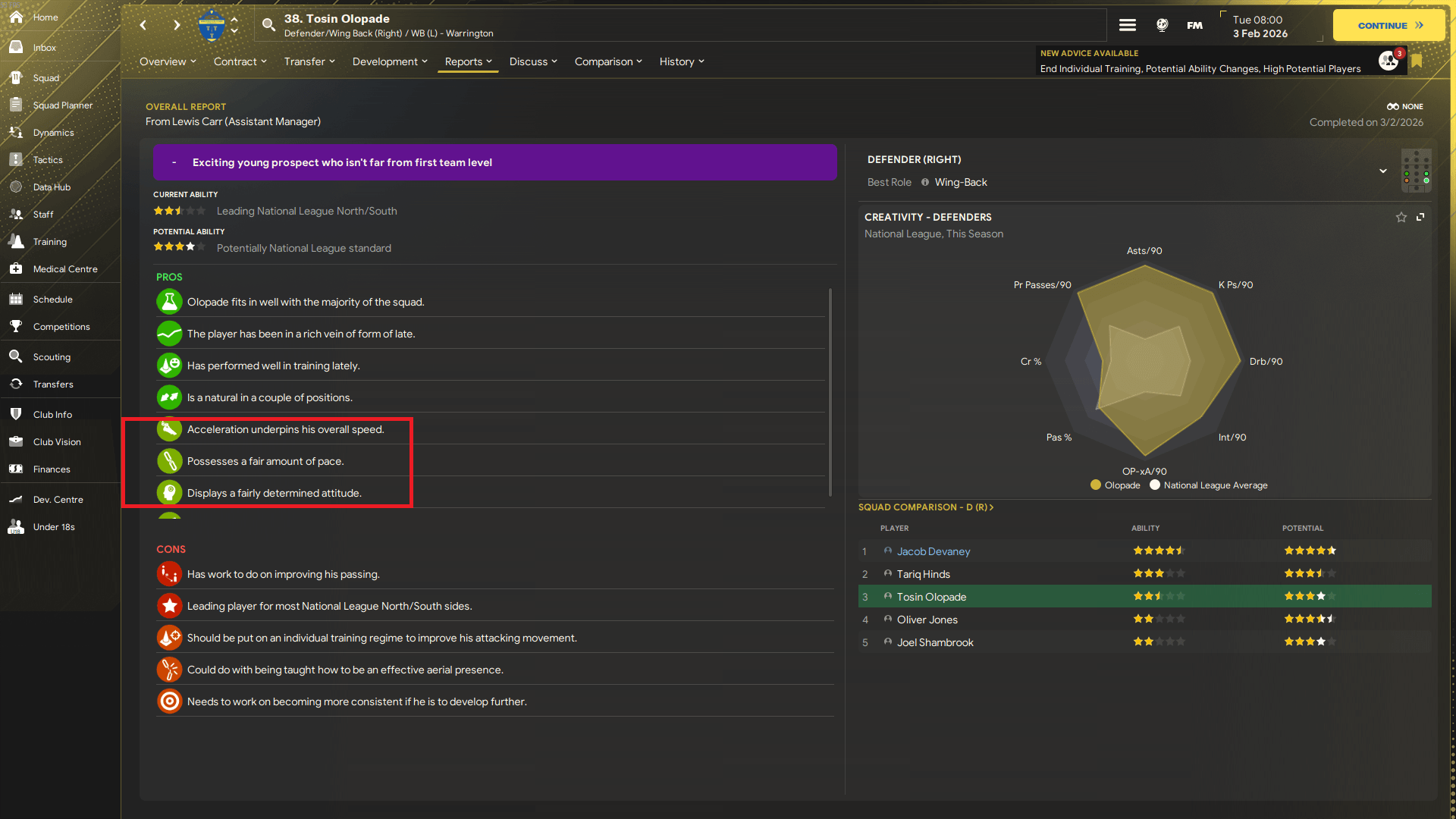
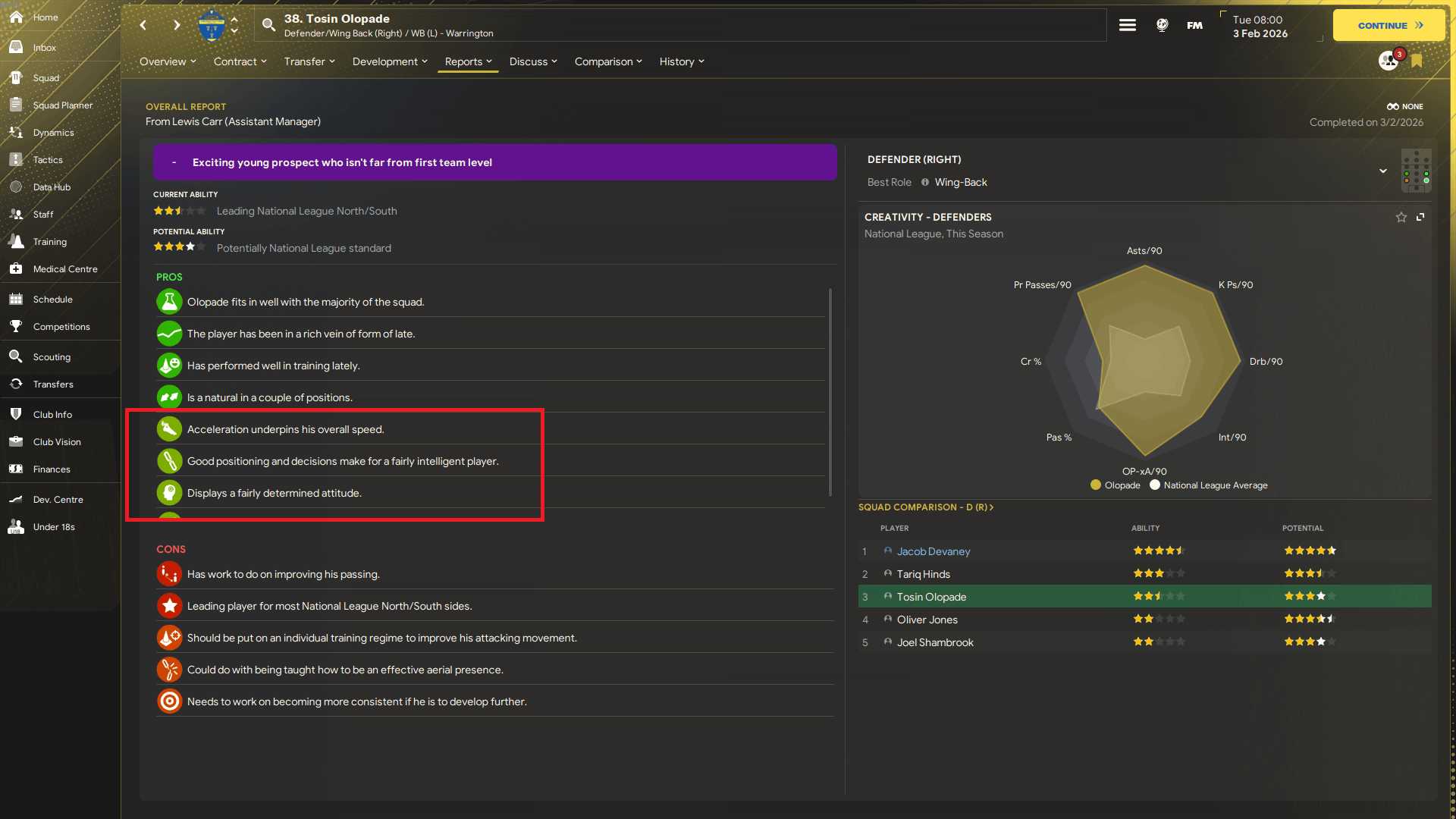
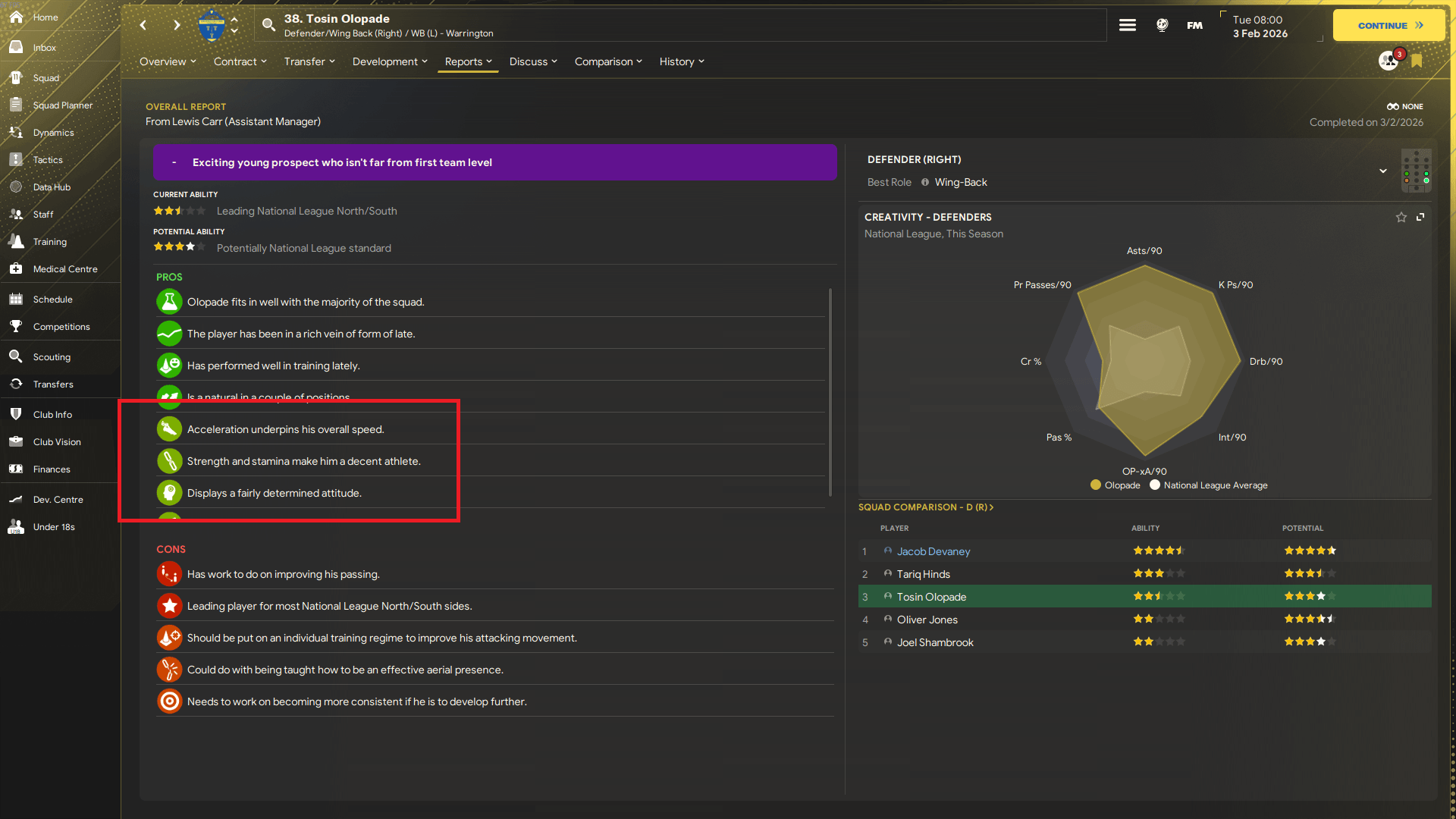
Now I'm not saying that the game uses the same aggregation/scaling in the match engine--the only place that I've found it make a difference is the coach report (see below; this is me hacking the return value from the function so it thinks groups 9, 8 and 3 are this player's best)--but it's worth bearing in mind. I'm going to keep this line of enquiry up and I'll report back anything I learn.
Expand Although what you discovered isn't exactly the golden ticket we are looking for, it's nonetheless a significant insight for me.
Perhaps it's something obvious to a programmer, but as someone who doesn't know programming and couldn't make heads or tails of the code before, finding out what the attributes are called in the code gives me a solid foothold to work with.
I spent a while trying to find attribute combos in the code using this info. I came across a few intriguing ones, such as Reflexes interacting with CommandOfArea for some reason, but no clear formula I'm looking for. Strangely 'versatility' seems to interact with certain other attributes, but maybe I'm just misinterpreting what the code is about. Even without the formula, these attribute associations are perhaps useful clues for forming hypotheses to test about attributes.
Another thing I noticed is that there are references to four-letter names such as 'TrDp' (made-up example), after translating it into plain english with AI. If anyone else has a go at it, I know from previously trying to find the newgen mechanics in the code that these four-letter names are the shorthand they use for the actual mechanic. So a real example of this for instance is you can change the fitness heart icon back to fitness % by changing the mechanic it reads from 'PcOI' to 'PCRF' in the skin. If you go through the other game files, you can find a bunch of these four letter names, even ones that are meant to be hidden mechanics.
So I think I already found an example of say TrDp = anticipation + work rate, where if TrDp was what you were interested in finding out the formula for, you'd have your answer.
I reckon that the attribute combinations, and other things like newgen mechanics, are lurking in there waiting to be found.
GeorgeFloydOverdosed said: Although what you discovered isn't exactly the golden ticket we are looking for, it's nonetheless a significant insight for me.
Perhaps it's something obvious to a programmer, but as someone who doesn't know programming and couldn't make heads or tails of the code before, finding out what the attributes are called in the code gives me a solid foothold to work with. Expand
I'm sorry to say that all the names in my post were given by me. There's nothing in the code I shared that names attributes or the groups they belong to (although you could infer them by reading the exact scout report detail they lead to).
The names in this post came straight from the qme_stat_relevant_attribute_data file in simatch.fmf though.
LightningFlik said: I'm sorry to say that all the names in my post were given by me. There's nothing in the code I shared that names attributes or the groups they belong to (although you could infer them by reading the exact scout report detail they lead to). Expand Hm.. isn't it the case though that 0x239 = acceleration?
Based on something my LLM said, it did occur to me that perhaps 0x239 just represents a generic offset (i.e. read ahead 0x239 amount starting at param1), but I saw interactions between attributes in lines of the code that made sense it was referring to specific attributes (i.e. I saw 0x244 (Aggression) with 0x240 (Dirtiness)).
I know your #defines list isn't the code itself, but you've nonetheless identified 0x239 effectively means acceleration, no?
Yes that's right. Everything in constants.h is right, that's from my app which scouts players in memory. I'm saying the names I gave to the attribute groups were made up by me.
Also I may have found the location in code where role/position suitability is calculated, but I can't get the code to fire in the course of the game, so testing it is proving difficult. It looks like that's what it's doing though.
LightningFlik said: Yes that's right. Everything in constants.h is right, that's from my app which scouts players in memory. I'm saying the names I gave to the attribute groups were made up by me.
Also I may have found the location in code where role/position suitability is calculated, but I can't get the code to fire in the course of the game, so testing it is proving difficult. It looks like that's what it's doing though. Expand So just to clarify, it is the case that 0x239 = acceleration, right?
What led you to 0x0144b40180 anyway? I've been looking through instances of 0x239 for example for something interesting, but maybe there's a better way of going about it
Would be interested in seeing the suspected role location
Correct. The game stores various objects in memory (Person, Player, Staff, Club, Team, Nation, Competition and so on) and 0x239 is the offset from the start of any given Player object where acceleration is stored. You can trust the offsets defined in my constants file.
I opened Cheat Engine, went to the memory address of a known player (which my scouting app told me) and added a "Tell me what read from this address" breakpoint on the player's acceleration. One of the instructions was the one I quoted in my code snippet here. I noticed the function actually hit a lot of offsets and learned it was combining and multiplying them in various ways.
This is something you led me to last night, with this comment:
GeorgeFloydOverdosed said: I spent a while trying to find attribute combos in the code using this info. I came across a few intriguing ones, such as Reflexes interacting with CommandOfArea for some reason, but no clear formula I'm looking for. Expand
I wondered what you were talking about so I searched the FM binary for "Command", "CommandOfArea" and "Command_of_Area".
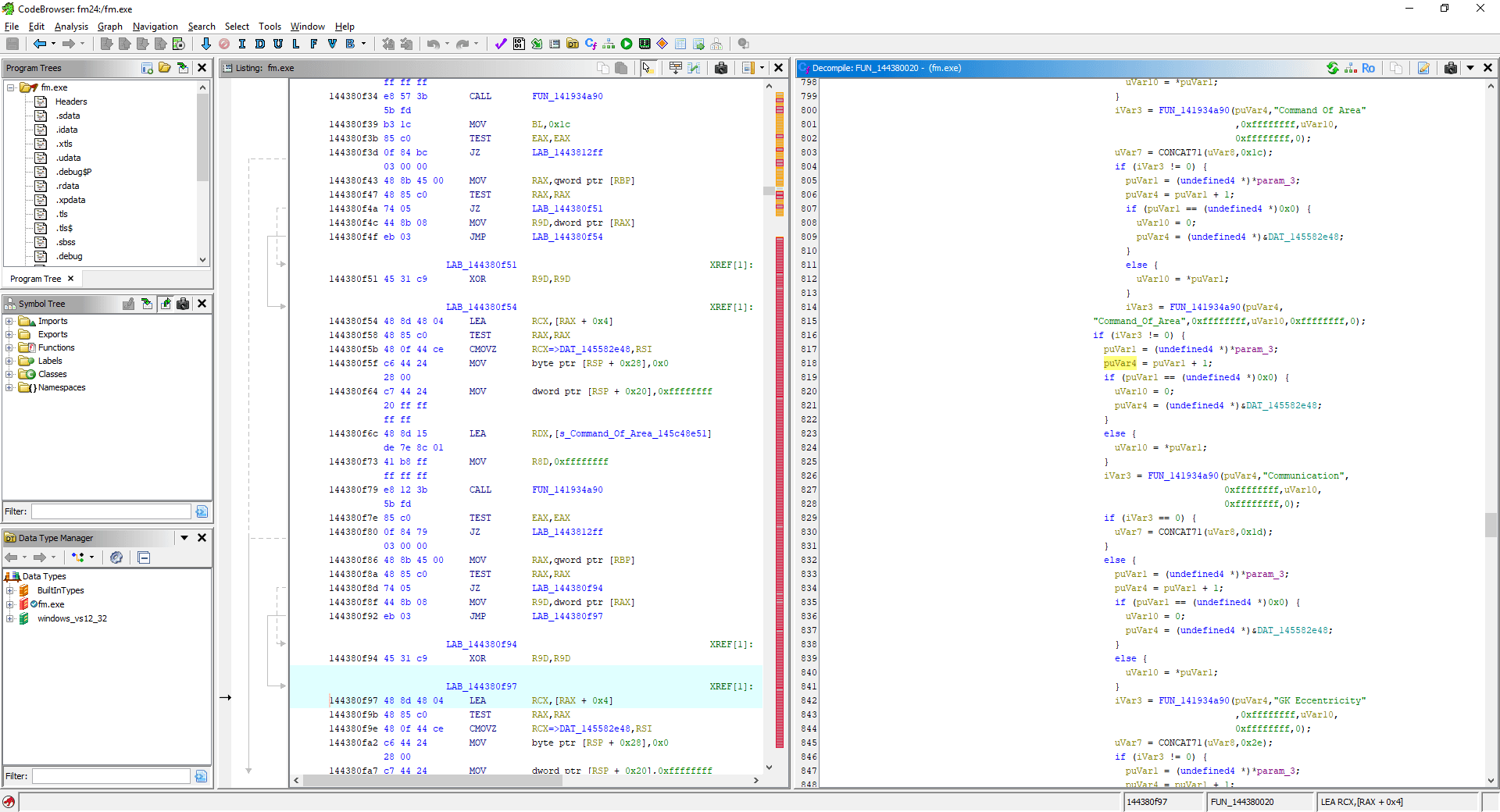
"Command_Of_Area" is a hard-coded string at memory location 0x145c48e51 and it is used in only one location: 0x144380f6c. I can't copy and paste the whole thing but as soon as I saw it, I was intrigued.
It looks like it's taking a bunch of attribute names, feeding them in to a function and then getting a value back from them. Reading player attributes? Surely not, they're stored in a Player object in memory and accessed through offsets, not by string.
I looked at what called that function and got one hit: 0x14231dcd7.
It's a very boring looking function but then I noticed some strange looking memory addresses on lines 16, 33 and 50. I looked closer and realised they're not memory addresses, they're the words "posi", "attr" and "weig" represented as numbers (i.e. the character codes for each letter have been concatenated to make a 4 byte number). This intrigued me further.
I went back to the previous function (the one that read in attributes and did something with them) and noticed the bottom: the game reads in string references to player positions (e.g. DL, AMRL, SW) and it takes those plus the values read in above and feeds them in to another function.
Given all this, I'm convinced it is determining some sort of relationship between positions and attributes. Problem is, I can't find when the code is executed. I've put breakpoints all around it and they never fire. Is the code unreachable and unused? Does it fire when the game first loads, before I get a chance to attach Cheat Engine to it? (I can test this by launching the game with a debugger already attached, which I will do after work). Is it legacy code? (This wouldn't necessarily surprise me, I've found some legacy stuff already (around a mechanic called Match Boost in training modules that never seems to get used)).
Thank you for all these discoveries, small question that i have, do staff have any relevant role in player development, i tend to try and have the best staff there is, but with all you all discovered im not sure if it really matters or not. Assitant managers, scouts, phisios, all that, does it really matter? Thank you
That's not 10%. To get 10% he'd need to divide goals prevented by xG: 1 / (1 + 9). Not sure which one of these he actually wanted though. Still, it's interesting so far.
Gerrard said: Expand I came here today with the intention of making an assessment of this video lol
Very interesting findings
Flair is strongly negatively correlated with possession won for midfielders. Is this because of the attribute itself altering the role, or the high flair causing a low-possession-won role to be selected? And then, does more possession won lead to more or less wins?
I think overall this can actually be triangulated with the key attribute template and EF 424 IF HP V2 P101 AC tactic to determine what tactical measures are beneficial and which are detrimental, and then refine the key attributes - to per position specificity - based on that. Perhaps it might even clue us into how the tactic can be edged out too.
We see that flair and off-the-ball have good & bad results for different positions/measures. And he finds bravery & one-on-ones for GK were significant in relation to goals conceded. So I will do some testing to see.
There are some caveats to his conclusions I think most will miss. For instance, the GK goals conceded thing, isn't actually measuring team goals conceded, and finishing produces more goals on wingers, but that doesn't mean the team scores more goals as a whole (my own testing on finishing shows that it simply take off goals from ST and give it to the winger).
But there's a lot of valid and potentially fresh information in it.
How do you feel about the premise that different positions require different attributes? I know that flies in the face of your theory of a generalised make-up (last I checked, anyway). I thought for a while that the positional requirements of attributes was overblown because FM always punishes me for expecting too much of it.
Now I'm unsure, but I've had great success promoting Warrington up the leagues using your old, old weights.
I just can't find where that code above is executed. I've decided to search for "weig" in hopes that I can find somewhere else in the code where that logic is performed. In doing so, I've found the nuttiest string references in the binary. What the actual hell is in this game?
EDIT: one more. I actually googled the strings in this one and found a medical website with the exact same strings. I'd love to talk to one of the people who worked on this game and ask exactly what directory they've accidentally included in their build pipeline on this project.
Maggh said: Thank you for all these discoveries, small question that i have, do staff have any relevant role in player development, i tend to try and have the best staff there is, but with all you all discovered im not sure if it really matters or not. Assitant managers, scouts, phisios, all that, does it really matter? Thank you Expand I would surmise overall that most staff do matter moderately, both for growth and performance. It can also matter for players being willing to sign for your club.
People are going to have different impressions, but for me I'd say staff are about 70% as impactful as I'd intuitively think they should be.
LightningFlik said: How do you feel about the premise that different positions require different attributes? I know that flies in the face of your theory of a generalised make-up (last I checked, anyway). I thought for a while that the positional requirements of attributes was overblown because FM always punishes me for expecting too much of it.
Now I'm unsure, but I've had great success promoting Warrington up the leagues using your old, old weights. Expand Before I played around with tactics, I would have made this critique of his findings, citing my attribute brute force testing, but now I am more open to the idea again of there being positional differences.
My impression now is that what is going on is that the Knap tactic favors a certain set of attributes, and this would extend to all the very similar top tactics in general (different roles or even formations, but all high pressing/intensity).
So if you play a defensive tactic, maybe then positioning would matter. Thing is, all defensive tactics lose. So effectively positioning never matters.
So it can be true at the same time that (1) only certain attributes matter for winning games, and (2) different tactics need different attributes.
Now I have tried positional variation in my attribute tests with the Knap tactic, and found there isn't any I can see (this is after being convinced for the longest time that concentration mattered for defenders but not forwards), but it's possible I am mistaken on one or two, or perhaps I didn't try the right combo (i.e. maybe I tested flair alone on ST, but not flair alone on MC).
I'll be doing some tests today based on Mustermann's findings, so we'll see if there are in fact position differences that actually increase/decrease win rate.
LightningFlik said: I just can't find where that code above is executed. I've decided to search for "weig" in hopes that I can find somewhere else in the code where that logic is performed. In doing so, I've found the nuttiest string references in the binary. What the actual hell is in this game?
Expand That's funny
I wonder what they've included that brought that stuff into it. I noticed there was some chinese characters, that links to a chinese website in the code for free template resources and whatnot - must be that they used an asset from it.
How did you get it to display the phrases as single lines like that? Maybe its cause I didn't let it fully finish processing I guess.
GeorgeFloydOverdosed said: How did you get it to display the phrases as single lines like that? Maybe its cause I didn't let it fully finish processing I guess. Expand Maybe Analysis -> One Shot -> ASCII Strings?
I know I did that at the start. Then I use Window -> Defined Strings to search.
Normal result is ~5th-7th, so perhaps a hint of a benefit to crossing in there due to the 1st which is not unprecedented but quite rare. Not quite enough to conclude crossing has any benefit though. I think a few more samples with high consistency & technique would settle this one way or the other.
No revelations here. Again, perhaps a very marginal benefit outweighed by CA cost, similar to strength or vision.
I forgot to change Man City's media expectation to 20th, hence the high rate of sackings. Doesn't invalidate the results, just means some samples are semi-wasted (9th sacked means they wont end up first, but they could have ended up 4th say).
I am also doing this in FM24, not FM26, but I doubt that that is why he finds crossing matters and whatnot.
Have you (or anyone else) done research into how wage demand is calculated? I'm curious if there is a way to estimate how much a player "should" make (based on age, CA, reputation, or whatever else affects it). This would be helpful for quickly understanding whether or not I can afford a player/if a player is undervalued by the market.
johnconnerson said: Have you (or anyone else) done research into how wage demand is calculated? I'm curious if there is a way to estimate how much a player "should" make (based on age, CA, reputation, or whatever else affects it). This would be helpful for quickly understanding whether or not I can afford a player/if a player is undervalued by the market. Expand
No. Contract negotiations have not really been tested, mainly because noone has made an easily scalable and reproduceable testing framework.
Since the wage budget is near the cap, the player reduced his demands by nearly 75%.
Though, this may well be only for contract renewals (again, never tested).
There are some other comments in that post that could be tested (for instance, putting/keeping low salary players with the Star Player squad status, and see if it influences salary negotiations with actual players that could be Star Players for that team.
It's not an easy task as the same player will demand up to 10x less wages on last day of transfer window compared to first. Depends on too many variables although I'm sure some could be tested at least in the sense if they have influence or not.
Timing is definitely a big factor, interest also, whether the players currently has a club (even trial), what role you offer him, country, player reputation, league level/reputation, loyalty ...
Generally the best way is just to ask the agent or scout them. It's not 100% but gets you a ballpark figure at that moment. You can find lots of gems for very cheap wages and on the other hand below average players who demand a lot.
johnconnerson said: Have you (or anyone else) done research into how wage demand is calculated? I'm curious if there is a way to estimate how much a player "should" make (based on age, CA, reputation, or whatever else affects it). This would be helpful for quickly understanding whether or not I can afford a player/if a player is undervalued by the market. Expand
I'm intrigued enough by the question to look.
Here's a very quick test. There are three metrics for reputation in the game:
- Home - Current - World
Other websites can probably explain (or guess) what they do but I'm just here to see if they affect contract negotiations. (How could they not?) I'll play with the values (and use my unchanged player as a baseline) and record them below.
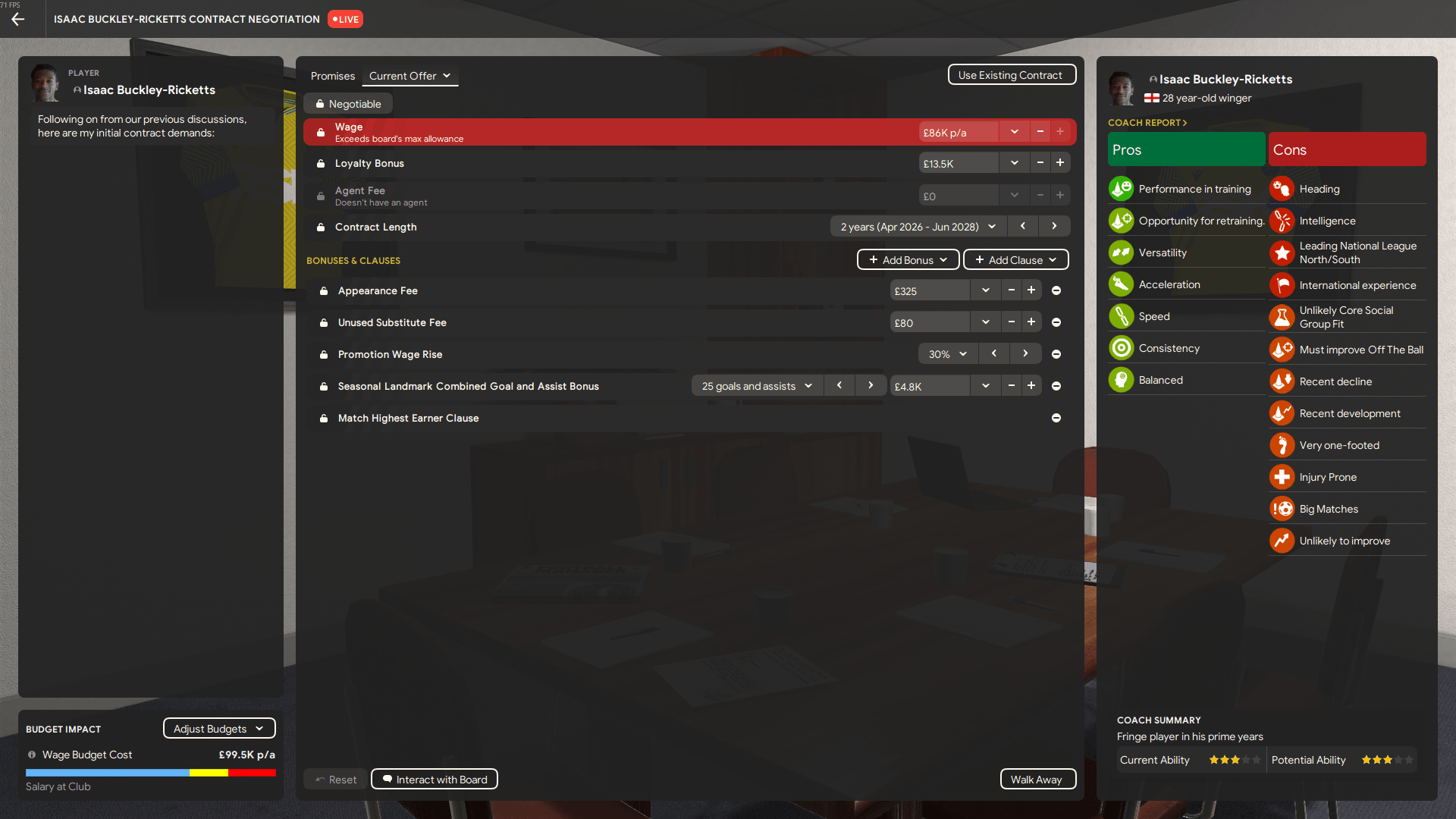
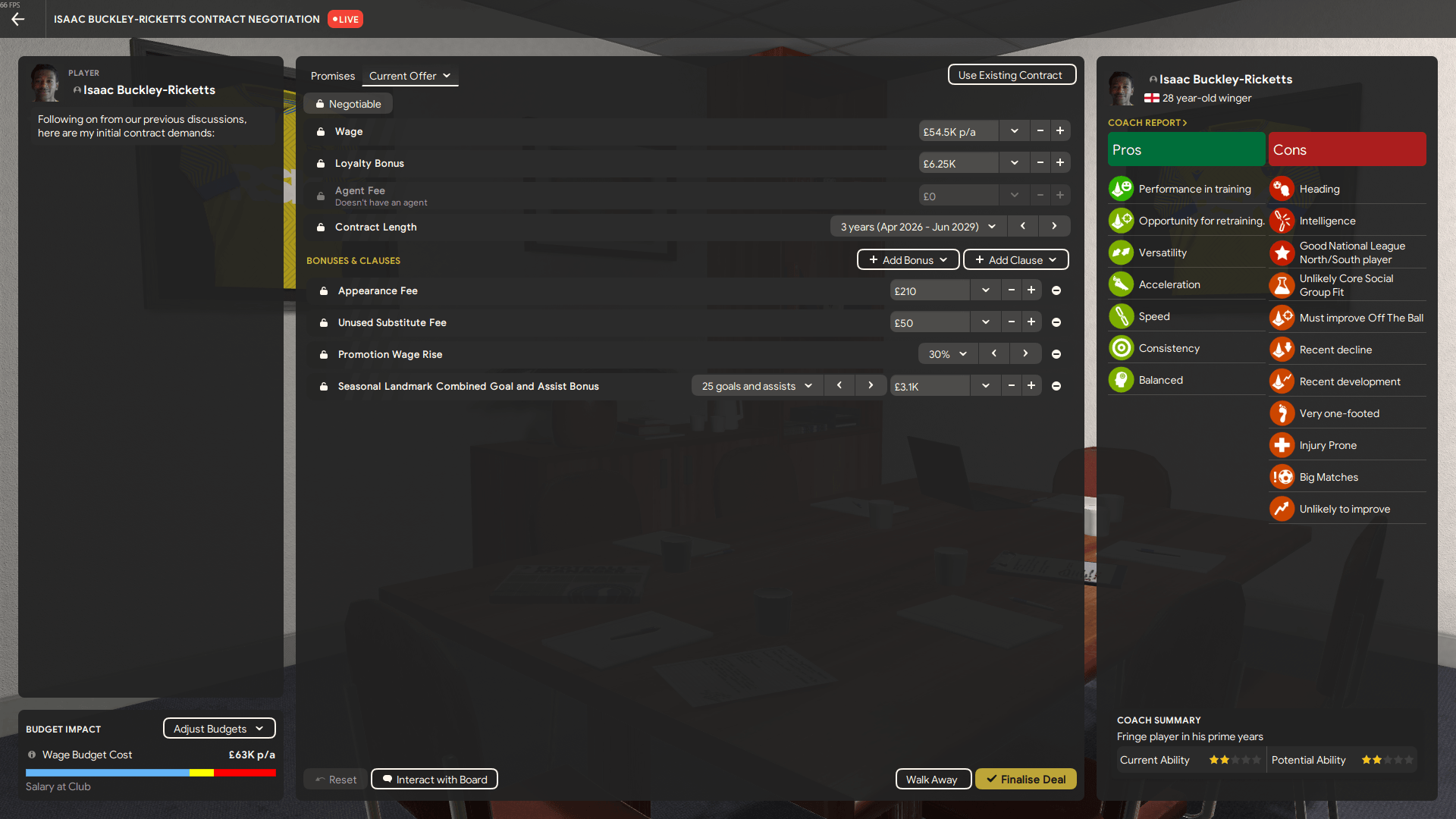
| Home rep | Current rep | World rep | Salary demand | 3,115 | 4,372 | 1,1911 | Important player, £53k p/a | 10,000 | 4,372 | 1,1911 | Important player, £55k p/a (plus small bonus increases) | 0 | 4,372 | 1,1911 | Same as baseline | 3,115 | 10,000 | 1,1911 | Wants to talk but thinks I can't afford him (1) | 3,115 | 0 | 1,1911 | Important player, £36k p/a (also his bonus demands have halved and the coach's estimation of his ability has decreased) | 3,115 | 4,372 | 10,1000 | Important player, £86k p/a (plus large bonus increases) | 3,115 | 4,372 | 0 | Important player, £51.5k p/a (plus small bonus decreases)
(1) This was true even after I adjusted my budget sliders and tried again and after I adjusted the club's reputation to be 10,000
N.b. after changing reputations I advance a few in-game hours so the system registers it
Other notes 1. I saw no change after setting my wage budget as low as it would go (£428k p/a) and as high as it would go (£1.2m p/a) even for the 10,000 world rep experiment. (But if someone on Reddit said it did then I'm not going to dispute that.) 2. World reputation is the only thing that changed the player's reputation on his Personal Information page. It was 5 grey stars ("Minimal" at 0 and 5 gold stars ("Exceptional" at 10,000. 3. It makes sense that Current Reputation would have such a big impact on demands + your star rating if it's meant to be the sense of how hot you are as a player. 4. I also tested the baseline player when the club had a reputation of 0 and 10,000.
0: Important player, £58k p/a 2,920 (baseline): Important player, £53k p/a 3,115 (player's home rep): Important player, £54k p/a 10,000: Important player, £64k p/a
5. I also tried setting the CA/PA of the player to various values:
6. I changed the manager's Home, Current and World reputations to 10,000 and it made no difference (although it made people like me more).
Here's a dump of screenshots showing (most) of the above. I know a lot of this might not be new information but it's a start.
Baseline
CA 120/120
Club rep 0
Club rep 10,000
Player current rep 0
Player current rep 10,000
Player home rep 0
Player home rep 10,000
Player world rep 10,000
EDIT: From reading the game's code I can tell you that the reputation of the league you're going to be playing in next season is a factor (or the current league, if next season's isn't decided yet). It's a minimal impact though, seemingly. If I tell Isaac that we're going to the Premier League next season instead of League Two, he asks for a tiny bit more money and his coach summary rating drops an entire star.
From the looks of the code, it seems like a few things are summed (reputations) and then scored (given a grade?) That is, I don't think changes are linear; I think you get bucketed in to discrete grades, which represent how strong your bargaining position is. After enough reputation points gained/lost, you might find yourself in the next bucket.
This has taken _far_ longer than I anticipated and I'm knackered so I might look at the actual calculations tomorrow (no promises though).
EDIT again: I can't help myself.
If you have a "Front End" Sugar Daddy, the player's demands increase. (+15 to the score it keeps track of).
Here's a very quick test. There are three metrics for reputation in the game:
- Home - Current - World
Other websites can probably explain (or guess) what they do but I'm just here to see if they affect contract negotiations. (How could they not?) I'll play with the values (and use my unchanged player as a baseline) and record them below.
| Home rep | Current rep | World rep | Salary demand | 3,115 | 4,372 | 1,1911 | Important player, £53k p/a | 10,000 | 4,372 | 1,1911 | Important player, £55k p/a (plus small bonus increases) | 0 | 4,372 | 1,1911 | Same as baseline | 3,115 | 10,000 | 1,1911 | Wants to talk but thinks I can't afford him (1) | 3,115 | 0 | 1,1911 | Important player, £36k p/a (also his bonus demands have halved and the coach's estimation of his ability has decreased) | 3,115 | 4,372 | 10,1000 | Important player, £86k p/a (plus large bonus increases) | 3,115 | 4,372 | 0 | Important player, £51.5k p/a (plus small bonus decreases)
(1) This was true even after I adjusted my budget sliders and tried again and after I adjusted the club's reputation to be 10,000
N.b. after changing reputations I advance a few in-game hours so the system registers it
Other notes 1. I saw no change after setting my wage budget as low as it would go (£428k p/a) and as high as it would go (£1.2m p/a) even for the 10,000 world rep experiment. (But if someone on Reddit said it did then I'm not going to dispute that.) 2. World reputation is the only thing that changed the player's reputation on his Personal Information page. It was 5 grey stars ("Minimal" at 0 and 5 gold stars ("Exceptional" at 10,000. 3. It makes sense that Current Reputation would have such a big impact on demands + your star rating if it's meant to be the sense of how hot you are as a player. 4. I also tested the baseline player when the club had a reputation of 0 and 10,000.
0: Important player, £58k p/a 2,920 (baseline): Important player, £53k p/a 3,115 (player's home rep): Important player, £54k p/a 10,000: Important player, £64k p/a
5. I also tried setting the CA/PA of the player to various values:
6. I changed the manager's Home, Current and World reputations to 10,000 and it made no difference (although it made people like me more).
Here's a dump of screenshots showing (most) of the above. I know a lot of this might not be new information but it's a start.
Baseline
CA 120/120
Club rep 0
Club rep 10,000
Player current rep 0
Player current rep 10,000
Player home rep 0
Player home rep 10,000
Player world rep 10,000
EDIT: From reading the game's code I can tell you that the reputation of the league you're going to be playing in next season is a factor (or the current league, if next season's isn't decided yet). It's a minimal impact though, seemingly. If I tell Isaac that we're going to the Premier League next season instead of League Two, he asks for a tiny bit more money and his coach summary rating drops an entire star.
From the looks of the code, it seems like a few things are summed (reputations) and then scored (given a grade?) That is, I don't think changes are linear; I think you get bucketed in to discrete grades, which represent how strong your bargaining position is. After enough reputation points gained/lost, you might find yourself in the next bucket.
This has taken _far_ longer than I anticipated and I'm knackered so I might look at the actual calculations tomorrow (no promises though).
EDIT again: I can't help myself.
If you have a "Front End" Sugar Daddy, the player's demands increase. (+15 to the score it keeps track of). Expand I found out recently what the three different reps mean exactly. I've forgot it now, but I'll post it later on. I think it was explained in a 2011 guide by two of the developers.
But yeah, there's not much to go on in regards to what affects wage demands. Perhaps someone on Youtube has done it in the past few years. I haven't looked into it myself.
Interesting that the coach rating decreased with lower current rep. Wouldn't have thought that.
Some handy findings there. So CA matters and PA doesn't. Club rep and manager rep doesn't matter, would have expected somewhat otherwise.
You know, I'm thinking this could kind of be integrated into the rating system if you use FMSS. You could do something like add 'divide by current/world rep & CA' to the formula. Makes it more useful for gameplay.
So teamwork does appear to be doing something here. It shouldn't be above 5 after 9 samples otherwise.
There is upside to having it at high values, but not as much downside to lacking it completely (7th at '1', vs 9th for Aggression at '1' for example, and many other key attributes fare far worse at '1' ).
8 > 16 is quite a big jump for a relatively small position gain of ~2 position, but that's only +1.6 per outfield player.
Overall I would now classify teamwork an attribute of minor importance, above Strength but probably below Aggression. Or maybe equal to Aggression, since the test team has 11 Aggression and only manages ~5th-7th on average.
Another thing to note is that because the test team's outfield players are identical, it wouldn't be the case that teamwork is simply handing over the ball to the players with the better attributes.
I'll be testing it at 20 on all players again to see what results that shows.
So versatility doesn't seem to do much. Possibly a very slight benefit. Too hard to tell like crossing.
Dirtiness surprisingly did worse at '1'. Perhaps it just requires more samples, but even so, one would expect '1' dirtiness to do better than 5th-7th given its deduced importance based on real player performance. In comparing the real players, there is a significant difference between 8 and 2 dirtiness, so it's not just about it being under '10' say. Only possibility I can think of, aside from simply requiring more samples, is that perhaps dirtiness interacts with temperament and/or sportsmanship and/or controversy, where high dirtiness can be beneficial (more hard tackles) when machiavellian sociopath but not when prone to losing temper and getting red carded for no gain.
So teamwork does appear to be doing something here. It shouldn't be above 5 after 9 samples otherwise.
There is upside to having it at high values, but not as much downside to lacking it completely (7th at '1', vs 9th for Aggression at '1' for example, and many other key attributes fare far worse at '1' ).
8 > 16 is quite a big jump for a relatively small position gain of ~2 position, but that's only +1.6 per outfield player.
Overall I would now classify teamwork an attribute of minor importance, above Strength but probably below Aggression. Or maybe equal to Aggression, since the test team has 11 Aggression and only manages ~5th-7th on average.
Another thing to note is that because the test team's outfield players are identical, it wouldn't be the case that teamwork is simply handing over the ball to the players with the better attributes.
I'll be testing it at 20 on all players again to see what results that shows.
So versatility doesn't seem to do much. Possibly a very slight benefit. Too hard to tell like crossing.
Dirtiness surprisingly did worse at '1'. Perhaps it just requires more samples, but even so, one would expect '1' dirtiness to do better than 5th-7th given its deduced importance based on real player performance. In comparing the real players, there is a significant difference between 8 and 2 dirtiness, so it's not just about it being under '10' say. Only possibility I can think of, aside from simply requiring more samples, is that perhaps dirtiness interacts with temperament and/or sportsmanship and/or controversy, where high dirtiness can be beneficial (more hard tackles) when machiavellian sociopath but not when prone to losing temper and getting red carded for no gain. Expand
Feels like doing test in a real league like this is absolutely incorrect RNG do more then this changes huh You better make a test league with capped CA, same teams, tactics etc and do 100 samples imo
GeorgeFloydOverdosed said: Interesting that the coach rating decreased with lower current rep. Wouldn't have thought that. Expand
I've always suspected that the coach report is vibes-based, really. It makes sense to me that their current reputation (and possibly even form) influences it, as well as the relative strength of the league and team-mates. I don't for one minute think the game is telling me that a 4.5 star player is unquestionably better than a 4 star player.
GeorgeFloydOverdosed said: Club rep and manager rep doesn't matter, would have expected somewhat otherwise. Expand
This surprised me too. Anecdotally I am convinced that my manager's reputation is factored in when talking to players one-on-one (my manager is always bullied in conversations with players when starting from the bottom; after a few seasons though I can reliably threaten to sell any player I want to keep them in line).
I'm going to do more investigation on this tonight; I think maybe the function I was looking at last night was actually determining how long the player wants his contract to be. It returns a number 1, 2 or 3 and I thought it was grading your bargaining position, but now I think it's how long the player wants.
I should be spending time finishing my scouting tool but it would actually be incredibly useful reverse engineering the mechanisms behind this so I can search the entire database for players who are interested in joining.
iezzex said: Feels like doing test in a real league like this is absolutely incorrect RNG do more then this changes huh You better make a test league with capped CA, same teams, tactics etc and do 100 samples imo Expand Adding controls for FM testing often does more harm than it helps in my opinion.
Suppose you do test against teams that have 10 in every attribute. Well then a player of Jumping Reach 11 is going to beat them all, but then in the actual game, Jumping Reach 11 would get your team relegated. You can't take opposition players and tactics out of the equation.
Besides, this has been done. HarvestGreen uses this controlled kind of testing, and so does FM Arena - although I believe FM Arena is a little different where uses a representative set of competitive attributes for its opposition teams (i.e. 13 instead of 10).
Another angle I would tackle it from is that RNG is part of the game, and therefore must also be taken into account. So with teamwork for example, we see the RNG range is 2nd-8th. With real Luton, the top Knap tactic produces ~2nd-9th range.
It's worth pointing out that that RNG range for real Luton is actually easily squashed down a lot by pre-selecting the team so it uses the same players. If pre-selected, the range goes down to ~2nd-4th. So really the RNG is only about -/+1 position difference. People overestimate the impact of the RNG of this game IMO.
With the meta team but with Raheem Sterling replacing AMR, the variance is also very low, getting ~6th almost all the time.
Why does the meta team, having identical outfield players, have a increased variance of 2nd-8th, compared to the meta team with Sterling? Don't know, but keep in mind I'm not using pre-selection for my meta tests either.
Now regardless of whether it's RNG or player fitness or bad luck injuries or whatnot, let's just surmise the reality as this:
You can expect to vary ~2-6 positions each season from expectation. An average save might last say 6 seasons. Are you going to experience the difference between 10 and 15 pace in 6 seasons? Yes, very much so. Are you going to experience the difference between 10 and 15 teamwork in 6 seasons? Probably not really, but when you have 10 of these minor attributes together as part of a weighting system for buying/assessing players, then you will.
This also goes to why I don't think 100 samples is necessary. No one is playing 100 seasons. If I take 9 samples representing 9 seasons, and the end result is an uncertainty of -/+ 1.81 position, then that reflects the reality of normal play and it should be left at that.
Which is the more useful and relevant information?:
The life expectancy of a nation as 82.59 based on measurements of millions of people, or
As a 60 year old with a particular cancer my doctor has guesstimated I most likely have 5-7 years to live based on several similar cases he has seen, or
The doctor telling me 'its all random...we all die sometime anyway'
I’ve noticed there have been some new findings regarding FM26 recently. What do you make of them?
We’re getting very close to FM27 now, so do you think these discoveries could have any real impact? And are you planning to release PL 2.2 as a result of them?
Suppose you do test against teams that have 10 in every attribute. Well then a player of Jumping Reach 11 is going to beat them all, but then in the actual game, Jumping Reach 11 would get your team relegated. You can't take opposition players and tactics out of the equation.
Besides, this has been done. HarvestGreen uses this controlled kind of testing, and so does FM Arena - although I believe FM Arena is a little different where uses a representative set of competitive attributes for its opposition teams (i.e. 13 instead of 10).
Another angle I would tackle it from is that RNG is part of the game, and therefore must also be taken into account. So with teamwork for example, we see the RNG range is 2nd-8th. With real Luton, the top Knap tactic produces ~2nd-9th range.
It's worth pointing out that that RNG range for real Luton is actually easily squashed down a lot by pre-selecting the team so it uses the same players. If pre-selected, the range goes down to ~2nd-4th. So really the RNG is only about -/+1 position difference. People overestimate the impact of the RNG of this game IMO.
With the meta team but with Raheem Sterling replacing AMR, the variance is also very low, getting ~6th almost all the time.
Why does the meta team, having identical outfield players, have a increased variance of 2nd-8th, compared to the meta team with Sterling? Don't know, but keep in mind I'm not using pre-selection for my meta tests either.
Now regardless of whether it's RNG or player fitness or bad luck injuries or whatnot, let's just surmise the reality as this:
You can expect to vary ~2-6 positions each season from expectation. An average save might last say 6 seasons. Are you going to experience the difference between 10 and 15 pace in 6 seasons? Yes, very much so. Are you going to experience the difference between 10 and 15 teamwork in 6 seasons? Probably not really, but when you have 10 of these minor attributes together as part of a weighting system for buying/assessing players, then you will.
This also goes to why I don't think 100 samples is necessary. No one is playing 100 seasons. If I take 9 samples representing 9 seasons, and the end result is an uncertainty of -/+ 1.81 position, then that reflects the reality of normal play and it should be left at that.
Which is the more useful and relevant information?:
The life expectancy of a nation as 82.59 based on measurements of millions of people, or
As a 60 year old with a particular cancer my doctor has guesstimated I most likely have 5-7 years to live based on several similar cases he has seen, or
The doctor telling me 'its all random...we all die sometime anyway' Expand
Well, a good point ngl
Also i feel like that some of counter type tactics which is meta are just designed for high pace physical players Better technical players may act better with posseios type tactic Untested, just a feeling based on my own long save team acting worse on meta ones
I’ve noticed there have been some new findings regarding FM26 recently. What do you make of them?
We’re getting very close to FM27 now, so do you think these discoveries could have any real impact? And are you planning to release PL 2.2 as a result of them?
Looking forward to hearing your thoughts! Expand I've addressed it further up the page, where I also retested a few of the attributes to be sure. Overall a good idea, but the correlations are simply clouding the correct insights. He's getting a bunch of attributes right, but also a few wrong (i.e. Crossing & Off the Ball), even if we test using his specific suggested positions.
Nonetheless it's still useful in several other ways. For instance, I was theorizing before that what leads to more sprints and pressures would perform better, because that is what the Knap tactic seems to favor. So I was initially excited to see his data, because it shows ostensibly what attributes contribute to sprints & pressures. But his correlations, which I don't dispute the validity of, on sprints & dribbles perhaps suggest that certain attributes inexplicably increase win rate even in spite of decreasing or doing little for sprints & pressures. That actually makes sense to me, because if you're a developer, you're probably likely to overlook that then or know about it but ignore it thinking users won't go for it because it makes no sense.
There won't be a Premier League 2.2 for a while. I feel it's at the standard I want it to be, and so I'm taking a break from that for now. If FM27 is any good, I'll probably do a new version for FM27. If not, it depends on how I feel.
iezzex said: Also i feel like that some of counter type tactics which is meta are just designed for high pace physical players Better technical players may act better with posseios type tactic Untested, just a feeling based on my own long save team acting worse on meta ones Expand It's possible, but I think unlikely. I usually always test with Knap tactic, but we know that other tactics do substantially worse with or without technically gifted players. I don't know Knap's methodology, but it's worth bearing in mind, if my following assumption is correct, that he is finding the best tactic based on the real top teams who are often highly technical, not the way I test with more barebones speed machines.
GerardFM24 said: Interesting topic that I will keep following.
Is there also such research about staff and staffroles,
Like what are the most important roles and which attribute are the best.
EBFM has important findings about various staff. This video shows the impact of coach attributes, which I would surmise as somewhat impactful but probably a fair bit less important than you would think.
From memory he also found that you only need 1 physio to get the full benefit, and it doesn't matter if this 1 physio has '1' physiotherapy. Hopefully I'm recalling that correctly. I think the idea is that a physio's attributes only estimate length of injury better, they can't actually reduce injury rate/length aside from their presence as a staff member.
For newgen impact, staff are mostly irrelevant. The only effect is that HoYD will influence 1-2 players coming in each intake with their personality. This possibly extends to other 'youth coaches' who supposedly have half this effect.
IMO an aspect that is emerging as important is stuff to do with tactical & team selection, because these appear to significantly influence winning - even if it's just selecting between similar players you have in your squad. So tactical knowledge, judging player ability, motivating for whoever you set the relevant responsibility for. One thing this would mean in practice is getting an assistant manager who is a great manager, rather than great coach.
LightningFlik said: I want to share something of potential interest.
I've been disassembling the "fm.exe" application for FM 24, which means I've turned the machine code back in to something resembling C so that I can look at it. I'm doing this because I want to find where shortlists/search results are stored in RAM so I can read them in my scouting tool but I might have found something else.
There's a function beginning at memory address 0x0144b40180 (at least in my Windows, Steam copy of FM 24.4.2+2081827), which appears to be grouping together player attributes and scoring them. I'll share the approximated C code here (feel free to ask Chat GPT what it means) as well as what I think it's doing. If you do feed this in to an LLM to decipher, give it this file too. That will map the offset codes (e.g. 0x23d, Pace) to the player's actual attributes.
From what I can see, this code is reading player attributes in groups, multiplying them together and creating a score for each group. It then returns the highest scoring group and the group itself.
For example, starting on line 65 of the code snippet:
Spoiler sVar1 = (short)((uint)(*(char *)(param_1 + 0x239) * 0x6667 + 0xccce) >> 0x10);
uVar8 = (sVar1 >> 1) - (sVar1 >> 0xf);
if ((short)uVar8 < 2) {
uVar8 = 1;
}
uVar6 = (uint)uVar8;
if (0x13 < uVar6) {
uVar6 = 0x14;
}
sVar1 = (short)((uint)(*(char *)(param_1 + 0x23d) * 0x6667 + 0xccce) >> 0x10);
uVar8 = (sVar1 >> 1) - (sVar1 >> 0xf);
if ((short)uVar8 < 2) {
uVar8 = 1;
}
uVar11 = 0x14;
if (uVar8 < 0x14) {
uVar11 = (uint)uVar8;
}
if ((int)(short)uVar2 < (int)((uVar11 + uVar6) * 5)) {
uVar2 = (short)(uVar11 + uVar6) * 5;
*param_2 = uVar2;
uVar3 = CONCAT71((int7)((ulonglong)uVar3 >> 8),9);
}
- The lines beginning sVar1 = (short)((uint)(*(char *) read a different attribute from the Player entity (Acceleration and Pace in this example (0x239 and 0x23d)).
- The lines uVar8 = (sVar1 >> 1) - (sVar1 >> 0xf); divide the attribute by 2, rounding down.
- The next two if conditions ensure the number is between 1-20 inclusive.
- The final if condition sums uVar11 (which is Pace / 2) and uVar6 (which is Acceleration / 2) and then multiplies the value by 5. If that result is > uVar2 (which is the highest rating it has seen so far), then it sets that to be the highest rating (*param_2 = uVar2) and sets the return value of the function to be the category ID (9 in this case).
Now here's the exciting part: the attributes it groups together and how it scores them.
Group 1: Set pieces
((Corners + Free Kicks + Penalties + Long Throws) * 10) / 4
Group 2: Attacking technique
(Crossing + Finishing + Long Shots + Passing + Technique) * 2
Group 3: Attacking intelligence
((Anticipation + Vision + Decisions + Positioning) * 10) / 4
(Yes, positioning.)
Group 4: Leadership
((Bravery + Work Rate + Teamwork) * 10) / 3
Group 5: Defensive intelligence
((Tackling + Marking + Concentration + Positioning) * 10) / 4
Group 6: Technical control
(Flair + Dribbling + First Touch + Composure + Balance) * 2
Group 7: Aerial Ability
(Heading + Jumping Reach) * 5
Group 8: Physique
((Strength + Natural Fitness + Stamina + Agility) * 10) / 4
Group 9: Speed
(Acceleration + Pace) * 5
Now I'm not saying that the game uses the same aggregation/scaling in the match engine--the only place that I've found it make a difference is the coach report (see below; this is me hacking the return value from the function so it thinks groups 9, 8 and 3 are this player's best)--but it's worth bearing in mind. I'm going to keep this line of enquiry up and I'll report back anything I learn.
Although what you discovered isn't exactly the golden ticket we are looking for, it's nonetheless a significant insight for me.
Perhaps it's something obvious to a programmer, but as someone who doesn't know programming and couldn't make heads or tails of the code before, finding out what the attributes are called in the code gives me a solid foothold to work with.
I spent a while trying to find attribute combos in the code using this info. I came across a few intriguing ones, such as Reflexes interacting with CommandOfArea for some reason, but no clear formula I'm looking for. Strangely 'versatility' seems to interact with certain other attributes, but maybe I'm just misinterpreting what the code is about. Even without the formula, these attribute associations are perhaps useful clues for forming hypotheses to test about attributes.
Another thing I noticed is that there are references to four-letter names such as 'TrDp' (made-up example), after translating it into plain english with AI. If anyone else has a go at it, I know from previously trying to find the newgen mechanics in the code that these four-letter names are the shorthand they use for the actual mechanic. So a real example of this for instance is you can change the fitness heart icon back to fitness % by changing the mechanic it reads from 'PcOI' to 'PCRF' in the skin. If you go through the other game files, you can find a bunch of these four letter names, even ones that are meant to be hidden mechanics.
So I think I already found an example of say TrDp = anticipation + work rate, where if TrDp was what you were interested in finding out the formula for, you'd have your answer.
I reckon that the attribute combinations, and other things like newgen mechanics, are lurking in there waiting to be found.
GeorgeFloydOverdosed said: Although what you discovered isn't exactly the golden ticket we are looking for, it's nonetheless a significant insight for me.
Perhaps it's something obvious to a programmer, but as someone who doesn't know programming and couldn't make heads or tails of the code before, finding out what the attributes are called in the code gives me a solid foothold to work with.
I'm sorry to say that all the names in my post were given by me. There's nothing in the code I shared that names attributes or the groups they belong to (although you could infer them by reading the exact scout report detail they lead to).
The names in this post came straight from the qme_stat_relevant_attribute_data file in simatch.fmf though.
LightningFlik said: I'm sorry to say that all the names in my post were given by me. There's nothing in the code I shared that names attributes or the groups they belong to (although you could infer them by reading the exact scout report detail they lead to).
Hm.. isn't it the case though that 0x239 = acceleration?
Based on something my LLM said, it did occur to me that perhaps 0x239 just represents a generic offset (i.e. read ahead 0x239 amount starting at param1), but I saw interactions between attributes in lines of the code that made sense it was referring to specific attributes (i.e. I saw 0x244 (Aggression) with 0x240 (Dirtiness)).
I know your #defines list isn't the code itself, but you've nonetheless identified 0x239 effectively means acceleration, no?
Yes that's right. Everything in constants.h is right, that's from my app which scouts players in memory. I'm saying the names I gave to the attribute groups were made up by me.
Also I may have found the location in code where role/position suitability is calculated, but I can't get the code to fire in the course of the game, so testing it is proving difficult. It looks like that's what it's doing though.
LightningFlik said: Yes that's right. Everything in constants.h is right, that's from my app which scouts players in memory. I'm saying the names I gave to the attribute groups were made up by me.
Also I may have found the location in code where role/position suitability is calculated, but I can't get the code to fire in the course of the game, so testing it is proving difficult. It looks like that's what it's doing though.
So just to clarify, it is the case that 0x239 = acceleration, right?
What led you to 0x0144b40180 anyway?
I've been looking through instances of 0x239 for example for something interesting, but maybe there's a better way of going about it
Would be interested in seeing the suspected role location
GeorgeFloydOverdosed said: So just to clarify, it is the case that 0x239 = acceleration, right?

Correct. The game stores various objects in memory (Person, Player, Staff, Club, Team, Nation, Competition and so on) and 0x239 is the offset from the start of any given Player object where acceleration is stored. You can trust the offsets defined in my constants file.
GeorgeFloydOverdosed said: What led you to 0x0144b40180 anyway
I opened Cheat Engine, went to the memory address of a known player (which my scouting app told me) and added a "Tell me what read from this address" breakpoint on the player's acceleration. One of the instructions was the one I quoted in my code snippet here. I noticed the function actually hit a lot of offsets and learned it was combining and multiplying them in various ways.
GeorgeFloydOverdosed said: Would be interested in seeing the suspected role location
This is something you led me to last night, with this comment:
GeorgeFloydOverdosed said: I spent a while trying to find attribute combos in the code using this info. I came across a few intriguing ones, such as Reflexes interacting with CommandOfArea for some reason, but no clear formula I'm looking for.
I wondered what you were talking about so I searched the FM binary for "Command", "CommandOfArea" and "Command_of_Area".
"Command_Of_Area" is a hard-coded string at memory location 0x145c48e51 and it is used in only one location: 0x144380f6c. I can't copy and paste the whole thing but as soon as I saw it, I was intrigued.
It looks like it's taking a bunch of attribute names, feeding them in to a function and then getting a value back from them. Reading player attributes? Surely not, they're stored in a Player object in memory and accessed through offsets, not by string.
I looked at what called that function and got one hit: 0x14231dcd7.
It's a very boring looking function but then I noticed some strange looking memory addresses on lines 16, 33 and 50. I looked closer and realised they're not memory addresses, they're the words "posi", "attr" and "weig" represented as numbers (i.e. the character codes for each letter have been concatenated to make a 4 byte number). This intrigued me further.
I went back to the previous function (the one that read in attributes and did something with them) and noticed the bottom: the game reads in string references to player positions (e.g. DL, AMRL, SW) and it takes those plus the values read in above and feeds them in to another function.
Given all this, I'm convinced it is determining some sort of relationship between positions and attributes. Problem is, I can't find when the code is executed. I've put breakpoints all around it and they never fire. Is the code unreachable and unused? Does it fire when the game first loads, before I get a chance to attach Cheat Engine to it? (I can test this by launching the game with a debugger already attached, which I will do after work). Is it legacy code? (This wouldn't necessarily surprise me, I've found some legacy stuff already (around a mechanic called Match Boost in training modules that never seems to get used)).
Thank you for all these discoveries, small question that i have, do staff have any relevant role in player development, i tend to try and have the best staff there is, but with all you all discovered im not sure if it really matters or not. Assitant managers, scouts, phisios, all that, does it really matter? Thank you
I assume it makes no difference to the results but I'm pretty sure that custom goalkeeper metric is wrong.
It says "+10% means the keeper conceded 10% fewer than expected."
If I faced 10 goals and only conceded 9 then I've conceded 10% fewer than expected, In this formula though...
(1 expected goal prevented + 9 conceded) / 9 conceded
10 / 9
11.11%
That's not 10%. To get 10% he'd need to divide goals prevented by xG: 1 / (1 + 9). Not sure which one of these he actually wanted though. Still, it's interesting so far.
Gerrard said:
I came here today with the intention of making an assessment of this video lol
Very interesting findings
Flair is strongly negatively correlated with possession won for midfielders. Is this because of the attribute itself altering the role, or the high flair causing a low-possession-won role to be selected? And then, does more possession won lead to more or less wins?
I think overall this can actually be triangulated with the key attribute template and EF 424 IF HP V2 P101 AC tactic to determine what tactical measures are beneficial and which are detrimental, and then refine the key attributes - to per position specificity - based on that. Perhaps it might even clue us into how the tactic can be edged out too.
We see that flair and off-the-ball have good & bad results for different positions/measures. And he finds bravery & one-on-ones for GK were significant in relation to goals conceded. So I will do some testing to see.
There are some caveats to his conclusions I think most will miss. For instance, the GK goals conceded thing, isn't actually measuring team goals conceded, and finishing produces more goals on wingers, but that doesn't mean the team scores more goals as a whole (my own testing on finishing shows that it simply take off goals from ST and give it to the winger).
But there's a lot of valid and potentially fresh information in it.
GeorgeFloydOverdosed said: Very interesting findings
How do you feel about the premise that different positions require different attributes? I know that flies in the face of your theory of a generalised make-up (last I checked, anyway). I thought for a while that the positional requirements of attributes was overblown because FM always punishes me for expecting too much of it.
Now I'm unsure, but I've had great success promoting Warrington up the leagues using your old, old weights.
I just can't find where that code above is executed. I've decided to search for "weig" in hopes that I can find somewhere else in the code where that logic is performed. In doing so, I've found the nuttiest string references in the binary. What the actual hell is in this game?
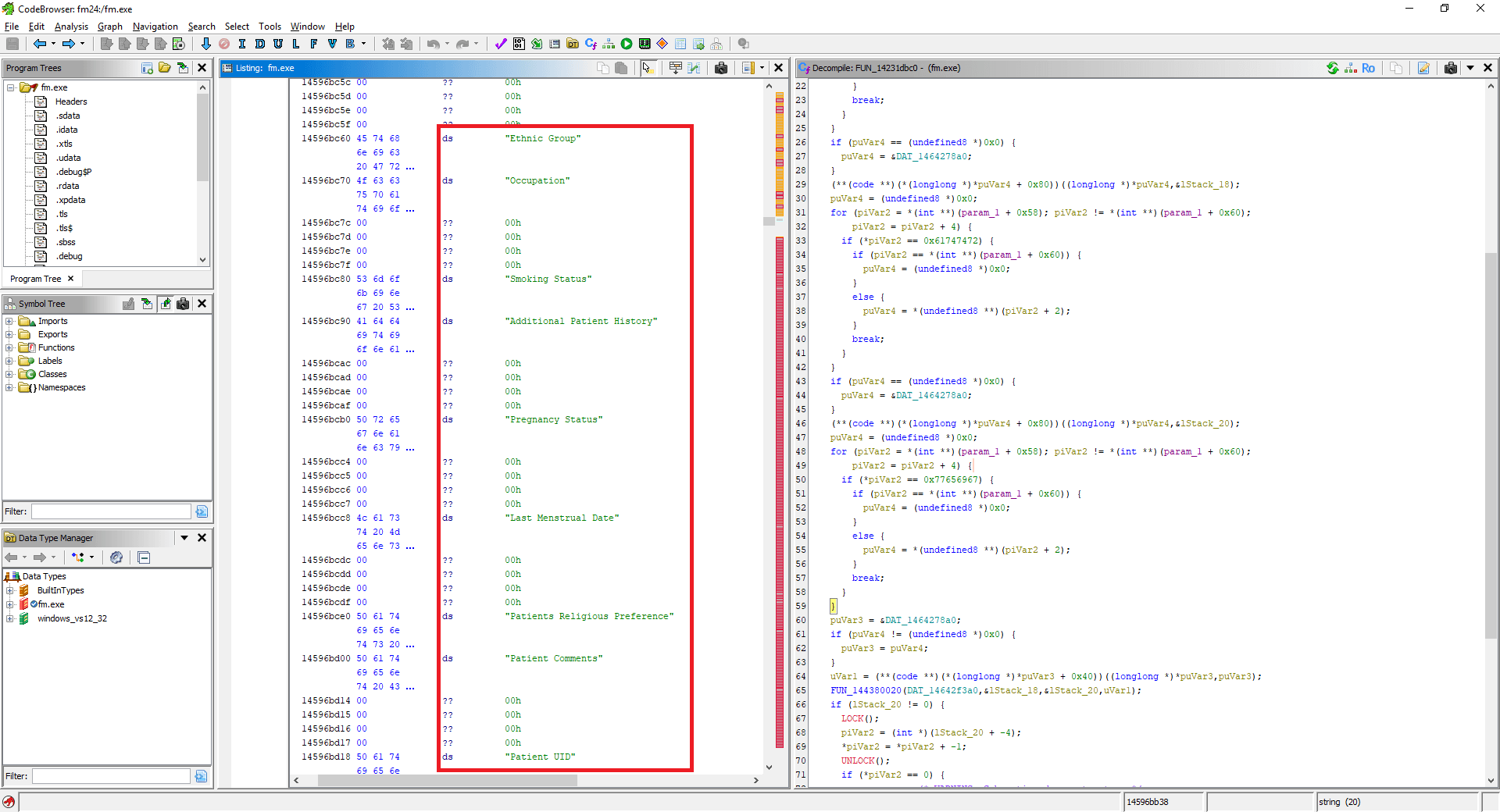

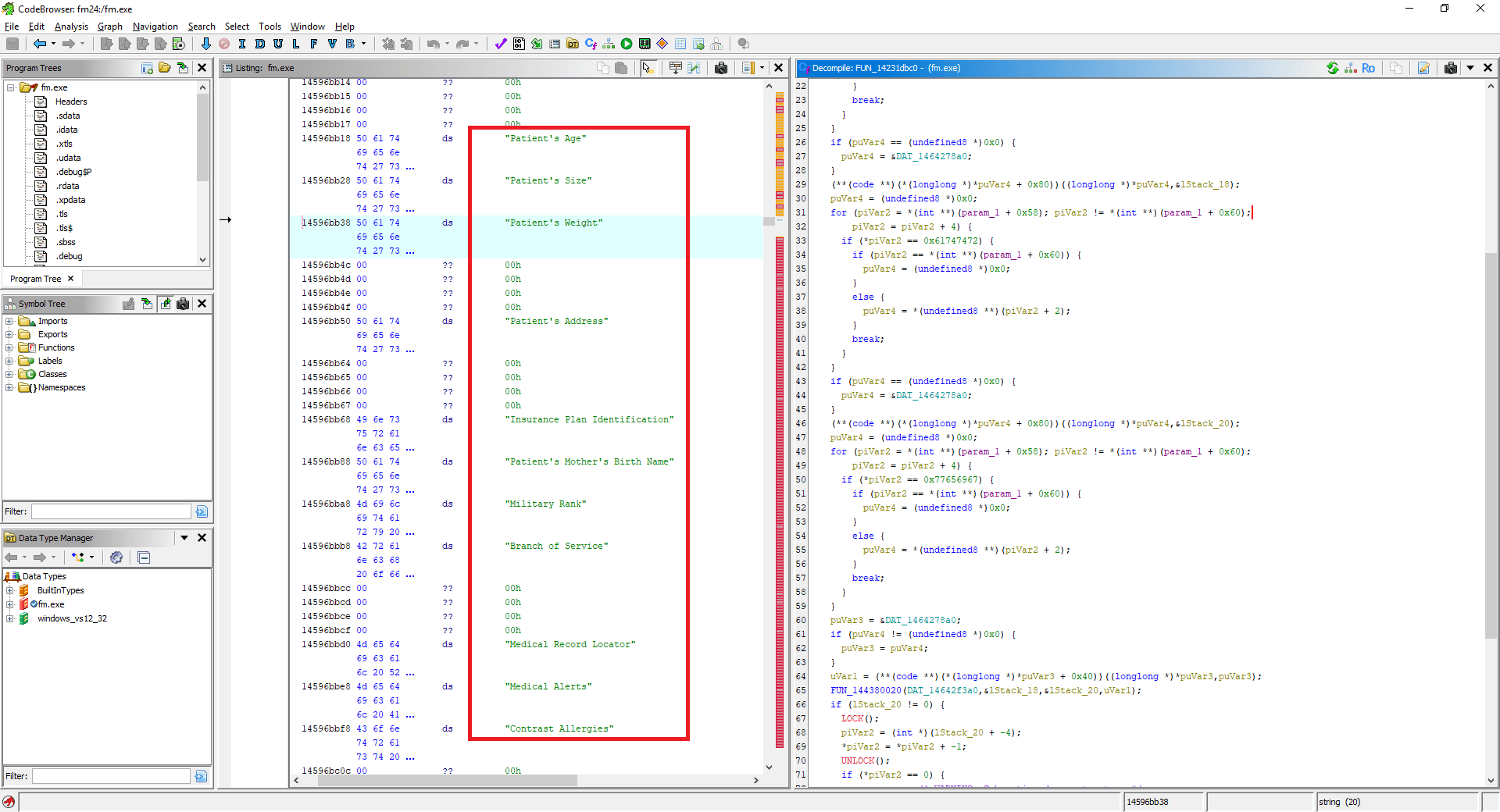

EDIT: one more. I actually googled the strings in this one and found a medical website with the exact same strings. I'd love to talk to one of the people who worked on this game and ask exactly what directory they've accidentally included in their build pipeline on this project.
Medical website
Maggh said: Thank you for all these discoveries, small question that i have, do staff have any relevant role in player development, i tend to try and have the best staff there is, but with all you all discovered im not sure if it really matters or not. Assitant managers, scouts, phisios, all that, does it really matter? Thank you
I would surmise overall that most staff do matter moderately, both for growth and performance. It can also matter for players being willing to sign for your club.
People are going to have different impressions, but for me I'd say staff are about 70% as impactful as I'd intuitively think they should be.
LightningFlik said: How do you feel about the premise that different positions require different attributes? I know that flies in the face of your theory of a generalised make-up (last I checked, anyway). I thought for a while that the positional requirements of attributes was overblown because FM always punishes me for expecting too much of it.



Now I'm unsure, but I've had great success promoting Warrington up the leagues using your old, old weights.
Before I played around with tactics, I would have made this critique of his findings, citing my attribute brute force testing, but now I am more open to the idea again of there being positional differences.
My impression now is that what is going on is that the Knap tactic favors a certain set of attributes, and this would extend to all the very similar top tactics in general (different roles or even formations, but all high pressing/intensity).
So if you play a defensive tactic, maybe then positioning would matter. Thing is, all defensive tactics lose. So effectively positioning never matters.
So it can be true at the same time that (1) only certain attributes matter for winning games, and (2) different tactics need different attributes.
Now I have tried positional variation in my attribute tests with the Knap tactic, and found there isn't any I can see (this is after being convinced for the longest time that concentration mattered for defenders but not forwards), but it's possible I am mistaken on one or two, or perhaps I didn't try the right combo (i.e. maybe I tested flair alone on ST, but not flair alone on MC).
I'll be doing some tests today based on Mustermann's findings, so we'll see if there are in fact position differences that actually increase/decrease win rate.
LightningFlik said: I just can't find where that code above is executed. I've decided to search for "weig" in hopes that I can find somewhere else in the code where that logic is performed. In doing so, I've found the nuttiest string references in the binary. What the actual hell is in this game?
That's funny
I wonder what they've included that brought that stuff into it. I noticed there was some chinese characters, that links to a chinese website in the code for free template resources and whatnot - must be that they used an asset from it.
How did you get it to display the phrases as single lines like that? Maybe its cause I didn't let it fully finish processing I guess.
GeorgeFloydOverdosed said: How did you get it to display the phrases as single lines like that? Maybe its cause I didn't let it fully finish processing I guess.
Maybe Analysis -> One Shot -> ASCII Strings?
I know I did that at the start. Then I use Window -> Defined Strings to search.
I first tried a bunch of adjustments together based on Mustermann's findings, and what seems to suit the knap tactic:
fb = tackling (cross success %)
fb = crossing, off the ball (high intensity sprints)
dm = low flair (posession won)
dm = off the ball, low marking (pressures attempted)
winger = low decisions, low off the ball (dribbles)
winger = crossing, teamwork, low heading (pressures completed)
st = off the ball, low technique (xG overperformance)
'Low' attributes were reduced to 1, while the others were increased to 20. CA was generally higher, with the highest gain being +20 CA on fullbacks.
Results: 7th, 7th
So no performance difference
I then tried just crossing 16 on fullbacks & wingers.
Results: 9th (sacked), 1st, 3rd, 7th, 6th (sacked), 8th (sacked) = 5.666 average
Normal result is ~5th-7th, so perhaps a hint of a benefit to crossing in there due to the 1st which is not unprecedented but quite rare. Not quite enough to conclude crossing has any benefit though. I think a few more samples with high consistency & technique would settle this one way or the other.
Next, bravery 20 for DCs.
Results: 6th (sacked), 3rd, 5th, 9th (sacked), 5th = 5.6 position
No revelations here. Again, perhaps a very marginal benefit outweighed by CA cost, similar to strength or vision.
I forgot to change Man City's media expectation to 20th, hence the high rate of sackings. Doesn't invalidate the results, just means some samples are semi-wasted (9th sacked means they wont end up first, but they could have ended up 4th say).
I am also doing this in FM24, not FM26, but I doubt that that is why he finds crossing matters and whatnot.
Aggression 11 > 1:
11th (sacked), 8th (sacked), 6th, 8th (sacked), 12th (sacked) = 9 position
Have you (or anyone else) done research into how wage demand is calculated? I'm curious if there is a way to estimate how much a player "should" make (based on age, CA, reputation, or whatever else affects it). This would be helpful for quickly understanding whether or not I can afford a player/if a player is undervalued by the market.
johnconnerson said: Have you (or anyone else) done research into how wage demand is calculated? I'm curious if there is a way to estimate how much a player "should" make (based on age, CA, reputation, or whatever else affects it). This would be helpful for quickly understanding whether or not I can afford a player/if a player is undervalued by the market.
No. Contract negotiations have not really been tested, mainly because noone has made an easily scalable and reproduceable testing framework.
What has been found years ago was wage demands were tied to the club's wage budget, and lowering the wage budget in the Board screen, before starting contract negotiations would significantly lower wage demands. It is something you can do if you renew all your players contracts in bulk: https://www.reddit.com/r/footballmanagergames/comments/s259l2/how_to_lower_player_contract_demands_this_game_is/
Since the wage budget is near the cap, the player reduced his demands by nearly 75%.
Though, this may well be only for contract renewals (again, never tested).
There are some other comments in that post that could be tested (for instance, putting/keeping low salary players with the Star Player squad status, and see if it influences salary negotiations with actual players that could be Star Players for that team.
It's not an easy task as the same player will demand up to 10x less wages on last day of transfer window compared to first. Depends on too many variables although I'm sure some could be tested at least in the sense if they have influence or not.
Timing is definitely a big factor, interest also, whether the players currently has a club (even trial), what role you offer him, country, player reputation, league level/reputation, loyalty ...
Generally the best way is just to ask the agent or scout them. It's not 100% but gets you a ballpark figure at that moment. You can find lots of gems for very cheap wages and on the other hand below average players who demand a lot.
johnconnerson said: Have you (or anyone else) done research into how wage demand is calculated? I'm curious if there is a way to estimate how much a player "should" make (based on age, CA, reputation, or whatever else affects it). This would be helpful for quickly understanding whether or not I can afford a player/if a player is undervalued by the market.
 at 0 and 5 gold stars ("Exceptional"
 at 10,000.
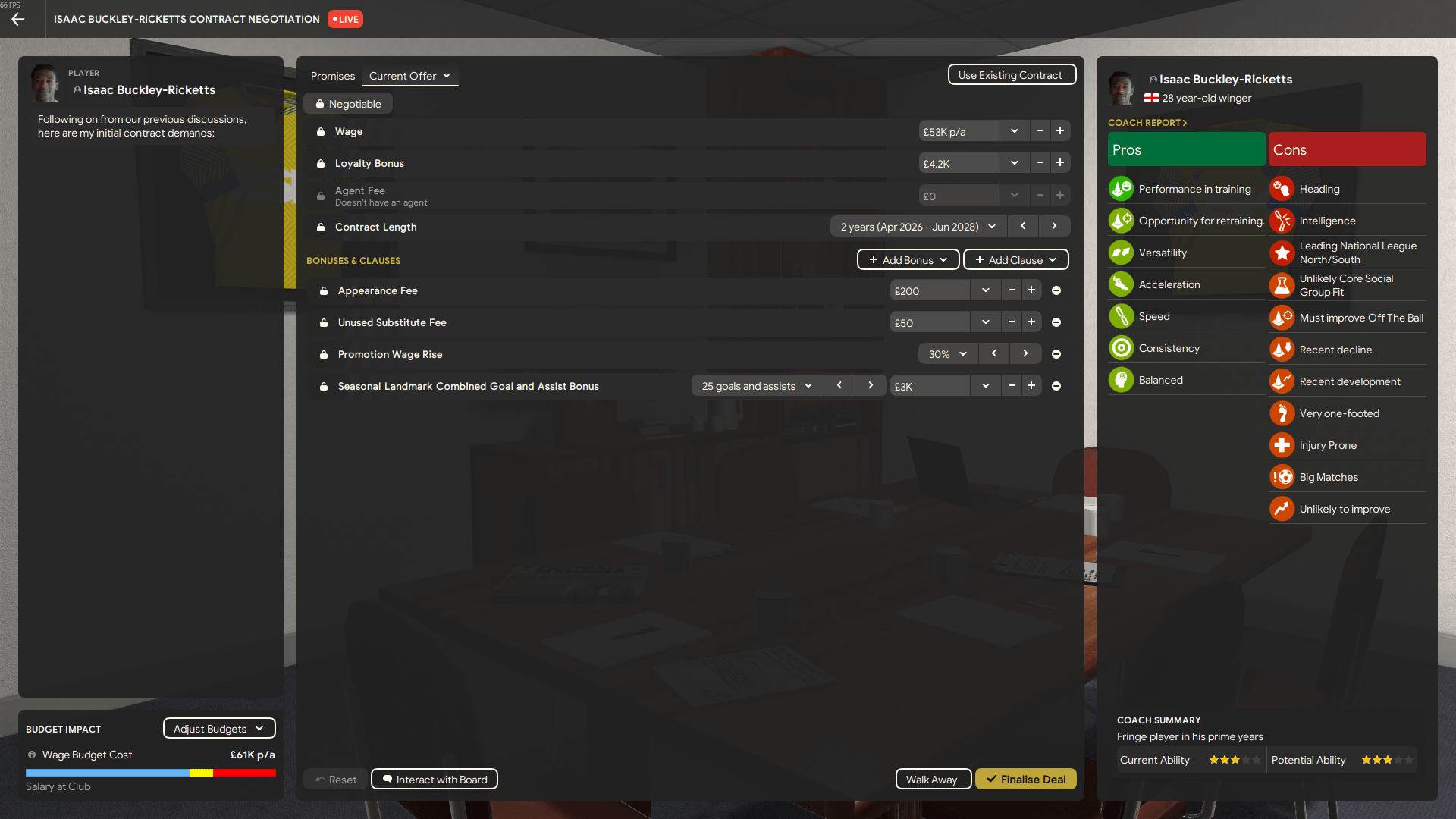
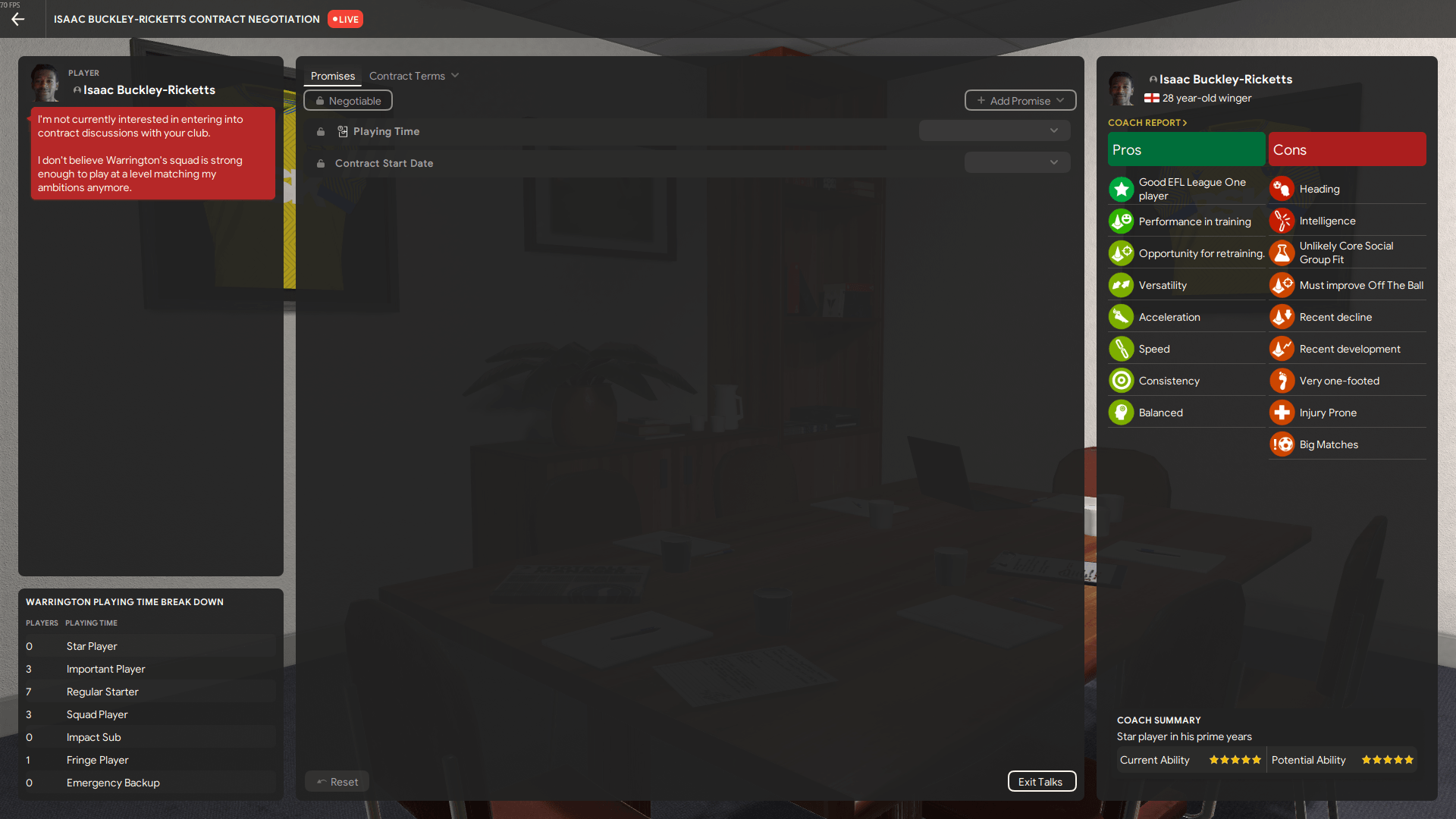
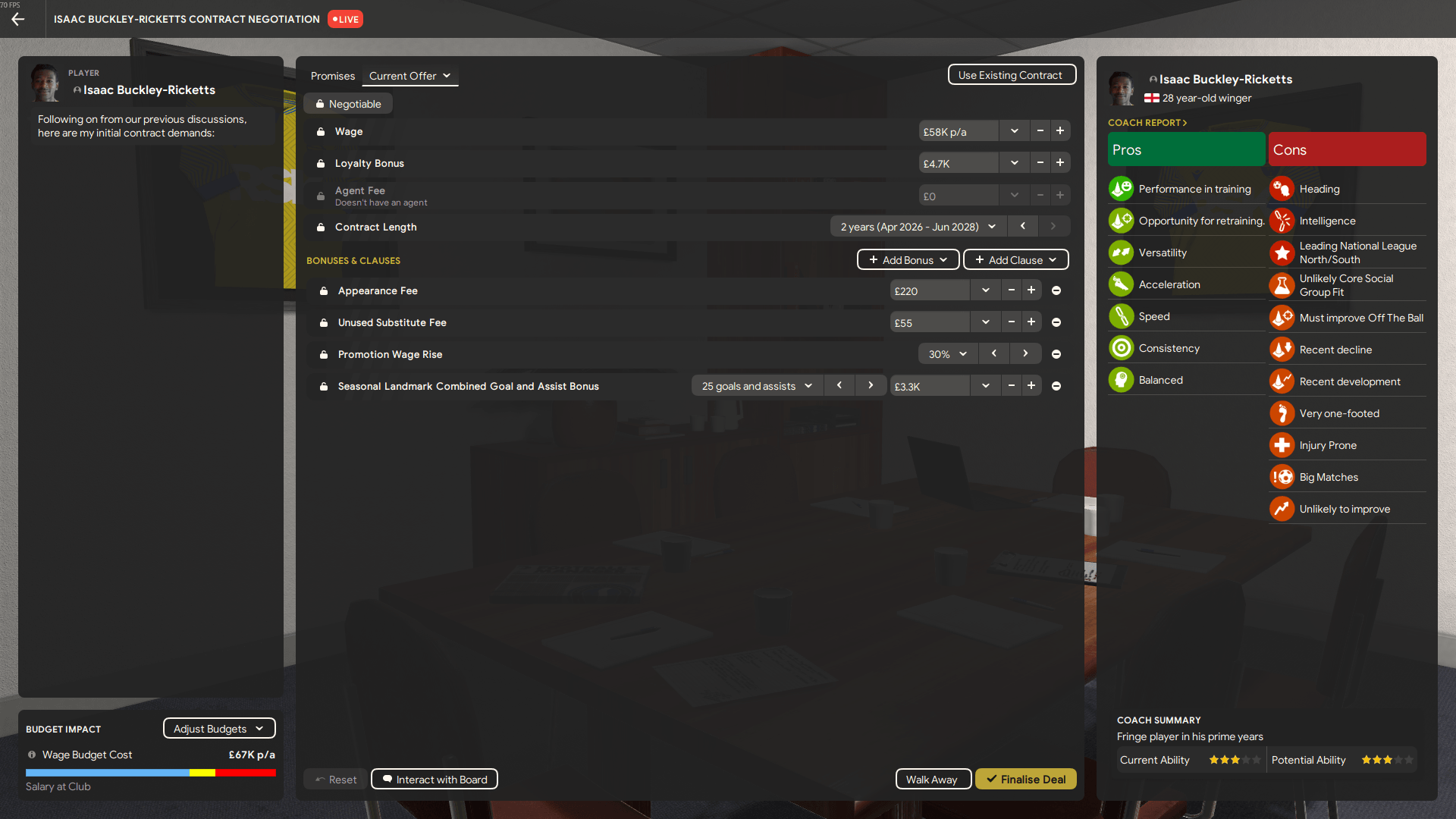

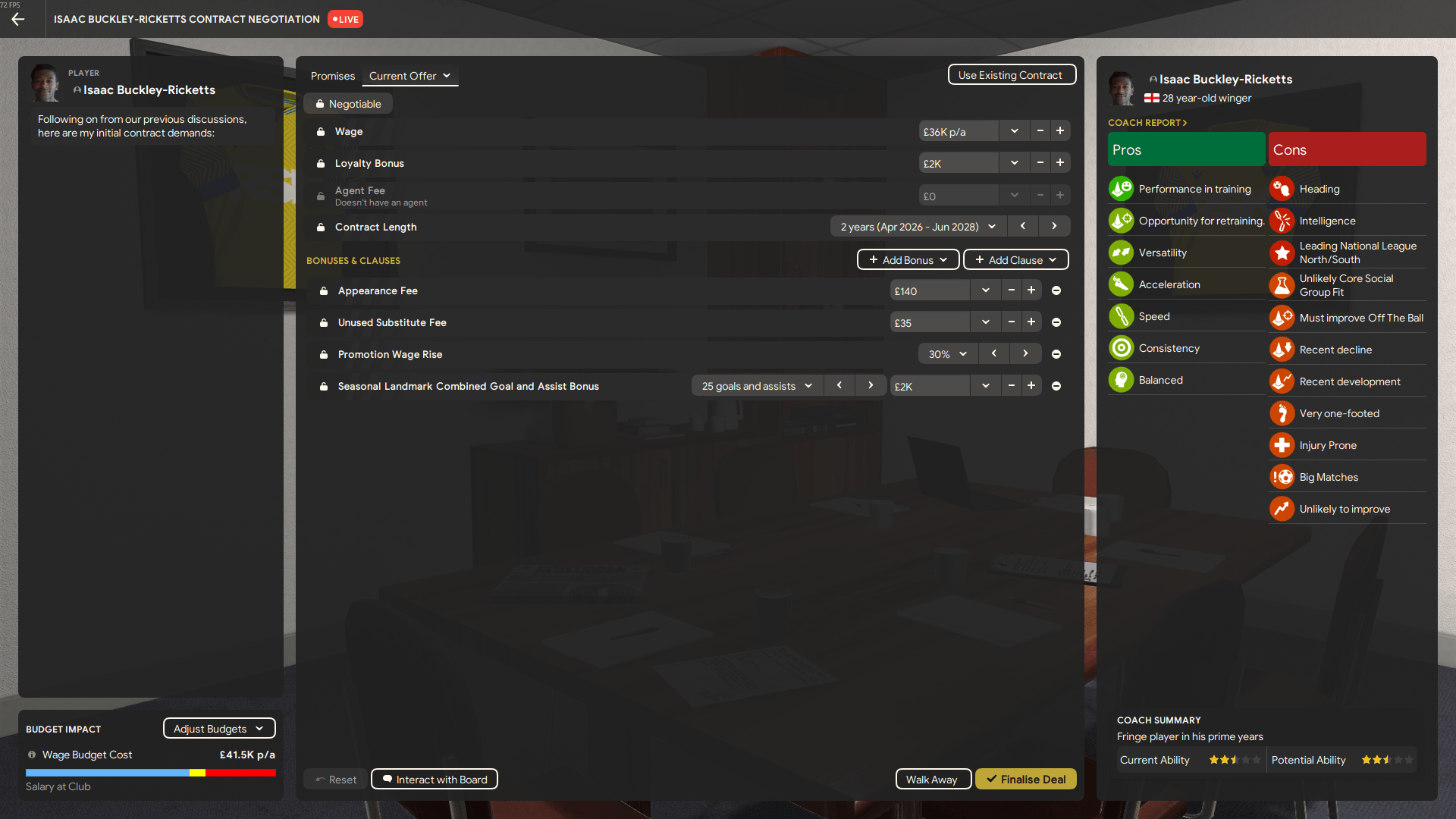
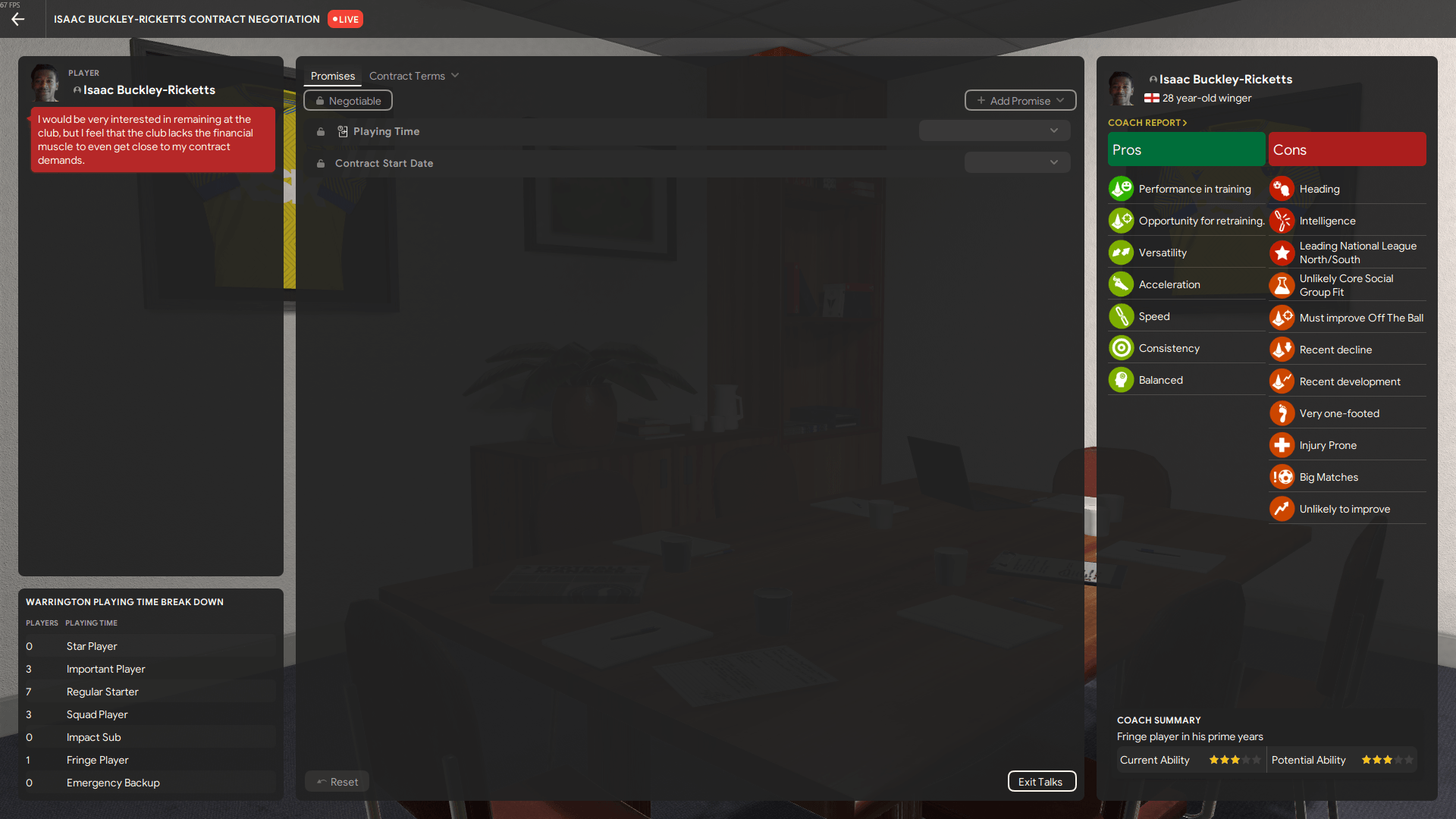

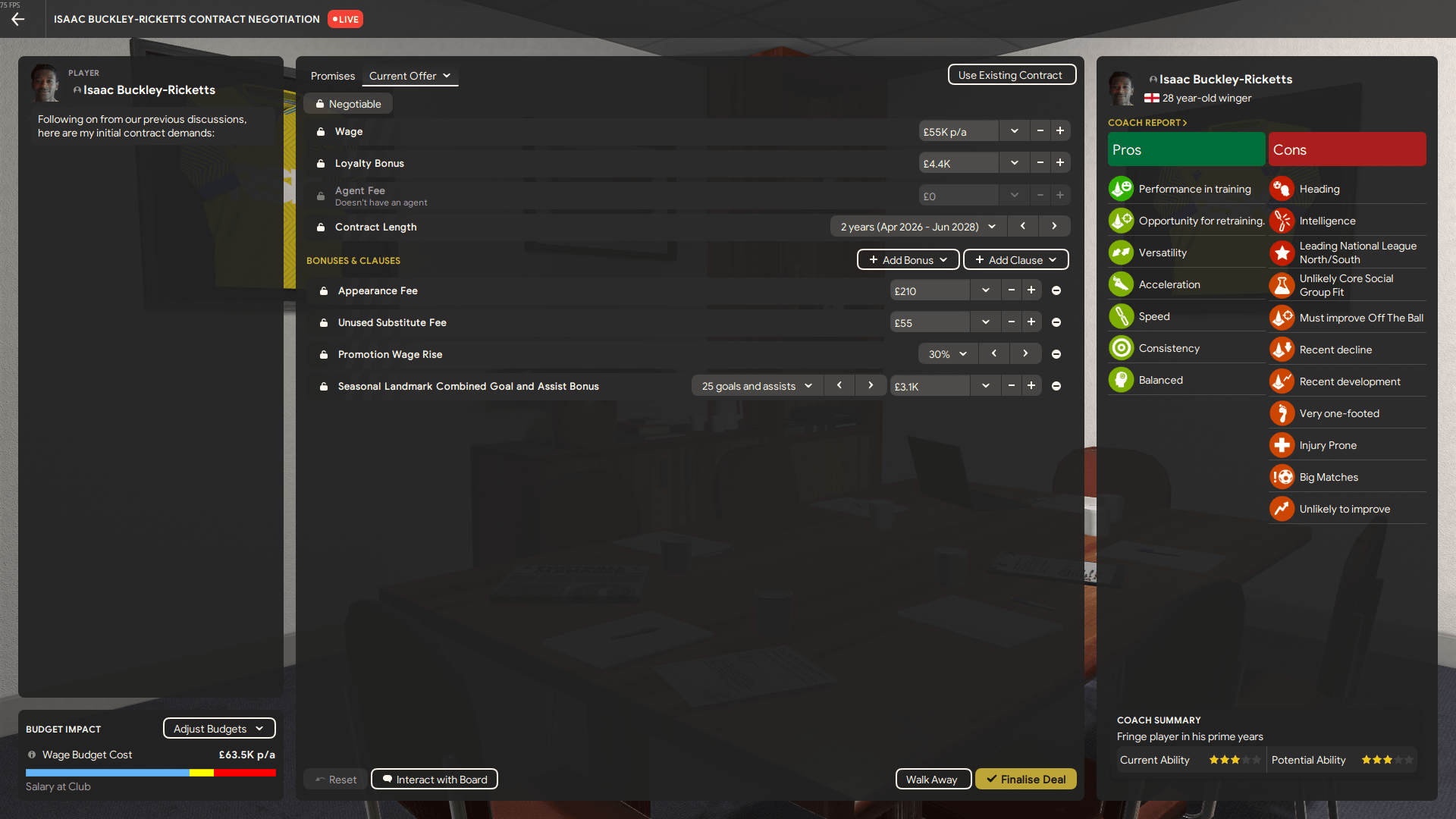
I'm intrigued enough by the question to look.
Here's a very quick test. There are three metrics for reputation in the game:
- Home
- Current
- World
Other websites can probably explain (or guess) what they do but I'm just here to see if they affect contract negotiations. (How could they not?) I'll play with the values (and use my unchanged player as a baseline) and record them below.
| Home rep | Current rep | World rep | Salary demand
| 3,115 | 4,372 | 1,1911 | Important player, £53k p/a
| 10,000 | 4,372 | 1,1911 | Important player, £55k p/a (plus small bonus increases)
| 0 | 4,372 | 1,1911 | Same as baseline
| 3,115 | 10,000 | 1,1911 | Wants to talk but thinks I can't afford him (1)
| 3,115 | 0 | 1,1911 | Important player, £36k p/a (also his bonus demands have halved and the coach's estimation of his ability has decreased)
| 3,115 | 4,372 | 10,1000 | Important player, £86k p/a (plus large bonus increases)
| 3,115 | 4,372 | 0 | Important player, £51.5k p/a (plus small bonus decreases)
(1) This was true even after I adjusted my budget sliders and tried again and after I adjusted the club's reputation to be 10,000
N.b. after changing reputations I advance a few in-game hours so the system registers it
Other notes
1. I saw no change after setting my wage budget as low as it would go (£428k p/a) and as high as it would go (£1.2m p/a) even for the 10,000 world rep experiment. (But if someone on Reddit said it did then I'm not going to dispute that.)
2. World reputation is the only thing that changed the player's reputation on his Personal Information page. It was 5 grey stars ("Minimal"
3. It makes sense that Current Reputation would have such a big impact on demands + your star rating if it's meant to be the sense of how hot you are as a player.
4. I also tested the baseline player when the club had a reputation of 0 and 10,000.
0: Important player, £58k p/a
2,920 (baseline): Important player, £53k p/a
3,115 (player's home rep): Important player, £54k p/a
10,000: Important player, £64k p/a
5. I also tried setting the CA/PA of the player to various values:
| CA | PA | Demands
| 67 | 120 | £53k p/a (baseline)
| 67 | 200 | Unchanged
| 67 | 67 | Unchanged
| 120 | 120 | Not willing to discuss!
| 1 | 200 | Unchanged
6. I changed the manager's Home, Current and World reputations to 10,000 and it made no difference (although it made people like me more).
Here's a dump of screenshots showing (most) of the above. I know a lot of this might not be new information but it's a start.
Baseline
CA 120/120
Club rep 0
Club rep 10,000
Player current rep 0
Player current rep 10,000
Player home rep 0
Player home rep 10,000
Player world rep 10,000
EDIT: From reading the game's code I can tell you that the reputation of the league you're going to be playing in next season is a factor (or the current league, if next season's isn't decided yet).
It's a minimal impact though, seemingly. If I tell Isaac that we're going to the Premier League next season instead of League Two, he asks for a tiny bit more money and his coach summary rating drops an entire star.
From the looks of the code, it seems like a few things are summed (reputations) and then scored (given a grade?) That is, I don't think changes are linear; I think you get bucketed in to discrete grades, which represent how strong your bargaining position is. After enough reputation points gained/lost, you might find yourself in the next bucket.
This has taken _far_ longer than I anticipated and I'm knackered so I might look at the actual calculations tomorrow (no promises though).
EDIT again: I can't help myself.
If you have a "Front End" Sugar Daddy, the player's demands increase. (+15 to the score it keeps track of).
LightningFlik said: I'm intrigued enough by the question to look.
 at 0 and 5 gold stars ("Exceptional"
 at 10,000.










Here's a very quick test. There are three metrics for reputation in the game:
- Home
- Current
- World
Other websites can probably explain (or guess) what they do but I'm just here to see if they affect contract negotiations. (How could they not?) I'll play with the values (and use my unchanged player as a baseline) and record them below.
| Home rep | Current rep | World rep | Salary demand
| 3,115 | 4,372 | 1,1911 | Important player, £53k p/a
| 10,000 | 4,372 | 1,1911 | Important player, £55k p/a (plus small bonus increases)
| 0 | 4,372 | 1,1911 | Same as baseline
| 3,115 | 10,000 | 1,1911 | Wants to talk but thinks I can't afford him (1)
| 3,115 | 0 | 1,1911 | Important player, £36k p/a (also his bonus demands have halved and the coach's estimation of his ability has decreased)
| 3,115 | 4,372 | 10,1000 | Important player, £86k p/a (plus large bonus increases)
| 3,115 | 4,372 | 0 | Important player, £51.5k p/a (plus small bonus decreases)
(1) This was true even after I adjusted my budget sliders and tried again and after I adjusted the club's reputation to be 10,000
N.b. after changing reputations I advance a few in-game hours so the system registers it
Other notes
1. I saw no change after setting my wage budget as low as it would go (£428k p/a) and as high as it would go (£1.2m p/a) even for the 10,000 world rep experiment. (But if someone on Reddit said it did then I'm not going to dispute that.)
2. World reputation is the only thing that changed the player's reputation on his Personal Information page. It was 5 grey stars ("Minimal"
3. It makes sense that Current Reputation would have such a big impact on demands + your star rating if it's meant to be the sense of how hot you are as a player.
4. I also tested the baseline player when the club had a reputation of 0 and 10,000.
0: Important player, £58k p/a
2,920 (baseline): Important player, £53k p/a
3,115 (player's home rep): Important player, £54k p/a
10,000: Important player, £64k p/a
5. I also tried setting the CA/PA of the player to various values:
| CA | PA | Demands
| 67 | 120 | £53k p/a (baseline)
| 67 | 200 | Unchanged
| 67 | 67 | Unchanged
| 120 | 120 | Not willing to discuss!
| 1 | 200 | Unchanged
6. I changed the manager's Home, Current and World reputations to 10,000 and it made no difference (although it made people like me more).
Here's a dump of screenshots showing (most) of the above. I know a lot of this might not be new information but it's a start.
Baseline
CA 120/120
Club rep 0
Club rep 10,000
Player current rep 0
Player current rep 10,000
Player home rep 0
Player home rep 10,000
Player world rep 10,000
EDIT: From reading the game's code I can tell you that the reputation of the league you're going to be playing in next season is a factor (or the current league, if next season's isn't decided yet).
It's a minimal impact though, seemingly. If I tell Isaac that we're going to the Premier League next season instead of League Two, he asks for a tiny bit more money and his coach summary rating drops an entire star.
From the looks of the code, it seems like a few things are summed (reputations) and then scored (given a grade?) That is, I don't think changes are linear; I think you get bucketed in to discrete grades, which represent how strong your bargaining position is. After enough reputation points gained/lost, you might find yourself in the next bucket.
This has taken _far_ longer than I anticipated and I'm knackered so I might look at the actual calculations tomorrow (no promises though).
EDIT again: I can't help myself.
If you have a "Front End" Sugar Daddy, the player's demands increase. (+15 to the score it keeps track of).
I found out recently what the three different reps mean exactly. I've forgot it now, but I'll post it later on. I think it was explained in a 2011 guide by two of the developers.
But yeah, there's not much to go on in regards to what affects wage demands. Perhaps someone on Youtube has done it in the past few years. I haven't looked into it myself.
Interesting that the coach rating decreased with lower current rep. Wouldn't have thought that.
Some handy findings there. So CA matters and PA doesn't. Club rep and manager rep doesn't matter, would have expected somewhat otherwise.
You know, I'm thinking this could kind of be integrated into the rating system if you use FMSS. You could do something like add 'divide by current/world rep & CA' to the formula. Makes it more useful for gameplay.
Teamwork 8 > 16 on AML/AMR (as Mustermann suggests): 8th (sacked), 4th, 2nd, 5th, 5th, 7th (sacked), 2nd, 4th, 2nd = 4.333 position
So teamwork does appear to be doing something here. It shouldn't be above 5 after 9 samples otherwise.
There is upside to having it at high values, but not as much downside to lacking it completely (7th at '1', vs 9th for Aggression at '1' for example, and many other key attributes fare far worse at '1' ).
8 > 16 is quite a big jump for a relatively small position gain of ~2 position, but that's only +1.6 per outfield player.
Overall I would now classify teamwork an attribute of minor importance, above Strength but probably below Aggression. Or maybe equal to Aggression, since the test team has 11 Aggression and only manages ~5th-7th on average.
Another thing to note is that because the test team's outfield players are identical, it wouldn't be the case that teamwork is simply handing over the ball to the players with the better attributes.
I'll be testing it at 20 on all players again to see what results that shows.
I also tested two other attributes:
Dirtiness 8 > 1 = 4th, 10th (sacked), 9th (sacked), 9th (sacked) = 8 position
Versatility 8 > 20 = 5th, 10th (sacked), 3rd, 3rd, 8th (sacked), 5th = 5.666 position
So versatility doesn't seem to do much. Possibly a very slight benefit. Too hard to tell like crossing.
Dirtiness surprisingly did worse at '1'. Perhaps it just requires more samples, but even so, one would expect '1' dirtiness to do better than 5th-7th given its deduced importance based on real player performance. In comparing the real players, there is a significant difference between 8 and 2 dirtiness, so it's not just about it being under '10' say. Only possibility I can think of, aside from simply requiring more samples, is that perhaps dirtiness interacts with temperament and/or sportsmanship and/or controversy, where high dirtiness can be beneficial (more hard tackles) when machiavellian sociopath but not when prone to losing temper and getting red carded for no gain.
GeorgeFloydOverdosed said: Teamwork 8 > 16 on AML/AMR (as Mustermann suggests): 8th (sacked), 4th, 2nd, 5th, 5th, 7th (sacked), 2nd, 4th, 2nd = 4.333 position
So teamwork does appear to be doing something here. It shouldn't be above 5 after 9 samples otherwise.
There is upside to having it at high values, but not as much downside to lacking it completely (7th at '1', vs 9th for Aggression at '1' for example, and many other key attributes fare far worse at '1' ).
8 > 16 is quite a big jump for a relatively small position gain of ~2 position, but that's only +1.6 per outfield player.
Overall I would now classify teamwork an attribute of minor importance, above Strength but probably below Aggression. Or maybe equal to Aggression, since the test team has 11 Aggression and only manages ~5th-7th on average.
Another thing to note is that because the test team's outfield players are identical, it wouldn't be the case that teamwork is simply handing over the ball to the players with the better attributes.
I'll be testing it at 20 on all players again to see what results that shows.
I also tested two other attributes:
Dirtiness 8 > 1 = 4th, 10th (sacked), 9th (sacked), 9th (sacked) = 8 position
Versatility 8 > 20 = 5th, 10th (sacked), 3rd, 3rd, 8th (sacked), 5th = 5.666 position
So versatility doesn't seem to do much. Possibly a very slight benefit. Too hard to tell like crossing.
Dirtiness surprisingly did worse at '1'. Perhaps it just requires more samples, but even so, one would expect '1' dirtiness to do better than 5th-7th given its deduced importance based on real player performance. In comparing the real players, there is a significant difference between 8 and 2 dirtiness, so it's not just about it being under '10' say. Only possibility I can think of, aside from simply requiring more samples, is that perhaps dirtiness interacts with temperament and/or sportsmanship and/or controversy, where high dirtiness can be beneficial (more hard tackles) when machiavellian sociopath but not when prone to losing temper and getting red carded for no gain.
Feels like doing test in a real league like this is absolutely incorrect
RNG do more then this changes huh
You better make a test league with capped CA, same teams, tactics etc and do 100 samples imo
GeorgeFloydOverdosed said: Interesting that the coach rating decreased with lower current rep. Wouldn't have thought that.
I've always suspected that the coach report is vibes-based, really. It makes sense to me that their current reputation (and possibly even form) influences it, as well as the relative strength of the league and team-mates. I don't for one minute think the game is telling me that a 4.5 star player is unquestionably better than a 4 star player.
GeorgeFloydOverdosed said: Club rep and manager rep doesn't matter, would have expected somewhat otherwise.
This surprised me too. Anecdotally I am convinced that my manager's reputation is factored in when talking to players one-on-one (my manager is always bullied in conversations with players when starting from the bottom; after a few seasons though I can reliably threaten to sell any player I want to keep them in line).
I'm going to do more investigation on this tonight; I think maybe the function I was looking at last night was actually determining how long the player wants his contract to be. It returns a number 1, 2 or 3 and I thought it was grading your bargaining position, but now I think it's how long the player wants.
I should be spending time finishing my scouting tool but it would actually be incredibly useful reverse engineering the mechanisms behind this so I can search the entire database for players who are interested in joining.
iezzex said: Feels like doing test in a real league like this is absolutely incorrect
RNG do more then this changes huh
You better make a test league with capped CA, same teams, tactics etc and do 100 samples imo
Adding controls for FM testing often does more harm than it helps in my opinion.
Suppose you do test against teams that have 10 in every attribute. Well then a player of Jumping Reach 11 is going to beat them all, but then in the actual game, Jumping Reach 11 would get your team relegated. You can't take opposition players and tactics out of the equation.
Besides, this has been done. HarvestGreen uses this controlled kind of testing, and so does FM Arena - although I believe FM Arena is a little different where uses a representative set of competitive attributes for its opposition teams (i.e. 13 instead of 10).
Another angle I would tackle it from is that RNG is part of the game, and therefore must also be taken into account. So with teamwork for example, we see the RNG range is 2nd-8th. With real Luton, the top Knap tactic produces ~2nd-9th range.
It's worth pointing out that that RNG range for real Luton is actually easily squashed down a lot by pre-selecting the team so it uses the same players. If pre-selected, the range goes down to ~2nd-4th. So really the RNG is only about -/+1 position difference. People overestimate the impact of the RNG of this game IMO.
With the meta team but with Raheem Sterling replacing AMR, the variance is also very low, getting ~6th almost all the time.
Why does the meta team, having identical outfield players, have a increased variance of 2nd-8th, compared to the meta team with Sterling? Don't know, but keep in mind I'm not using pre-selection for my meta tests either.
Now regardless of whether it's RNG or player fitness or bad luck injuries or whatnot, let's just surmise the reality as this:
You can expect to vary ~2-6 positions each season from expectation.
An average save might last say 6 seasons.
Are you going to experience the difference between 10 and 15 pace in 6 seasons? Yes, very much so.
Are you going to experience the difference between 10 and 15 teamwork in 6 seasons? Probably not really, but when you have 10 of these minor attributes together as part of a weighting system for buying/assessing players, then you will.
This also goes to why I don't think 100 samples is necessary. No one is playing 100 seasons. If I take 9 samples representing 9 seasons, and the end result is an uncertainty of -/+ 1.81 position, then that reflects the reality of normal play and it should be left at that.
Which is the more useful and relevant information?:
The life expectancy of a nation as 82.59 based on measurements of millions of people, or
As a 60 year old with a particular cancer my doctor has guesstimated I most likely have 5-7 years to live based on several similar cases he has seen, or
The doctor telling me 'its all random...we all die sometime anyway'
Hi @GeorgeFloydOverdosed, always a pleasure to see you here as usual!
I’ve noticed there have been some new findings regarding FM26 recently. What do you make of them?
We’re getting very close to FM27 now, so do you think these discoveries could have any real impact? And are you planning to release PL 2.2 as a result of them?
Looking forward to hearing your thoughts!
GeorgeFloydOverdosed said: Adding controls for FM testing often does more harm than it helps in my opinion.
Suppose you do test against teams that have 10 in every attribute. Well then a player of Jumping Reach 11 is going to beat them all, but then in the actual game, Jumping Reach 11 would get your team relegated. You can't take opposition players and tactics out of the equation.
Besides, this has been done. HarvestGreen uses this controlled kind of testing, and so does FM Arena - although I believe FM Arena is a little different where uses a representative set of competitive attributes for its opposition teams (i.e. 13 instead of 10).
Another angle I would tackle it from is that RNG is part of the game, and therefore must also be taken into account. So with teamwork for example, we see the RNG range is 2nd-8th. With real Luton, the top Knap tactic produces ~2nd-9th range.
It's worth pointing out that that RNG range for real Luton is actually easily squashed down a lot by pre-selecting the team so it uses the same players. If pre-selected, the range goes down to ~2nd-4th. So really the RNG is only about -/+1 position difference. People overestimate the impact of the RNG of this game IMO.
With the meta team but with Raheem Sterling replacing AMR, the variance is also very low, getting ~6th almost all the time.
Why does the meta team, having identical outfield players, have a increased variance of 2nd-8th, compared to the meta team with Sterling? Don't know, but keep in mind I'm not using pre-selection for my meta tests either.
Now regardless of whether it's RNG or player fitness or bad luck injuries or whatnot, let's just surmise the reality as this:
You can expect to vary ~2-6 positions each season from expectation.
An average save might last say 6 seasons.
Are you going to experience the difference between 10 and 15 pace in 6 seasons? Yes, very much so.
Are you going to experience the difference between 10 and 15 teamwork in 6 seasons? Probably not really, but when you have 10 of these minor attributes together as part of a weighting system for buying/assessing players, then you will.
This also goes to why I don't think 100 samples is necessary. No one is playing 100 seasons. If I take 9 samples representing 9 seasons, and the end result is an uncertainty of -/+ 1.81 position, then that reflects the reality of normal play and it should be left at that.
Which is the more useful and relevant information?:
The life expectancy of a nation as 82.59 based on measurements of millions of people, or
As a 60 year old with a particular cancer my doctor has guesstimated I most likely have 5-7 years to live based on several similar cases he has seen, or
The doctor telling me 'its all random...we all die sometime anyway'
Well, a good point ngl
Also i feel like that some of counter type tactics which is meta are just designed for high pace physical players
Better technical players may act better with posseios type tactic
Untested, just a feeling based on my own long save team acting worse on meta ones
bf3metro said: Hi @GeorgeFloydOverdosed, always a pleasure to see you here as usual!

I’ve noticed there have been some new findings regarding FM26 recently. What do you make of them?
We’re getting very close to FM27 now, so do you think these discoveries could have any real impact? And are you planning to release PL 2.2 as a result of them?
Looking forward to hearing your thoughts!
I've addressed it further up the page, where I also retested a few of the attributes to be sure. Overall a good idea, but the correlations are simply clouding the correct insights. He's getting a bunch of attributes right, but also a few wrong (i.e. Crossing & Off the Ball), even if we test using his specific suggested positions.
Nonetheless it's still useful in several other ways. For instance, I was theorizing before that what leads to more sprints and pressures would perform better, because that is what the Knap tactic seems to favor. So I was initially excited to see his data, because it shows ostensibly what attributes contribute to sprints & pressures. But his correlations, which I don't dispute the validity of, on sprints & dribbles perhaps suggest that certain attributes inexplicably increase win rate even in spite of decreasing or doing little for sprints & pressures. That actually makes sense to me, because if you're a developer, you're probably likely to overlook that then or know about it but ignore it thinking users won't go for it because it makes no sense.
There won't be a Premier League 2.2 for a while. I feel it's at the standard I want it to be, and so I'm taking a break from that for now. If FM27 is any good, I'll probably do a new version for FM27. If not, it depends on how I feel.
iezzex said: Also i feel like that some of counter type tactics which is meta are just designed for high pace physical players
Better technical players may act better with posseios type tactic
Untested, just a feeling based on my own long save team acting worse on meta ones
It's possible, but I think unlikely. I usually always test with Knap tactic, but we know that other tactics do substantially worse with or without technically gifted players. I don't know Knap's methodology, but it's worth bearing in mind, if my following assumption is correct, that he is finding the best tactic based on the real top teams who are often highly technical, not the way I test with more barebones speed machines.